
Introduction
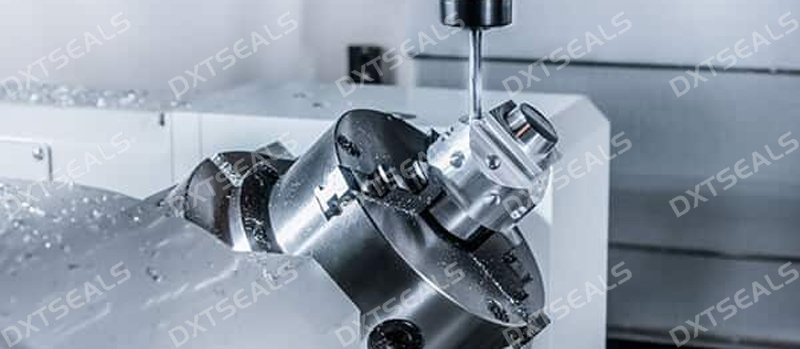
As industrial components become more complex, conventional 3-axis CNC machining may require multiple setups, specialized fixtures, or additional machining operations. 5-axis CNC machining provides greater flexibility by allowing the cutting tool and workpiece to be positioned from multiple directions during a machining process.
For complex parts with angled surfaces, deep features, curved geometries, and multiple machined faces, 5-axis CNC machining can reduce the number of setups and improve manufacturing efficiency. It is widely used for precision components in aerospace, automotive, medical equipment, energy systems, industrial machinery, tooling, and sealing applications.
However, 5-axis machining is not simply a matter of adding two more axes to a conventional CNC machine. Machine configuration, workholding, tool selection, programming, material behavior, inspection, and operator expertise all influence the final result.
Understanding both the benefits and challenges of 5-axis CNC machining is therefore important when selecting a manufacturing process for complex custom parts.
What Is 5-Axis CNC Machining?
5-axis CNC machining uses three linear axes—typically X, Y, and Z—together with two additional rotary axes. The exact rotary-axis configuration depends on the machine design.
The additional rotary movement allows the cutting tool to approach a workpiece from different directions without manually repositioning the part for every surface.
There are two common approaches to 5-axis machining:
-
3+2 machining: The rotary axes position the workpiece or tool at a selected angle, followed by conventional 3-axis cutting.
-
Simultaneous 5-axis machining: Multiple linear and rotary axes move continuously during cutting, allowing the tool to maintain an optimized orientation along complex surfaces.
The appropriate method depends on part geometry, tolerance requirements, tooling, surface requirements, and production objectives.
Key Benefits of 5-Axis CNC Machining for Complex Parts
1. Fewer Workpiece Setups
One of the most important advantages of 5-axis machining is the ability to access multiple surfaces with fewer setups.
With conventional machining, a complex component may need to be removed from the fixture and repositioned several times. Every additional setup introduces the possibility of positioning errors.
5-axis machining can reduce the number of repositioning operations, which can help maintain better feature-to-feature relationships across different surfaces.
2. Better Access to Complex Geometries
Complex components often contain:
-
Angled holes
-
Inclined surfaces
-
Deep pockets
-
Curved surfaces
-
Multi-sided features
-
Undercut-related geometries
-
Compound contours
-
Features located on several faces
A 5-axis machine can approach many of these features from more suitable directions than a standard 3-axis machine.
This is particularly valuable when the geometry requires the cutting tool to remain properly oriented relative to the machined surface.
3. Improved Tool Orientation
Tool orientation is an important factor in complex surface machining.
With simultaneous 5-axis machining, the cutting tool can change its orientation while following a curved or angled surface. This can help maintain a more appropriate cutting condition and reduce problems associated with machining a surface from a fixed direction.
For certain geometries, optimized tool orientation can also improve surface finish and tool accessibility.
4. Reduced Fixture Requirements for Certain Parts
Because more surfaces can potentially be machined in a single setup, some complex components may require less complicated workholding than they would on a conventional machine.
This does not mean that 5-axis machining eliminates the need for fixtures. Proper workholding remains critical, especially when machining thin walls, delicate components, or parts requiring high dimensional stability.
5. Efficient Machining of Complex Surfaces
5-axis CNC machining is particularly useful for components containing three-dimensional or freeform surfaces.
The continuous movement of the tool and workpiece can allow smoother toolpaths across complex geometries compared with machining the same geometry through numerous independent setups.
This capability is commonly used for molds, aerospace components, impellers, turbine-related components, medical parts, and other precision components with complex surface structures.
5-Axis CNC Machining Capabilities
The exact capabilities of a 5-axis CNC machine depend on its mechanical configuration, spindle performance, work envelope, control system, tooling, and inspection equipment.
Typical capabilities may include:
| Machining Capability | Typical Application |
|---|---|
| Multi-surface machining | Complex components with features on several faces |
| Angled feature machining | Inclined holes, slots, and surfaces |
| Complex contour machining | 3D curved and freeform surfaces |
| Deep feature access | Pockets and internal features with difficult tool access |
| 3+2 machining | Angled positioning followed by 3-axis cutting |
| Simultaneous 5-axis machining | Continuous machining of complex surfaces |
| High-precision custom machining | Tight-tolerance industrial components |
| Multi-feature machining | Multiple related features in fewer setups |
The machine should be selected according to the actual geometry rather than simply choosing the highest number of axes available.
Materials Suitable for 5-Axis CNC Machining
5-axis CNC machining can be used with a broad range of engineering materials.
Metals
Common metallic materials include:
-
Aluminum alloys
-
Stainless steel
-
Carbon steel
-
Tool steel
-
Titanium alloys
-
Brass
-
Copper
-
Nickel-based alloys
Material machinability has a significant influence on tooling, cutting parameters, thermal behavior, surface finish, and production time.
Engineering Plastics
5-axis machining can also be used for precision engineering plastics such as:
-
PTFE
-
PEEK
-
UHMW-PE
-
Nylon
-
POM
-
Polyurethane
-
Other specialized engineering polymers
Plastic materials require careful control of cutting conditions because thermal expansion, deformation, and clamping forces can affect dimensional accuracy.
Graphite and Carbon-Based Materials
Graphite and carbon graphite components can also be CNC machined when suitable equipment, tooling, and dust-management procedures are available.
These materials are often used for industrial sealing components, electrical applications, high-temperature components, and specialized mechanical parts.
Because graphite can be relatively brittle and abrasive, machining strategy and tool selection require particular attention.
5-Axis Machining for Precision Sealing Components
5-axis CNC machining can be useful for manufacturing complex sealing components when the part geometry goes beyond simple rotational or planar forms.
Industrial sealing applications may include:
-
Mechanical seal components
-
Custom seal rings
-
Graphite sealing components
-
PTFE components
-
Valve sealing parts
-
Pump components
-
Compressor components
-
Custom wear components
-
Special industrial sealing structures
Not every seal requires 5-axis machining. Simple circular seal rings may be more efficiently produced using CNC turning.
However, when a sealing component includes multiple angled surfaces, complex pockets, non-standard mounting features, or several intersecting geometries, multi-axis machining can provide greater manufacturing flexibility.
Manufacturing Challenges of 5-Axis CNC Machining
Despite its advantages, 5-axis CNC machining introduces several manufacturing challenges.
1. Higher Equipment and Programming Complexity
5-axis machines generally have more complicated mechanical structures and control systems than standard 3-axis machines.
Programming also requires a more advanced understanding of tool orientation, machine kinematics, collision avoidance, and toolpath optimization.
A machine may have excellent hardware capabilities, but the actual manufacturing result still depends heavily on programming quality and process planning.
2. Tool Collision and Clearance Problems
As the cutting tool and rotary axes move simultaneously, collision risks can become more complicated.
Potential interference may occur between:
-
Tool and workpiece
-
Tool holder and workpiece
-
Spindle and fixture
-
Machine components and workholding equipment
Reliable simulation and careful toolpath verification are therefore important for complex 5-axis machining.
3. Workholding Becomes More Important
Although 5-axis machining can reduce the number of setups, the workholding system must allow sufficient tool access while securely supporting the workpiece.
Poor fixture design can lead to:
-
Part movement
-
Vibration
-
Deformation
-
Restricted tool access
-
Dimensional instability
For thin-walled or irregularly shaped parts, fixture design can become one of the most important aspects of the manufacturing process.
4. Thermal and Mechanical Stability
High-precision 5-axis machining requires attention to machine thermal stability, spindle behavior, tool deflection, vibration, and material deformation.
The number of axes alone does not determine machining accuracy.
A stable machine structure, appropriate cutting parameters, suitable tooling, effective workholding, and controlled inspection process are all necessary for consistent precision.
5. Higher Manufacturing Costs for Some Parts
5-axis machining equipment, programming, tooling, and skilled labor can increase manufacturing costs compared with simpler CNC processes.
However, a higher machine cost does not necessarily mean a higher total part cost.
If a complex component requires four or five setups on a 3-axis machine, a 5-axis process may reduce setup time, fixture requirements, handling, and secondary operations.
The correct comparison should therefore consider the entire manufacturing process rather than the hourly machine rate alone.
5-Axis vs. 3-Axis CNC Machining
The choice between 3-axis and 5-axis machining should be based on part requirements.
| Factor | 3-Axis CNC | 5-Axis CNC |
|---|---|---|
| Linear axes | X, Y, Z | X, Y, Z plus two rotary axes |
| Setup requirements | Often higher for complex parts | Often lower for multi-sided parts |
| Complex angled features | More limited | Strong capability |
| Freeform surfaces | Possible but may require more toolpath strategies | Well suited |
| Tool orientation | More limited | Highly flexible |
| Programming complexity | Lower | Higher |
| Equipment cost | Generally lower | Generally higher |
| Simple parts | Highly suitable | Often unnecessary |
| Complex parts | May require multiple setups | Often more efficient |
5-axis machining should not automatically replace 3-axis machining. For relatively simple parts, 3-axis equipment may provide a more economical and efficient solution.
When Should You Choose 5-Axis CNC Machining?
5-axis CNC machining is particularly attractive when a component has one or more of the following characteristics:
-
Complex 3D geometry
-
Multiple angled surfaces
-
Features on several sides
-
Difficult tool access
-
Tight relationships between multiple features
-
Freeform or contoured surfaces
-
A need to reduce the number of setups
-
High-value components where setup accuracy is important
For simple plates, blocks, brackets, and basic pockets, conventional 3-axis machining may be sufficient.
For rotational components, CNC turning may be the better choice.
For components combining turning and milling operations, mill-turn machining may offer a more efficient solution.
The best manufacturing process is therefore determined by the geometry and production requirements rather than the number of available machine axes.
How to Improve 5-Axis Machining Results
Several factors can improve the reliability of a 5-axis machining process.
Optimize the Part Design
Design features should consider tool accessibility, workholding, machining direction, and inspection requirements.
When possible, avoid unnecessarily deep or inaccessible features that require complex toolpaths.
Select Appropriate Cutting Tools
Tool diameter, flute geometry, tool material, tool length, and tool holder configuration should match the material and geometry.
Long tools may provide access to deep features but can also increase deflection and vibration.
Minimize Unnecessary Setups
The goal is not simply to reduce the number of setups. The setup strategy should also provide sufficient rigidity and access to all critical features.
Use CAM Simulation
Simulation can help identify tool collisions, excessive tool-axis movement, fixture interference, and inefficient toolpaths before machining begins.
Establish an Inspection Strategy
Complex parts often require more than simple dimensional checks.
Depending on the application, inspection may include:
-
CMM measurement
-
Dimensional inspection
-
Surface finish measurement
-
Geometric tolerance verification
-
First-article inspection
-
Material verification
Inspection requirements should be considered during process planning rather than only after machining is completed.
Choosing a 5-Axis CNC Machining Manufacturer
When selecting a manufacturer for complex 5-axis CNC parts, machine capability is only one consideration.
Important factors include:
-
5-axis machine configuration
-
Maximum workpiece dimensions
-
Positioning and repeatability specifications
-
CAM programming capabilities
-
Tooling and workholding expertise
-
Material machining experience
-
Quality control systems
-
Dimensional inspection equipment
-
Experience with custom components
-
Ability to support prototypes and production quantities
A capable manufacturer should also be able to determine whether 5-axis machining is actually the most appropriate process for the part.
In some cases, a combination of CNC turning, 3-axis milling, 4-axis machining, and 5-axis machining may provide a more efficient overall manufacturing solution.
Conclusion
5-axis CNC machining provides important advantages for complex custom parts by expanding tool access, reducing certain setup requirements, improving machining flexibility, and enabling efficient production of multi-surface and three-dimensional geometries.
At the same time, 5-axis machining requires careful control of programming, tooling, workholding, machine stability, collision avoidance, and inspection. The technology is most valuable when its additional flexibility solves a genuine manufacturing challenge.
For precision industrial components, including complex sealing parts, PTFE components, graphite components, mechanical seal parts, and other custom-machined products, the right machining strategy should be selected according to geometry, material, tolerance, surface finish, production volume, and inspection requirements.
A professional CNC machining manufacturer can evaluate the part drawing and determine whether 3-axis, 4-axis, 5-axis, turning, or mill-turn machining provides the most suitable balance of precision, efficiency, and cost.