
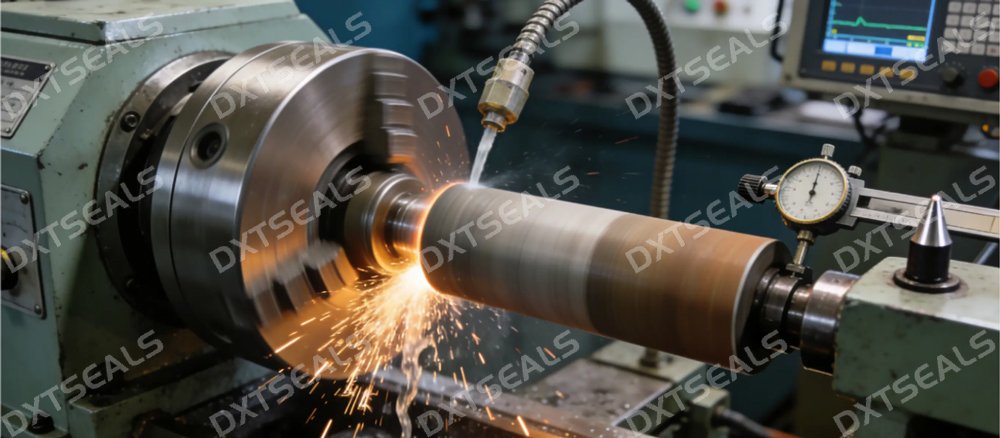
CNC machining equipment plays an important role in modern manufacturing, especially for precision metal, plastic, graphite, and engineered-material components. Different CNC machines are designed for different machining tasks. CNC lathes are primarily optimized for rotational parts, CNC mills are widely used for prismatic and complex geometries, while multi-axis machines can combine multiple machining directions to manufacture more complicated components with fewer setups.
Understanding the differences between CNC lathes, CNC mills, and multi-axis machining equipment helps manufacturers select the right process for a specific component. Factors such as part geometry, dimensional accuracy, material, production volume, machining operations, and required surface finish all influence the most suitable CNC machining method.
What Is CNC Machining?
CNC, or Computer Numerical Control, machining uses programmed instructions to control machine tools and cutting operations.
A CNC machining process generally involves:
-
Creating or receiving a CAD model or engineering drawing.
-
Developing the machining process and tool paths.
-
Generating CNC programs.
-
Securing the workpiece.
-
Performing cutting operations with appropriate tools.
-
Inspecting critical dimensions and surface characteristics.
CNC machining can be used for a wide range of materials, including:
-
Stainless steel
-
Carbon steel
-
Aluminum
-
Copper alloys
-
Brass
-
Engineering plastics
-
PTFE
-
PEEK
-
Graphite
-
Carbon graphite
-
Other machinable materials
The machine type determines how the workpiece and cutting tools move relative to each other.
CNC Lathe: Best for Rotational Components
A CNC lathe is primarily designed to manufacture components with rotational symmetry.
In a conventional turning process, the workpiece rotates while a cutting tool moves along or across the workpiece to remove material.
Typical CNC lathe operations include:
-
External turning
-
Internal boring
-
Facing
-
Grooving
-
Threading
-
Chamfering
-
Parting
-
Drilling
Typical CNC Lathe Applications
CNC lathes are particularly suitable for components such as:
-
Shaft seals
-
Oil seals
-
Seal rings
-
Bushings
-
Sleeves
-
O-rings grooves
-
Rotating equipment components
-
Cylindrical spacers
-
Round flanges
-
Precision shafts
For example, a circular sealing ring can often be efficiently manufactured on a CNC lathe because its primary geometry is defined by diameters, widths, grooves, and other rotational features.
Advantages of CNC Lathes
CNC lathes offer several important advantages:
-
Efficient machining of cylindrical parts
-
High repeatability
-
Good dimensional control
-
Efficient material removal
-
Suitable for internal and external diameters
-
Efficient production of rotational grooves and threads
For large quantities of relatively simple rotational components, CNC turning can also provide an efficient manufacturing solution.
CNC Mill: Best for Prismatic and Complex Geometries
A CNC milling machine removes material using rotating cutting tools while the workpiece is secured to the machine table or fixture.
Unlike turning, milling does not require the workpiece itself to rotate as the primary cutting motion.
Typical CNC milling operations include:
-
Face milling
-
End milling
-
Slot milling
-
Pocket machining
-
Drilling
-
Tapping
-
Contouring
-
Chamfering
-
3D surface machining
Typical CNC Mill Applications
CNC mills are suitable for components with features such as:
-
Flat surfaces
-
Slots
-
Pockets
-
Bolt holes
-
Irregular contours
-
Keyways
-
Complex external profiles
-
Multiple perpendicular surfaces
Typical examples include:
-
Machine brackets
-
Flange plates
-
Valve components
-
Equipment covers
-
Fixtures
-
Custom blocks
-
Structural components
-
Precision plates
A CNC mill is often a better choice when a component contains many non-rotational features that cannot be efficiently produced through turning alone.
CNC Lathe vs CNC Mill
The fundamental difference between a CNC lathe and a CNC mill is the primary cutting motion.
| Feature | CNC Lathe | CNC Mill |
|---|---|---|
| Primary machining method | Turning | Milling |
| Main cutting motion | Workpiece rotation | Tool rotation |
| Typical geometry | Cylindrical | Prismatic / irregular |
| Main features | Diameters, grooves, threads | Slots, pockets, holes, profiles |
| Typical parts | Shafts, sleeves, seal rings | Plates, brackets, housings |
| Internal machining | Boring | Pocketing / drilling |
| External machining | Turning | Milling |
| Best suited for | Rotational components | Non-rotational components |
Neither machine is universally better. The appropriate machine depends primarily on the geometry and machining requirements of the part.
Multi-Axis CNC Machining: More Complex Tool Movement
Multi-axis CNC machines add additional controlled axes beyond the conventional three linear axes.
A typical 3-axis machining center controls:
-
X axis
-
Y axis
-
Z axis
Multi-axis machines can add rotational axes, commonly referred to as A, B, or C axes depending on the machine configuration.
Examples include:
-
4-axis machining
-
5-axis machining
-
5-axis simultaneous machining
-
Mill-turn machining
-
Other specialized multi-axis configurations
The exact axis configuration varies between machine types and manufacturers.
What Is 4-Axis CNC Machining?
A 4-axis CNC machine adds an additional rotational axis to a conventional three-axis system.
This can allow the workpiece to be rotated so that multiple surfaces can be machined without manually repositioning the part.
Potential advantages include:
-
Fewer setups
-
Better positional consistency
-
Access to additional surfaces
-
Improved machining efficiency
-
Reduced manual repositioning
Four-axis machining can be useful for components that require machining around multiple sides or cylindrical features combined with milling operations.
What Is 5-Axis CNC Machining?
A 5-axis CNC machine controls five axes of movement, allowing the cutting tool and/or workpiece to approach the component from multiple directions.
This is particularly useful for complex three-dimensional geometries.
Typical applications include:
-
Aerospace components
-
Turbine components
-
Complex molds
-
Impellers
-
Medical components
-
Complex mechanical parts
-
Components with multiple angled surfaces
A major advantage of 5-axis machining is the ability to access multiple surfaces and maintain favorable tool orientations during machining.
However, 5-axis machining is not automatically necessary for every precision component. For relatively simple parts, conventional 3-axis milling or CNC turning may be more efficient and economical.
CNC Mill vs Multi-Axis Machine
The main difference between conventional CNC milling and multi-axis machining is the number and coordination of controlled axes.
| Feature | 3-Axis CNC Mill | Multi-Axis CNC Machine |
|---|---|---|
| Standard axes | X, Y, Z | X, Y, Z + rotary axes |
| Setup requirements | Often multiple for complex parts | Can reduce setups |
| Complex angled surfaces | More limited | More capable |
| Tool orientation | Relatively limited | More flexible |
| Complex 3D geometry | Possible | More efficient for many geometries |
| Programming complexity | Lower | Higher |
| Equipment cost | Generally lower | Generally higher |
| Suitable applications | Standard machined components | Complex multi-surface components |
Multi-axis machining is therefore best understood as an advanced manufacturing option rather than a universal replacement for conventional CNC milling.
CNC Lathe, CNC Mill, and Multi-Axis Machine Compared
The three machine categories can be compared from a practical manufacturing perspective.
| Category | CNC Lathe | CNC Mill | Multi-Axis CNC |
|---|---|---|---|
| Primary strength | Rotational machining | Prismatic machining | Complex multi-surface machining |
| Typical workpiece | Round | Block/plate | Complex 3D component |
| Rotational symmetry | Excellent | Limited | Excellent depending on configuration |
| Flat surfaces | Limited | Excellent | Excellent |
| Grooves | Excellent | Excellent | Excellent |
| Pockets | Limited | Excellent | Excellent |
| Angled surfaces | Limited | Moderate | Excellent |
| Multiple surfaces | Limited | Multiple setups may be required | Often fewer setups |
| Programming | Moderate | Moderate | More complex |
| Equipment investment | Moderate | Moderate | Higher |
| Ideal use | Shafts, rings, sleeves | Plates, housings, brackets | Complex precision components |
Mill-Turn CNC Machines
Some advanced CNC machines combine turning and milling capabilities.
These are commonly referred to as mill-turn machines or turning-milling centers.
A mill-turn machine can perform operations such as:
-
Turning
-
Facing
-
Boring
-
Milling
-
Drilling
-
Threading
-
Grooving
The major advantage is that multiple machining operations can be completed on one machine with fewer setups.
This can help reduce:
-
Setup time
-
Workpiece repositioning
-
Alignment errors
-
Intermediate handling
-
Production time
Mill-turn equipment can be particularly useful when a component contains both significant rotational geometry and complex milling features.
How Machine Selection Affects Precision
Machine selection can influence dimensional accuracy and production consistency.
Every additional setup can introduce opportunities for:
-
Positioning errors
-
Datum changes
-
Alignment variation
-
Workholding errors
-
Cumulative tolerances
A multi-axis machine may reduce the number of setups required for certain complex components. However, this does not mean that a 5-axis machine automatically produces higher accuracy than a 3-axis machine.
Actual precision depends on many factors, including:
-
Machine construction
-
Machine condition
-
Thermal stability
-
Tooling
-
Workholding
-
Programming
-
Cutting parameters
-
Material properties
-
Operator and process control
-
Inspection equipment
Therefore, the machining process should be selected as a complete manufacturing system rather than based solely on the number of axes.
CNC Machining for Sealing Components
CNC machining is widely used for manufacturing precision sealing components, particularly when custom dimensions or complex geometries are required.
Common machined sealing components include:
-
Mechanical seal components
-
Seal rings
-
PTFE seals
-
Carbon graphite rings
-
Bushings
-
Guide components
-
Valve sealing parts
-
Custom sealing rings
-
Wear rings
For example, rotational PTFE or graphite components can often be manufactured efficiently using CNC turning.
When a sealing component includes slots, holes, pockets, or other non-rotational features, CNC milling may be required in addition to turning.
For more complicated geometries, multi-axis machining may reduce the number of setups and improve manufacturing efficiency.
CNC Machining for Graphite and Engineering Plastics
Machine selection is also important when machining non-metallic materials.
Materials such as graphite, PTFE, PEEK, and other engineering plastics have different machining characteristics from metals.
Factors that may require consideration include:
-
Cutting tool geometry
-
Cutting speed
-
Feed rate
-
Heat generation
-
Material deformation
-
Chip control
-
Dust management
-
Workholding
Graphite components, for example, may require machining strategies designed specifically for abrasive and brittle material characteristics.
PTFE and other soft engineering plastics may require different workholding and cutting strategies because excessive cutting forces can cause deformation.
How to Choose the Right CNC Machine
The best machine should be selected based on the actual component requirements.
Choose a CNC Lathe When:
-
The component is primarily rotational.
-
Most dimensions are diameters and axial lengths.
-
The part requires turning, boring, or threading.
-
Cylindrical grooves are important.
-
High-volume production of round components is required.
Choose a CNC Mill When:
-
The component is mainly prismatic.
-
Flat surfaces and pockets are required.
-
Multiple holes or slots are needed.
-
The part has irregular external profiles.
-
The geometry can be efficiently machined with standard 3-axis operations.
Choose Multi-Axis Machining When:
-
The component has multiple complex surfaces.
-
Several angled features are required.
-
Multiple setups would otherwise be necessary.
-
Complex 3D surfaces need controlled tool orientation.
-
Maintaining positional relationships between multiple features is important.
Choose Mill-Turn Machining When:
-
The component combines rotational and milling features.
-
Multiple machining operations are required.
-
Reducing setups is important.
-
The component can be completed more efficiently on a combined platform.
Factors Beyond Machine Type
Machine type is only one part of CNC manufacturing capability.
A complete machining solution should also consider:
Material
Different materials require different tools, cutting parameters, and machining strategies.
Tolerance
Tight dimensional tolerances may require more controlled machining and inspection processes.
Surface Finish
The required surface finish influences tooling, cutting parameters, and finishing operations.
Part Size
The machine's working envelope, spindle capacity, table size, and workholding system must match the component dimensions.
Production Volume
A process that is economical for one custom component may not be optimal for thousands of identical parts.
Geometry
The geometry ultimately determines which machining operations are required and whether multiple setups or additional axes are beneficial.
Custom CNC Machining Capabilities
A capable CNC machining manufacturer should be able to evaluate the component and select the appropriate equipment instead of forcing every part into the same manufacturing process.
Depending on the product requirements, manufacturing capabilities may include:
-
CNC turning
-
CNC milling
-
4-axis machining
-
5-axis machining
-
Mill-turn machining
-
Precision boring
-
Drilling and tapping
-
Thread machining
-
Custom groove machining
-
Prototype machining
-
Small-batch production
-
OEM production
-
Precision inspection
For sealing components and other precision industrial parts, the ability to combine different CNC processes can be particularly valuable.
Conclusion
CNC lathes, CNC mills, and multi-axis machines each serve different manufacturing purposes.
CNC lathes are highly effective for cylindrical and rotational components. CNC mills are better suited to flat surfaces, pockets, holes, slots, and irregular prismatic geometries. Multi-axis machines provide greater flexibility for complex surfaces and multi-directional machining, while mill-turn equipment can combine turning and milling operations in a single manufacturing process.
The best CNC machining equipment is not necessarily the machine with the largest number of axes. Instead, the correct choice depends on the component's geometry, material, tolerances, surface finish, production volume, and required machining operations.
For custom industrial components, selecting the appropriate CNC machining process can improve manufacturing efficiency, dimensional consistency, and overall production reliability.