
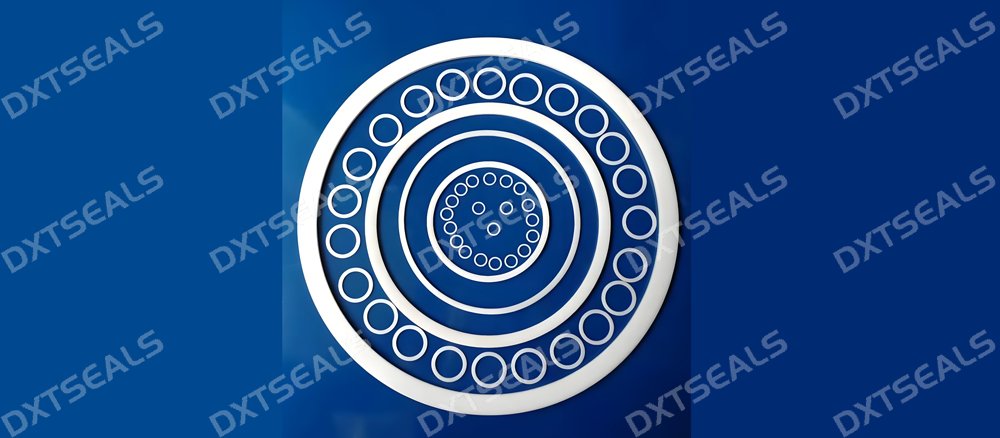
In industrial sealing systems, flat gaskets play a critical role in ensuring leak-free connections between flanges, pipes, and machinery parts.
However, not all gaskets are created equal — the material choice directly impacts performance, durability, and cost.
This article by DXTSEALS explores the key differences between common gasket materials and provides practical application cases to help you choose the right solution for your needs.
1. What Is a Flat Gasket?
A flat gasket is a thin sealing element placed between two flat surfaces to prevent fluid or gas leakage.
They are widely used in petrochemical, water treatment, mechanical, and power generation industries.
Flat gaskets can be made from rubber, PTFE, graphite, or metal, depending on the operating environment and required sealing performance.
2. Common Flat Gasket Materials and Their Properties
Choosing the right material is crucial for achieving stable and long-lasting sealing. Below are the most commonly used materials and their key characteristics.
(1) Rubber Flat Gaskets
-
Materials: NBR, EPDM, FKM, Silicone, Neoprene
-
Features: Excellent elasticity, good sealing at low to medium pressure, resistant to water, oil, and mild chemicals
-
Applications: Pumps, compressors, pipelines, and general machinery
-
Example: NBR gaskets are ideal for hydraulic systems with oil-based fluids, while EPDM performs better in hot water or steam systems.
(2) PTFE Flat Gaskets
-
Features: Exceptional chemical resistance, non-stick surface, and wide temperature tolerance (-200°C to +250°C)
-
Applications: Chemical processing, food equipment, and pharmaceutical systems
-
Advantages: Non-reactive and suitable for highly corrosive environments
-
Example: PTFE gaskets are used in acid pipelines or alkali-resistant flange connections in chemical plants.
(3) Graphite Flat Gaskets
-
Features: Outstanding high-temperature resistance (up to 450°C), excellent compressibility, and chemical stability
-
Applications: Power plants, exhaust systems, and high-temperature flange joints
-
Example: Flexible graphite gaskets are widely used in steam pipelines where both heat and pressure resistance are essential.
(4) Metal Flat Gaskets
-
Materials: Stainless steel, copper, aluminum, carbon steel
-
Features: Extremely durable, can withstand high pressure and temperature
-
Applications: High-pressure flanges, heat exchangers, and valve covers
-
Example: Stainless steel gaskets are ideal for high-pressure oil & gas systems requiring mechanical strength and sealing integrity.
3. Material Comparison Summary
| Material | Temperature Resistance | Chemical Resistance | Pressure Capability | Elasticity | Typical Use |
|---|---|---|---|---|---|
| Rubber (NBR, EPDM) | -40°C ~ +150°C | Moderate | Medium | Excellent | General industrial sealing |
| PTFE | -200°C ~ +250°C | Excellent | Medium | Low | Chemical process systems |
| Graphite | Up to 450°C | Excellent | High | Good | Steam and power systems |
| Metal (SS, Copper) | Up to 800°C | Variable | Very High | Poor | High-pressure flanges |
This comparison highlights that no single gasket material is perfect for all conditions — the key is matching material to working environment.
4. Application Cases from DXTSEALS
Case 1: EPDM Flat Gaskets in Water Treatment Equipment
DXTSEALS supplied EPDM gaskets for municipal water pipelines due to their excellent resistance to ozone and aging.
Result: Over 3 years of continuous service without leakage or deformation.
Case 2: PTFE Gaskets in Acid Chemical Plants
A customer in the chemical industry required acid-resistant sealing for flanged joints.
DXTSEALS custom-designed PTFE flat gaskets, ensuring zero leakage even under aggressive corrosion.
Case 3: Graphite Gaskets in Power Generation
For a steam turbine system, graphite gaskets were chosen to withstand high temperatures and pressure.
The gaskets maintained sealing integrity even after multiple maintenance cycles.
5. DXTSEALS Custom Manufacturing Advantages
At DXTSEALS, we provide custom flat gasket manufacturing with precision cutting, material certification, and quality assurance.
Our advantages include:
-
Support for various materials (rubber, PTFE, graphite, metal)
-
CNC cutting and molding for high dimensional accuracy
-
Custom thickness and size according to flange standards
-
Fast sampling and global delivery
Whether you need a prototype gasket or mass production, DXTSEALS offers professional engineering support to help optimize your sealing system.
Conclusion
Choosing the correct flat gasket material depends on a deep understanding of temperature, pressure, chemical media, and application requirements.
Rubber gaskets are flexible and cost-effective, PTFE excels in corrosion resistance, graphite performs under heat, and metal handles extreme pressure.
With DXTSEALS’s expertise in material selection and custom gasket manufacturing, you can achieve long-term reliability and sealing efficiency across all industrial systems.
Contact DXTSEALS today to discuss your custom gasket needs or request a technical consultation.