
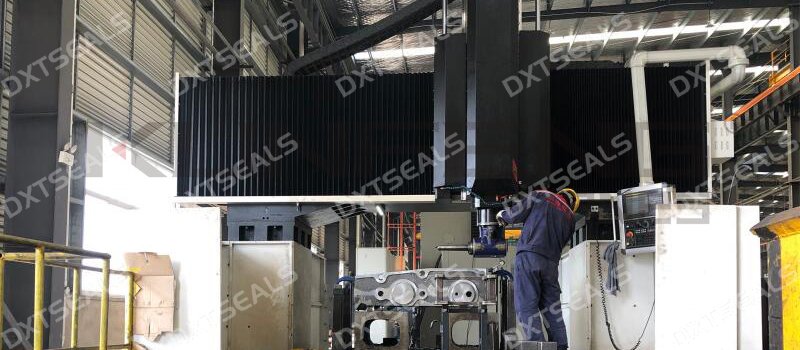
Manufacturing large and heavy industrial components requires machining equipment that goes far beyond the capabilities of conventional CNC machining centers. When a custom part becomes too large, too heavy, or too long for standard equipment, manufacturers need specialized solutions to maintain machining accuracy, stability, and production efficiency.
Gantry machining is one of the most effective solutions for extra-large custom parts. With a large working envelope, rigid machine structure, high load capacity, and flexible machining capabilities, gantry milling machines can process components that cannot be accommodated by conventional CNC equipment.
From oversized PTFE plates and large sealing components to machine bases, industrial covers, structural parts, and large flanges, gantry machines provide the capacity required for demanding large-format machining applications.
What Is Extra-Large Custom Machining?
Extra-large custom machining refers to the manufacturing of components whose dimensions or weight exceed the normal working range of standard CNC machines.
These components can include:
-
Large PTFE plates
-
Oversized PTFE covers
-
Large sealing rings
-
Industrial machine bases
-
Large flanges
-
Heavy equipment components
-
Structural plates
-
Large hydraulic components
-
Custom industrial covers
-
Large-diameter mechanical parts
-
Special-purpose machinery components
The exact definition of "extra-large" depends on the machining equipment available. A component measuring several meters in length may be impossible to process on a conventional vertical machining center but completely manageable on a large gantry milling machine.
Therefore, extra-large machining capability is determined not only by the dimensions of the part but also by the manufacturer's machine envelope, table capacity, lifting equipment, tooling, and inspection capabilities.
How Does a Gantry Milling Machine Work?
A gantry milling machine uses a bridge-like structure that spans across the machining table. The cutting head moves along the gantry structure while the workpiece remains securely supported on the machine bed.
This configuration provides several important advantages for large components.
The gantry structure allows the machine to cover a much larger machining area than conventional machining centers. At the same time, the machine can provide a rigid platform for heavy workpieces.
Depending on the machine configuration, movement can be controlled along multiple axes, allowing manufacturers to perform operations such as:
-
Face milling
-
Slot machining
-
Pocket machining
-
Drilling
-
Contouring
-
Step machining
-
Surface finishing
-
Precision dimensional machining
This makes gantry machining suitable for both relatively simple large plates and more complicated custom components.
1. Large Working Envelope
One of the biggest advantages of gantry machining is the large working envelope.
Conventional CNC machines are often limited by their X, Y, and Z travel. When the workpiece exceeds these dimensions, manufacturers may have to reposition the component or divide the machining process into multiple stages.
A large gantry machine can accommodate significantly larger workpieces within its machining area.
This is particularly useful for components such as:
-
Extra-large plates
-
Large equipment covers
-
Long structural components
-
Large sealing surfaces
-
Oversized PTFE components
A larger working envelope can reduce the need for repositioning and make it easier to maintain dimensional relationships between different features.
2. High Load Capacity for Heavy Components
Large dimensions often come with high weight.
A large steel, stainless steel, alloy, or other industrial component can weigh hundreds or thousands of kilograms. The machining equipment must therefore be capable of supporting the workpiece safely and securely.
Gantry machining systems are designed for heavy-duty applications and can be configured with high-capacity machine beds and tables.
However, machine load capacity is only one part of the process.
The manufacturer must also consider:
-
Crane capacity
-
Workholding fixtures
-
Lifting points
-
Material handling
-
Workpiece positioning
-
Machine table loading
-
Safe loading and unloading procedures
Proper handling is essential because a heavy component can be difficult to reposition once it is placed on the machine.
3. Rigid Machine Structure Improves Machining Stability
Machining large components requires a rigid machine structure.
During cutting, the tool generates cutting forces against the workpiece. If the machine or workholding system is not sufficiently rigid, vibration and deflection can occur.
These problems can affect:
-
Dimensional accuracy
-
Surface finish
-
Tool life
-
Edge quality
-
Flatness
-
Overall machining consistency
A rigid gantry structure helps provide stable tool movement across large surfaces.
This is especially important when machining large flat surfaces where even relatively small deviations can become significant over several meters.
4. Gantry Machines Reduce the Need for Multiple Setups
One of the major challenges in extra-large machining is workpiece repositioning.
If a component cannot fit within the machining envelope, the manufacturer may need to machine one section, reposition the workpiece, and then continue machining another section.
Every repositioning introduces the possibility of:
-
Datum errors
-
Alignment errors
-
Positioning deviations
-
Accumulated tolerances
When a large component can be machined within a sufficiently large working envelope, fewer setups may be required.
This can improve dimensional consistency between different surfaces and reduce the risk of mismatch between separately machined areas.
For large custom parts with demanding dimensional requirements, minimizing setups can be a significant advantage.
5. Precision Machining of Large Flat Surfaces
Large industrial components often contain extensive flat surfaces.
Examples include:
-
Equipment mounting surfaces
-
Flange surfaces
-
Sealing surfaces
-
Machine bases
-
Large covers
-
Structural plates
Maintaining flatness across a large area is more difficult than machining a small surface.
The machining process must account for machine geometry, workpiece deformation, material stress, thermal effects, tool condition, and cutting parameters.
A gantry milling machine provides a stable platform for machining large planar surfaces while allowing the cutting tool to move across a broad area.
For sealing applications, this capability can be particularly important because surface flatness can directly affect sealing performance.
6. Machining Large PTFE Custom Parts
Gantry machining is not limited to large metal components.
It can also be highly useful for oversized engineering plastic parts, including PTFE components.
PTFE is widely used for industrial seals, chemical equipment, valve components, sliding parts, insulation components, and other applications because of its excellent chemical resistance and low friction.
Large PTFE components can include:
-
PTFE plates
-
PTFE covers
-
Large PTFE rings
-
PTFE sealing components
-
Custom PTFE liners
-
Large PTFE machining blanks
However, large PTFE parts present their own machining challenges.
PTFE has a relatively high coefficient of thermal expansion and can deform under mechanical stress. When the dimensions become large, controlling flatness and dimensional stability becomes increasingly important.
Gantry machining allows manufacturers to work with large PTFE blanks while providing the necessary machining area for oversized components.
7. Managing Workpiece Deformation
Large and heavy components are not always perfectly rigid.
A thin large-format plate may deform because of its own weight. Some materials may also contain internal stresses that are released during machining.
This can create dimensional changes during the machining process.
Manufacturers may address these issues through:
-
Appropriate workholding methods
-
Controlled clamping forces
-
Optimized machining sequences
-
Rough and finish machining stages
-
Intermediate inspection
-
Controlled material removal
-
Proper support points
The goal is not simply to remove material as quickly as possible, but to maintain the dimensional stability of the component throughout the manufacturing process.
8. Temperature Control Matters for Large Parts
Temperature can become an important factor when machining extra-large components.
Both the machine and the workpiece can experience temperature changes during production.
Metal components expand and contract with temperature variations, while engineering plastics such as PTFE can experience even more noticeable dimensional changes.
For large precision components, manufacturers may therefore need to control:
-
Workshop temperature
-
Material temperature
-
Machine operating conditions
-
Measurement temperature
-
Time between machining and inspection
Consistent environmental conditions help reduce dimensional variation and improve the reliability of final measurements.
9. Tooling for Extra-Large Custom Machining
Tool selection is another important factor in large-format machining.
Large components may require tools with sufficient reach to access deep pockets, cavities, or recessed surfaces.
However, increasing tool length can also increase tool deflection and vibration.
Manufacturers therefore need to balance:
-
Tool diameter
-
Tool length
-
Cutting speed
-
Feed rate
-
Cutting depth
-
Material characteristics
-
Surface finish requirements
For large surfaces, larger-diameter cutters may be used to improve machining efficiency. For detailed features, smaller tools may be required.
The machining strategy should therefore be developed according to the geometry and material of the individual component.
10. Large Components Require Careful Material Handling
Machining capability and material handling capability are closely connected.
A manufacturer may have a sufficiently large CNC machine but still face difficulties if it cannot safely move the raw material into the workshop.
Extra-large custom machining may require:
-
Overhead cranes
-
Heavy-duty forklifts
-
Gantry cranes
-
Lifting beams
-
Customized fixtures
-
Specialized loading equipment
The workshop layout also matters.
There must be sufficient space around the machine for loading, unloading, inspection, and movement of the workpiece.
This is why large-part machining capability should be evaluated as a complete manufacturing system rather than based solely on the size of one CNC machine.
11. Inspection of Extra-Large Components
Inspection becomes more challenging as part dimensions increase.
A small component can often be measured using conventional inspection equipment. Extra-large components may require specialized measurement methods.
Depending on the required tolerance, manufacturers may use:
-
Precision height gauges
-
Large-format measuring equipment
-
Laser measurement systems
-
Coordinate measurement systems
-
Surface measurement tools
-
Multiple datum references
Large components also require careful inspection planning.
For example, when checking the flatness of a large sealing surface, measurements may need to be taken at multiple locations across the entire surface rather than at only a few points.
12. Applications of Gantry-Machined Custom Parts
Extra-large gantry machining is used in many industrial sectors.
Industrial Machinery
Large machine bases, frames, covers, and structural components can require large-format machining.
Hydraulic Equipment
Large hydraulic cylinders, mounting components, plates, and custom sealing components may require oversized machining capabilities.
Energy Equipment
Energy-related machinery often contains large components that require heavy-duty machining and high dimensional consistency.
Chemical Equipment
Large PTFE components and corrosion-resistant parts can be used in chemical processing systems.
Sealing Applications
Large flange components, sealing plates, PTFE rings, and custom sealing surfaces can benefit from large-format CNC machining.
Heavy Equipment
Construction, mining, marine, and other heavy equipment industries frequently require large custom-machined components.
13. Why Choose a Manufacturer with Large Gantry Machining Capability?
When ordering an extra-large custom component, the manufacturer's equipment capability can directly affect the manufacturing process.
A supplier with large gantry machining equipment may be able to:
-
Handle larger workpieces
-
Reduce the number of machining setups
-
Machine large surfaces efficiently
-
Improve dimensional consistency
-
Process oversized PTFE components
-
Handle heavy industrial materials
-
Provide customized machining solutions
More importantly, an experienced manufacturer can evaluate the entire manufacturing process before production begins.
This includes reviewing the drawing, material, dimensions, tolerances, machining sequence, workholding method, inspection requirements, and transportation requirements.
Conclusion
Extra-large custom machining requires much more than simply using a bigger CNC machine.
Large and heavy components create challenges in machining capacity, workholding, material handling, tool selection, deformation control, thermal stability, and dimensional inspection.
Gantry milling machines provide an effective solution because their large working envelopes and rigid structures allow manufacturers to process components that are beyond the practical limits of conventional CNC machining centers.
For oversized PTFE plates, large sealing components, industrial covers, machine bases, structural parts, and other custom components, large gantry machining can reduce the need for multiple setups while providing greater control over machining accuracy and consistency.
When selecting a supplier for an extra-large custom part, it is therefore important to evaluate not only CNC machining experience but also actual machine dimensions, load capacity, gantry milling capability, material handling systems, inspection methods, and experience with large-format components.
A manufacturer equipped for extra-large machining can provide a more complete solution—from handling the raw material to precision machining, inspection, and delivery of the finished component.