
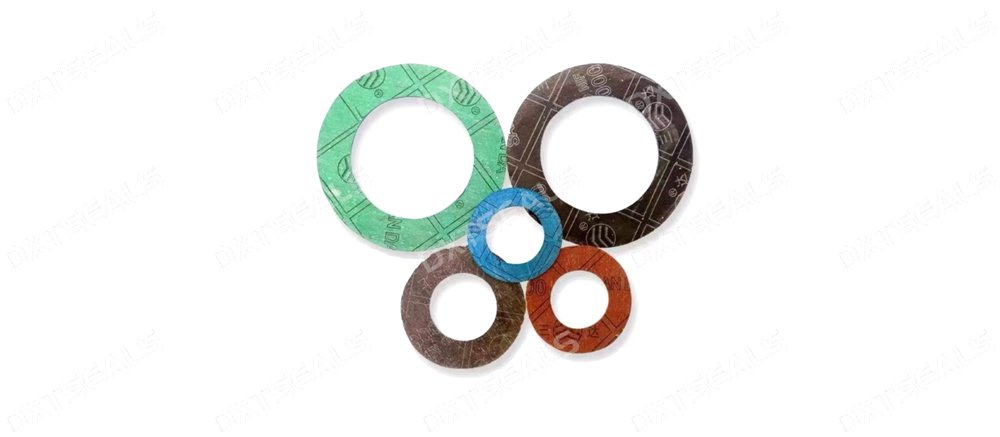
Flange gaskets are essential sealing components used in piping systems, pumps, valves, heat exchangers, industrial equipment, and process systems. Their primary function is to create a reliable seal between mating flange surfaces and prevent the leakage of liquids or gases.
However, flange gasket terminology can sometimes be confusing. FF, RF, EPDM, and Non-Asbestos do not all describe the same aspect of a gasket. FF and RF primarily describe the flange facing and gasket configuration, while EPDM and Non-Asbestos describe gasket material categories.
Understanding this distinction is important when selecting a gasket for industrial equipment or replacing an existing flange gasket.
A correct selection should consider the complete combination of:
Flange type + gasket configuration + material + dimensions + temperature + pressure + sealing medium
This article explains the major differences and applications of FF, RF, EPDM, and non-asbestos flange gasket solutions.
1. What Is a Flange Gasket?
A flange gasket is a sealing component installed between two mating flanges.
When the flange bolts are tightened, the gasket is compressed between the flange surfaces. The gasket fills surface irregularities and creates a sealing barrier that helps prevent the process medium from escaping.
Flange gaskets are used in many applications, including:
-
Water pipelines
-
HVAC systems
-
Chemical processing equipment
-
Pumps
-
Valves
-
Heat exchangers
-
Industrial machinery
-
Oil and gas equipment
-
Power generation systems
-
General process piping
Different applications require different gasket materials and configurations.
A gasket that performs well in a water system may be unsuitable for petroleum oil, aggressive chemicals, or high-temperature steam.
2. FF, RF, EPDM, and Non-Asbestos: What Do These Terms Mean?
Before comparing these gasket types, it is important to understand what each term actually describes.
| Term | What It Describes | Typical Meaning |
|---|---|---|
| FF | Flange facing / gasket configuration | Full Face |
| RF | Flange facing / gasket configuration | Raised Face |
| EPDM | Gasket material | Ethylene Propylene Diene Monomer rubber |
| Non-Asbestos | Gasket material construction | Asbestos-free compressed gasket material |
This means that FF and RF are not material names, while EPDM and Non-Asbestos are material categories.
For example, an EPDM gasket can be manufactured in an FF configuration, while a non-asbestos gasket can also be manufactured as an FF or RF gasket depending on the flange design.
This distinction is important for accurate gasket selection.
3. FF Flange Gaskets
FF stands for Full Face.
A Full Face flange gasket generally extends across the entire flange face and includes the bolt-hole area.
FF gaskets are normally associated with flat-face flange systems.
The larger gasket profile provides sealing coverage across the full flange surface.
Typical FF Gasket Features
An FF gasket may include:
-
Full-face coverage
-
Bolt holes
-
Inner sealing diameter
-
Outer diameter
-
Defined gasket thickness
FF gaskets can be manufactured from many materials, including:
-
EPDM
-
NBR
-
FKM
-
PTFE
-
Non-asbestos compressed fiber
-
Graphite
-
Other engineered gasket materials
The material must be selected according to the actual service conditions.
4. RF Flange Gaskets
RF stands for Raised Face.
A Raised Face flange has a raised sealing surface, and the gasket is normally positioned over this defined sealing area.
Compared with an FF gasket, an RF gasket generally has a smaller outside diameter and does not extend over the complete flange face.
RF flange gaskets are commonly used in industrial piping and process equipment.
Typical RF gasket materials include:
-
Non-asbestos compressed fiber
-
PTFE
-
Graphite
-
Spiral wound gasket materials
-
Metallic gasket materials
-
Other specialized sealing materials
The correct RF gasket dimensions depend on the flange standard, nominal size, pressure class, and facing configuration.
5. FF vs RF: Main Structural Differences
The main difference between FF and RF gaskets is the relationship between the gasket and the flange sealing surface.
| Feature | FF Gasket | RF Gasket |
|---|---|---|
| Full name | Full Face | Raised Face |
| Associated flange | Flat Face | Raised Face |
| Gasket coverage | Most/all flange face | Raised sealing area |
| Gasket outside diameter | Generally larger | Generally smaller |
| Bolt holes | Usually included | Usually outside the gasket sealing area |
| Sealing area | Larger | More concentrated |
| Typical applications | Water, utilities, HVAC | Industrial process piping |
| Common materials | EPDM, rubber, PTFE, non-asbestos | PTFE, graphite, non-asbestos, spiral wound |
Neither configuration is universally better. The correct choice depends first on the flange design.
6. EPDM Flange Gaskets
EPDM stands for Ethylene Propylene Diene Monomer.
EPDM is a synthetic rubber widely used in sealing applications because of its excellent resistance to water, ozone, weathering, and many polar chemicals.
EPDM flange gaskets can be manufactured in different shapes and dimensions, including both FF and application-specific configurations.
Main Advantages of EPDM
EPDM is known for:
-
Excellent water resistance
-
Excellent ozone resistance
-
Excellent weathering resistance
-
Good resistance to many dilute acids
-
Good resistance to many alkalis
-
Good flexibility
-
Good sealing conformity
-
Good outdoor durability
These characteristics make EPDM particularly useful in water-based applications.
Typical EPDM Applications
EPDM flange gaskets are commonly considered for:
-
Water pipelines
-
Cooling water systems
-
Chilled water systems
-
HVAC equipment
-
Water treatment
-
Outdoor piping
-
General utility systems
-
Some hot-water applications
The exact temperature capability depends on the specific EPDM compound.
7. Limitations of EPDM Gaskets
EPDM is not a universal gasket material.
One of its most important limitations is poor compatibility with many:
-
Mineral oils
-
Petroleum-based oils
-
Fuels
-
Hydrocarbon fluids
Therefore, an EPDM gasket should not be selected solely because the operating temperature appears suitable.
For oil, fuel, or hydrocarbon service, other materials such as NBR, FKM, PTFE, graphite, or application-specific gasket materials may be more appropriate depending on the conditions.
Chemical compatibility should always be checked against the actual medium, concentration, and operating temperature.
8. Non-Asbestos Flange Gaskets
Non-asbestos flange gaskets are compressed gasket materials manufactured without asbestos fibers.
Modern non-asbestos gasket sheets may use combinations of:
-
Aramid fibers
-
Synthetic fibers
-
Mineral fibers
-
Elastomeric binders
-
Fillers
-
Other reinforcing materials
The exact composition varies between manufacturers and gasket grades.
Therefore, "non-asbestos" is not a single universal material specification.
Different non-asbestos grades can have different:
-
Temperature resistance
-
Chemical resistance
-
Compression characteristics
-
Recovery properties
-
Mechanical strength
-
Pressure capabilities
The specific gasket grade should therefore be selected according to the application.
9. Advantages of Non-Asbestos Gaskets
Non-asbestos gasket materials are widely used in industrial applications because they can provide a combination of mechanical strength, compressibility, and sealing performance.
Common advantages include:
-
Good mechanical strength
-
Good compressibility
-
Reliable flange sealing
-
Wide range of industrial grades
-
Availability in different thicknesses
-
Suitable for custom cutting
-
Suitable for FF and RF configurations
-
Good general-purpose industrial performance
They are commonly used in pumps, valves, industrial piping, process equipment, water systems, and general machinery.
10. EPDM vs Non-Asbestos: Material Comparison
EPDM and non-asbestos gaskets are fundamentally different materials.
| Property | EPDM | Non-Asbestos |
|---|---|---|
| Material type | Synthetic rubber | Compressed fiber/elastomer composite |
| Flexibility | High | Moderate |
| Elasticity | High | Lower than rubber |
| Water resistance | Excellent | Generally good |
| Weather resistance | Excellent | Depends on grade |
| Ozone resistance | Excellent | Depends on grade |
| Oil resistance | Generally poor | Grade-dependent |
| Mechanical strength | Moderate to high | Generally high |
| Compression behavior | Elastomeric | Compressed-sheet behavior |
| Chemical resistance | Good for many polar fluids | Depends strongly on grade |
| Typical applications | Water, HVAC, outdoor systems | Industrial piping and equipment |
The table provides a general comparison. Actual performance depends on the specific compound or gasket grade.
11. FF EPDM Gaskets
Combining the two classification systems gives a more precise product description.
An FF EPDM gasket is:
-
An FF gasket configuration
-
Made from EPDM rubber
-
Designed for an appropriate flat-face flange application
This type of gasket can be useful for water and HVAC systems where the flange design requires a full-face gasket.
Typical applications include:
-
Water pipelines
-
HVAC equipment
-
Cooling systems
-
Water treatment equipment
-
General utility piping
The EPDM material must still be checked against the operating temperature and medium.
12. FF Non-Asbestos Gaskets
An FF non-asbestos gasket combines:
-
Full Face gasket geometry
-
Non-asbestos compressed gasket material
This configuration is commonly considered for flat-face industrial flange systems.
Potential applications include:
-
Water piping
-
Utility systems
-
Pumps
-
Valves
-
Industrial equipment
-
General process systems
The appropriate non-asbestos grade should be selected based on temperature, pressure, and chemical compatibility.
13. RF Non-Asbestos Gaskets
An RF non-asbestos gasket is manufactured from compressed non-asbestos gasket material and designed for a raised-face flange configuration.
RF non-asbestos gaskets may be used for:
-
Industrial process piping
-
Pumps
-
Valves
-
General machinery
-
Utility systems
-
Process equipment
The gasket dimensions must match the applicable flange standard.
14. Can EPDM Be Used for RF Gaskets?
In principle, gasket material and flange configuration are separate selection factors.
EPDM is a material, while RF describes a flange/gasket configuration.
Therefore, an EPDM gasket can be manufactured in an appropriate RF configuration when the flange design, material properties, and application requirements permit it.
However, the gasket should not be selected based on the word "RF" alone.
The complete application should be evaluated, including:
-
Flange type
-
Flange dimensions
-
Operating medium
-
Temperature
-
Pressure
-
Required gasket thickness
-
Compression requirements
15. Choosing Between FF and RF Gaskets
The first step is to identify the flange facing.
Choose an FF Configuration When:
The application uses a compatible flat-face flange system and requires a gasket covering the full flange face.
Typical examples include:
-
Flat-face water flanges
-
Certain cast iron flange systems
-
HVAC equipment
-
Utility piping
-
General low-to-moderate pressure applications where an FF gasket is specified
Choose an RF Configuration When:
The application uses a raised-face flange and requires a gasket designed for the raised sealing surface.
Typical examples include:
-
Process piping
-
Industrial valves
-
Pumps
-
Heat exchangers
-
Chemical processing equipment
-
Industrial pressure piping
The actual flange standard and pressure class should always be verified.
16. Choosing Between EPDM and Non-Asbestos Gaskets
Once the flange configuration has been identified, the gasket material should be selected according to the service conditions.
EPDM May Be Preferred When:
-
Water is the primary medium
-
Weather resistance is important
-
Ozone resistance is important
-
High flexibility is desirable
-
The application involves outdoor exposure
-
The system is compatible with EPDM
Non-Asbestos May Be Preferred When:
-
A compressed sheet gasket is required
-
Higher mechanical strength is important
-
A specific industrial gasket grade is required
-
The application requires a custom-cut gasket
-
Industrial piping or equipment requires a compressed fiber solution
The specific non-asbestos grade must be confirmed before final selection.
17. Flange Gasket Selection by Application
The following table provides a simplified starting point.
| Application | Possible Gasket Solution |
|---|---|
| Water piping | EPDM FF/RF or suitable non-asbestos |
| HVAC | EPDM, depending on flange configuration |
| Cooling water | EPDM |
| Outdoor water equipment | EPDM |
| General industrial piping | Non-asbestos or application-specific material |
| Industrial pumps | EPDM, non-asbestos, PTFE, graphite, etc. depending on medium |
| Industrial valves | Material selected according to medium and temperature |
| Chemical processing | PTFE, graphite, or suitable chemical-resistant material |
| Petroleum oil | Generally avoid EPDM; evaluate NBR, FKM, PTFE, or other suitable materials |
| Steam | Grade-specific evaluation required |
| Custom flange | Select FF/RF configuration and material according to the flange and service conditions |
This table is intended for preliminary selection only.
18. Flange Standards and Gasket Dimensions
Correct gasket selection also requires attention to flange standards.
Common standards include:
-
ASME
-
ANSI
-
EN
-
DIN
-
JIS
-
Other regional or equipment-specific standards
Different standards may use different:
-
Flange dimensions
-
Bolt-hole patterns
-
Bolt-hole diameters
-
Pressure classes
-
Facing dimensions
-
Gasket dimensions
For example, two flanges may have the same nominal pipe size but different bolt patterns or flange dimensions because they follow different standards.
Therefore, a replacement flange gasket should always be matched to the actual flange standard.
19. Gasket Thickness and Sealing Performance
Gasket thickness can also affect sealing performance.
A thicker gasket is not automatically better.
Gasket thickness influences:
-
Compression
-
Bolt load requirements
-
Flange separation
-
Gasket deformation
-
Creep and relaxation
-
Ability to accommodate flange irregularities
The correct thickness depends on the gasket material, flange condition, design requirements, and application.
For replacement applications, it is important to reproduce the original gasket thickness when appropriate rather than selecting a thickness based only on availability.
20. Custom FF, RF, EPDM, and Non-Asbestos Gaskets
Industrial equipment frequently requires non-standard gasket dimensions.
Custom gasket manufacturing can provide:
-
Custom FF gaskets
-
Custom RF gaskets
-
EPDM flange gaskets
-
Non-asbestos flange gaskets
-
Large-diameter gaskets
-
Special bolt-hole patterns
-
Non-standard thicknesses
-
Special-shaped gaskets
-
Replacement gaskets based on samples
-
Replacement gaskets based on engineering drawings
For custom orders, useful technical information includes:
-
Flange standard
-
Nominal size
-
Pressure class
-
FF or RF configuration
-
Inside diameter
-
Outside diameter
-
Bolt-hole diameter
-
Number of bolt holes
-
Bolt-circle diameter
-
Gasket thickness
-
Material
-
Operating temperature
-
Operating pressure
-
Process medium
Accurate technical information helps prevent incorrect gasket dimensions and installation problems.
21. Common Flange Gasket Selection Mistakes
Mistake 1: Treating FF and EPDM as Competing Materials
FF describes the gasket configuration, while EPDM describes the material.
They are not directly interchangeable categories.
An EPDM gasket can have an FF configuration.
Mistake 2: Treating RF as a Material
RF does not mean a particular gasket material.
It describes the raised-face flange configuration.
Mistake 3: Choosing EPDM for Oil Service
EPDM's excellent water resistance does not make it suitable for petroleum oil or fuel.
Mistake 4: Assuming All Non-Asbestos Gaskets Are Identical
Different non-asbestos grades can have substantially different performance.
Mistake 5: Ignoring the Flange Standard
Nominal pipe size alone is insufficient to determine gasket dimensions.
Mistake 6: Selecting the Gasket Before Identifying the Flange
The flange configuration should be identified before choosing the gasket geometry.
22. A Practical Flange Gasket Selection Process
A reliable selection process can be summarized as follows:
Step 1: Identify the flange
Determine whether the flange is flat face, raised face, or another specialized design.
Step 2: Identify the flange standard
Confirm ASME, EN, DIN, JIS, or another applicable standard.
Step 3: Confirm dimensions
Check nominal size, pressure class, bolt pattern, and sealing-face dimensions.
Step 4: Identify the medium
Determine whether the gasket will contact water, oil, fuel, steam, chemicals, gas, or another medium.
Step 5: Determine temperature and pressure
Use both normal and maximum operating conditions.
Step 6: Select the gasket material
Choose EPDM, non-asbestos, PTFE, graphite, NBR, FKM, or another material according to compatibility.
Step 7: Select the gasket configuration
Confirm FF or RF geometry.
Step 8: Confirm thickness
Select a suitable gasket thickness according to the design and material.
Step 9: Check installation requirements
Verify flange surface condition, bolt condition, tightening sequence, and required compression.
23. Conclusion
FF, RF, EPDM, and Non-Asbestos are all important terms in industrial flange gasket selection, but they describe different aspects of the sealing solution.
FF (Full Face) describes a gasket configuration designed to cover the full flange face and is generally associated with flat-face flange systems.
RF (Raised Face) describes a gasket configuration designed for a raised-face flange, with the sealing area concentrated around the raised face.
EPDM is a synthetic rubber material known for excellent water, ozone, and weather resistance, making it particularly suitable for water, HVAC, and outdoor applications when chemically compatible.
Non-Asbestos refers to a category of compressed gasket materials manufactured without asbestos and available in different grades for industrial piping and equipment.
The best flange gasket is not simply the one with the highest temperature rating or the lowest price. It is the gasket whose configuration, material, dimensions, and performance characteristics match the complete flange system and operating conditions.
For reliable industrial sealing, always evaluate:
Flange facing + flange standard + gasket configuration + gasket material + medium + temperature + pressure + dimensions
This systematic approach helps reduce leakage risk, improve equipment reliability, and ensure that replacement or custom flange gaskets perform as intended.