
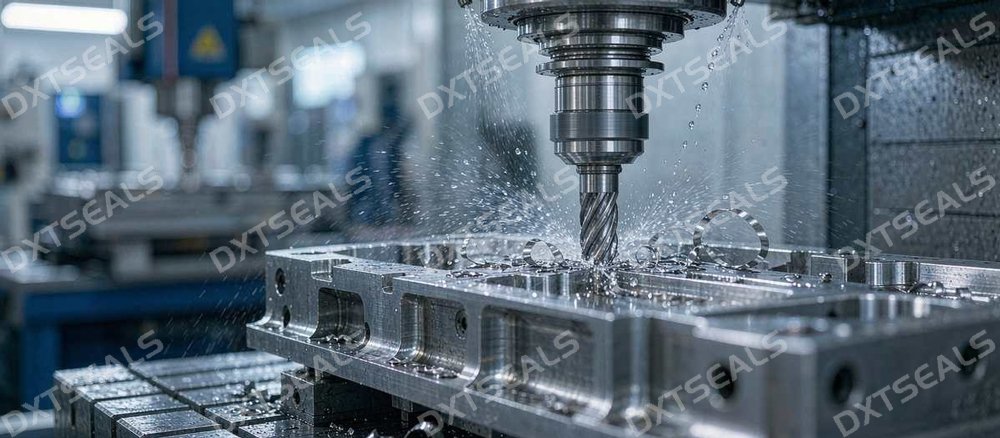
Custom machining covers a wide range of manufacturing requirements, from small precision components to extremely large industrial parts. Choosing the right machining equipment is therefore an important part of achieving the required quality, dimensional accuracy, production efficiency, and overall cost.
Standard CNC machining centers are suitable for a broad range of conventional components. However, when a workpiece becomes particularly large, heavy, long, or wide, a standard CNC machine may no longer be the most practical solution.
This is where large gantry machining equipment becomes valuable.
Understanding the differences between standard CNC machines and large gantry machines can help manufacturers select the appropriate machining solution for each custom component.
What Is Custom CNC Machining?
Custom CNC machining is the process of manufacturing components according to specific customer drawings, dimensions, materials, tolerances, and functional requirements.
Unlike standard catalog parts, custom-machined components can have almost unlimited variations in:
-
Dimensions
-
Materials
-
Geometries
-
Tolerances
-
Surface finishes
-
Hole patterns
-
Sealing surfaces
-
Machining features
Custom machining may involve metals, engineering plastics, PTFE, graphite, composites, and other industrial materials.
The appropriate machining equipment depends largely on the size, geometry, material, and precision requirements of the component.
Standard CNC Machines: The Best Choice for Conventional Components
Standard CNC machining centers are widely used because they offer a good balance between flexibility, precision, speed, and operating cost.
They are suitable for many common custom components, including:
-
Small and medium-sized mechanical parts
-
Precision brackets
-
Flanges
-
Bushings
-
Valve components
-
Small sealing components
-
Precision plastic parts
-
Metal machined components
For workpieces that comfortably fit within the machine's working envelope, a standard CNC machining center can provide excellent machining accuracy and production efficiency.
Advantages of Standard CNC Machining
Standard CNC machines generally provide:
-
High dimensional accuracy
-
Flexible CNC programming
-
Efficient material removal
-
Wide tooling options
-
Short setup times for suitable parts
-
Lower operating costs
-
Excellent repeatability
For small and medium-sized components, using a large gantry machine may provide no practical advantage and could unnecessarily increase manufacturing costs.
The most appropriate equipment is therefore not always the largest machine available.
When Does a Standard CNC Machine Become Insufficient?
The primary limitation of a standard CNC machine is its working envelope.
Every machining center has maximum X, Y, and Z travel. The workpiece must fit within these limits while leaving enough space for tool movement, fixturing, and safe machining.
A standard machine may become unsuitable when:
-
The part is too long
-
The part is too wide
-
The part is too tall
-
The workpiece exceeds table load capacity
-
The tool cannot reach required features
-
Multiple setups would be required
-
The part becomes difficult to fixture
-
Large surface areas require continuous machining
For example, an oversized PTFE plate may have dimensions that exceed the working area of a conventional vertical machining center.
In this situation, simply trying to machine the component using multiple setups can introduce additional alignment challenges.
What Is a Large Gantry Machining Machine?
A large gantry milling machine uses a bridge-like structure spanning across a large machining table.
The cutting head travels along the gantry while the workpiece is supported on the machine bed.
This configuration allows manufacturers to machine significantly larger components than would normally fit on standard CNC machining centers.
Gantry machines can be designed for heavy-duty applications and may provide:
-
Large X-axis travel
-
Large Y-axis travel
-
Extended Z-axis capability
-
High table load capacity
-
Rigid machine construction
-
Large machining areas
-
Heavy-duty cutting capability
These characteristics make gantry equipment particularly suitable for oversized custom machining.
Standard CNC vs. Large Gantry Machining
The two types of equipment are not competitors in every application. They are designed to solve different machining requirements.
| Factor | Standard CNC Machine | Large Gantry Machine |
|---|---|---|
| Typical part size | Small to medium | Large to extra-large |
| Machine footprint | Relatively compact | Large |
| Workpiece weight | Moderate | Heavy |
| Working envelope | Limited | Very large |
| Large flat surfaces | Limited by travel | Highly suitable |
| Large PTFE parts | Suitable for smaller sizes | Suitable for oversized parts |
| Multiple setups | More likely for large parts | Often reduced |
| Heavy components | Limited by table capacity | Better suited |
| Production flexibility | Excellent | Excellent for large components |
| Equipment cost | Generally lower | Generally higher |
The right choice depends on the actual requirements of the component.
1. Part Dimensions Should Be the First Consideration
The physical dimensions of the component are usually the first factor to evaluate.
Manufacturers should compare the part dimensions with the machine's actual working envelope.
It is not enough for a component to technically fit inside the machine.
There must also be sufficient space for:
-
Tool movement
-
Workholding
-
Tool changes
-
Cutting operations
-
Safe loading and unloading
-
Inspection
For large custom parts, a machine with only slightly greater travel than the part dimensions may still be impractical.
A sufficient machining margin is important for stable production.
2. Workpiece Weight Is Equally Important
Size and weight are separate considerations.
A large PTFE component may have a relatively low weight compared with a similarly sized steel component.
A large steel plate, however, can weigh hundreds or thousands of kilograms.
The machine must therefore have sufficient table load capacity.
The manufacturer must also have appropriate equipment for:
-
Lifting
-
Positioning
-
Clamping
-
Supporting
-
Removing the workpiece
A machine may have enough travel to accommodate a large component but still be unsuitable if the table cannot safely support its weight.
3. Machining Accuracy and Setup Requirements
Part size can also influence machining accuracy.
When a large component requires several setups, each repositioning operation can introduce additional alignment errors.
This becomes especially important when different features need to maintain precise positional relationships.
A sufficiently large gantry machine can sometimes machine multiple features within a single setup.
This can reduce:
-
Repositioning errors
-
Datum transfer errors
-
Alignment variation
-
Accumulated tolerances
For precision custom components, reducing the number of setups can be a major advantage.
4. Large Flat Surfaces Favor Gantry Machining
Large flat surfaces are one of the most obvious applications for gantry equipment.
Examples include:
-
Large sealing surfaces
-
Equipment covers
-
Mounting plates
-
Machine bases
-
Structural plates
-
Large PTFE sheets and covers
Machining a large surface on a standard CNC machine may require multiple operations and repositioning.
A gantry machine can allow the cutting tool to travel continuously across a much larger area.
This can improve consistency and simplify the machining process.
5. Large PTFE Custom Parts
PTFE is frequently used for industrial sealing and chemical-resistant applications.
Custom PTFE components may include:
-
Large PTFE plates
-
PTFE covers
-
Large sealing rings
-
PTFE liners
-
Custom PTFE gaskets
-
Large sliding components
For small PTFE parts, standard CNC equipment is often sufficient.
For very large PTFE components, however, a gantry machine can provide significant advantages.
Large PTFE parts may require special attention to:
-
Thermal expansion
-
Material deformation
-
Flatness
-
Clamping force
-
Cutting parameters
-
Tool selection
-
Final dimensional inspection
The larger the component becomes, the more important these factors become.
6. Material Type Can Influence Equipment Selection
Different materials require different machining strategies.
Metals
Steel, stainless steel, aluminum, brass, and other metals may require substantial cutting forces.
Machine rigidity and spindle power become important considerations.
Engineering Plastics
Engineering plastics generally require different cutting parameters from metals. Thermal effects and deformation may also need to be considered.
PTFE
PTFE has excellent chemical resistance and low friction but can be sensitive to thermal and mechanical deformation during machining.
Graphite and Carbon Materials
Graphite components may require specialized tooling and machining strategies because of their brittle structure and dust generation.
The material and part size should therefore be evaluated together when selecting machining equipment.
7. When Multiple Setups Become a Problem
Multiple setups are not inherently bad. Many precision components require several machining operations.
The problem occurs when multiple setups are required primarily because the machine is too small for the component.
For example, a large plate may need to be repositioned several times simply to machine its entire surface.
This can increase:
-
Production time
-
Labor requirements
-
Setup costs
-
Alignment risks
-
Inspection requirements
If the same component can be processed with fewer setups on a gantry machine, the larger machine may provide better overall manufacturing efficiency.
8. Gantry Machining Can Improve Large-Part Efficiency
Large gantry equipment typically requires a greater investment than standard CNC equipment.
However, equipment cost should not be evaluated independently from manufacturing efficiency.
For an oversized component, using a machine that is properly sized for the job can reduce the number of setups and handling operations.
This may reduce total production time and improve consistency.
The most cost-effective machining solution is therefore not necessarily the machine with the lowest hourly rate.
Instead, manufacturers should consider the total manufacturing process.
9. Equipment Selection Should Consider Transportation and Handling
Large custom machining does not begin when the cutting tool starts rotating.
The manufacturer must first receive, unload, move, and position the raw material.
After machining, the finished part must also be removed, packaged, and transported.
For oversized components, manufacturers should evaluate:
-
Workshop access
-
Crane capacity
-
Loading equipment
-
Machine table capacity
-
Workpiece handling space
-
Packaging requirements
-
Transportation restrictions
These considerations become especially important for very large and heavy industrial components.
10. Inspection Requirements Also Matter
The inspection method should be considered when selecting a machining solution.
Large components may require specialized inspection equipment and measurement strategies.
For example, checking a large sealing surface may require measurements across multiple points to verify flatness.
The manufacturer may need to use:
-
Large precision measuring equipment
-
Height gauges
-
Laser measurement systems
-
Coordinate measurement equipment
-
Surface inspection tools
A complete manufacturing solution should therefore include both machining and inspection capabilities.
11. How to Choose the Right Machining Solution
A practical equipment-selection process can begin with several basic questions.
Step 1: Determine the Overall Dimensions
Measure the maximum length, width, and height of the component.
Step 2: Determine the Weight
Calculate or estimate the finished and raw-material weight.
Step 3: Identify the Material
Determine whether the part is made from metal, PTFE, graphite, engineering plastic, or another material.
Step 4: Review the Tightest Tolerances
Identify critical dimensions, flatness requirements, hole positions, and sealing surfaces.
Step 5: Evaluate the Machining Features
Consider pockets, holes, grooves, contours, steps, and large planar surfaces.
Step 6: Determine the Number of Setups
Evaluate whether the component can be machined efficiently in one setup or requires multiple repositioning operations.
Step 7: Consider Handling Requirements
Confirm that the manufacturer can safely load, unload, support, and move the workpiece.
Step 8: Evaluate Inspection Capability
Make sure the manufacturer has an appropriate method for verifying the final dimensions.
This process helps identify whether standard CNC machining or large gantry machining is the better solution.
Standard CNC or Gantry Machine: Which Is Better?
There is no universal answer.
Standard CNC machining is often the better choice when the component is relatively compact and requires high precision, flexible machining, and efficient production.
Large gantry machining becomes more attractive when the component is:
-
Very large
-
Very heavy
-
Long or wide
-
Difficult to reposition
-
Dominated by large flat surfaces
-
Made from oversized PTFE blanks
-
Subject to strict dimensional requirements across a large area
The goal is not to choose the largest machine available. The goal is to choose the machine that matches the component's actual manufacturing requirements.
Why a Manufacturer's Equipment Range Matters
For custom machining, equipment capability directly affects what a manufacturer can produce.
A supplier equipped with both standard CNC machining centers and large gantry machines can select the appropriate equipment according to each customer's requirements.
This provides greater flexibility.
Small and medium-sized components can be produced efficiently on standard CNC equipment, while oversized components can be transferred to large-format machining equipment.
Such a manufacturing setup can support a wider range of custom parts without forcing every component into the same machining process.
Conclusion
Choosing between standard CNC machines and large gantry equipment depends primarily on the size, weight, material, geometry, tolerance, and production requirements of the custom component.
Standard CNC machining remains an excellent solution for small and medium-sized precision parts. It offers flexibility, efficiency, and cost-effective production for components that fit comfortably within its working envelope.
Large gantry machining, on the other hand, is designed for applications where conventional CNC equipment reaches its practical limits. Its large working area, rigid structure, and heavy-load capability make it suitable for oversized plates, large PTFE components, machine bases, industrial covers, large sealing surfaces, and other extra-large custom parts.
For manufacturers handling a wide range of custom machining projects, having access to both standard CNC equipment and large gantry machinery provides greater production flexibility.
Ultimately, the right machining solution is the one that can process the complete component efficiently while maintaining the required accuracy, stability, and quality.
When selecting a custom machining supplier, customers should therefore look beyond the phrase "CNC machining services" and evaluate the manufacturer's actual equipment capacity, maximum workpiece dimensions, load capability, gantry machining experience, material handling systems, and inspection methods.