
Introduction
In spring-energized seals, the energizing spring plays a critical role in maintaining consistent sealing force. While much attention is often given to PTFE jacket materials, the type of spring used inside the seal has a direct impact on friction, wear, pressure response, and service life.
This article compares two commonly used spring types—helical springs and wave springs—and explains how each affects sealing performance in different applications.
Role of the Energizing Spring in Spring-Energized Seals
The energizing spring compensates for wear, thermal expansion, and pressure fluctuations by maintaining continuous contact between the seal lip and the mating surface. The spring design determines how evenly and consistently this force is applied.
Helical Springs in Spring-Energized Seals
Structural Characteristics
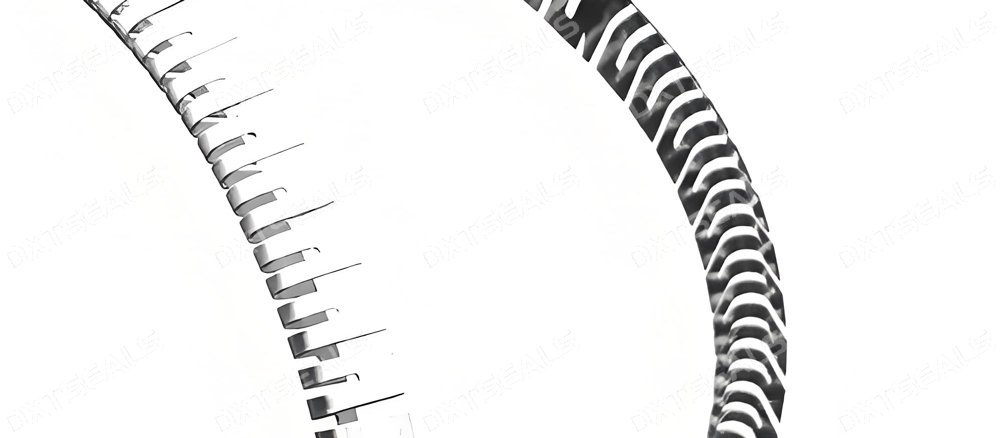
Helical springs consist of tightly wound coils that provide strong and uniform radial force along the seal circumference.
Performance Advantages
-
High and stable sealing force
-
Excellent compensation for wear
-
Suitable for high-pressure applications
Typical Applications
-
Hydraulic systems
-
High-pressure valves
-
Static and low-speed dynamic sealing
Considerations
Helical springs may generate higher friction, making them less ideal for high-speed or low-torque applications.
Wave Springs in Spring-Energized Seals
Structural Characteristics
Wave springs feature a flat wire formed into a wave pattern, creating multiple contact points with lower overall spring force.
Performance Advantages
-
Lower friction and reduced heat generation
-
Smooth sealing force distribution
-
Ideal for high-speed and low-pressure applications
Typical Applications
-
Rotary shafts
-
Pneumatic systems
-
Precision and low-torque equipment
At DXTSEALS, wave spring-energized seals are commonly selected for applications requiring minimal friction and long wear life.
Performance Comparison
| Performance Factor | Helical Spring | Wave Spring |
|---|---|---|
| Sealing Force | High | Moderate |
| Friction Level | Higher | Lower |
| Pressure Capability | Excellent | Moderate |
| Speed Capability | Moderate | Excellent |
| Wear Compensation | Very good | Good |
| Typical Applications | High-pressure systems | High-speed rotation |
Selecting the Right Spring Type
Choosing between helical and wave springs depends on application requirements such as:
-
Operating pressure and speed
-
Friction and torque limitations
-
Media and temperature conditions
-
Seal service life expectations
Proper spring selection ensures optimal balance between sealing reliability and system efficiency.
Conclusion
Both helical springs and wave springs play essential roles in spring-energized seal performance. Helical springs provide strong sealing force for high-pressure applications, while wave springs excel in high-speed and low-friction environments.
Understanding these differences allows engineers to select the most effective spring-energized seal configuration for their specific application needs.