
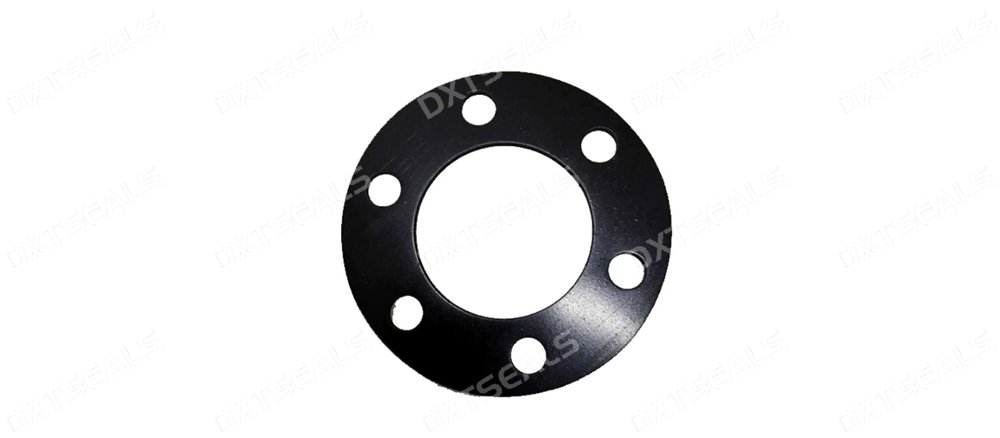
Choosing the correct EPDM flange gasket requires more than selecting a rubber material and nominal pipe size. The gasket must match the flange standard, dimensions, pressure designation, facing type, operating temperature, and process medium.
American and European piping systems use different standards and dimensional conventions. American projects commonly reference ASME flange standards and may still use the term ANSI flange in commercial specifications. European systems commonly use EN flange standards, with DN and PN designations widely used.
Because these systems are not automatically interchangeable, selecting the correct EPDM flange gasket requires careful confirmation of the flange configuration.
This guide explains the key factors to consider when choosing EPDM flange gaskets for both American and European piping standards.
What Is an EPDM Flange Gasket?
An EPDM flange gasket is a sealing component made from ethylene propylene diene monomer rubber. It is installed between mating flange surfaces to prevent leakage.
EPDM is commonly selected for applications involving:
- Water
- Hot water
- Cooling water
- Chilled water
- HVAC systems
- Water treatment
- Outdoor piping
- Certain dilute chemicals
- General industrial fluid systems
EPDM is particularly useful where resistance to water, ozone, weathering, and many water-based chemicals is required.
However, EPDM is generally not the preferred elastomer for petroleum-based oils and fuels. Material compatibility should always be checked against the actual service medium.
Step 1: Identify the Flange Standard
The first step is identifying which flange standard the equipment uses.
Common specifications include:
- ASME flange standards
- ANSI-related flange terminology
- EN flange standards
- Other national or industry-specific standards
For American-style piping systems, ASME B16.5 is commonly referenced for pipe flanges and flanged fittings within its specified scope.
European piping systems commonly use EN flange standards, including the EN 1092 series for various flange configurations.
The gasket should be manufactured according to the actual flange standard rather than selected solely by the pipe diameter.
Step 2: Confirm NPS or DN Size
American and European piping systems commonly use different nominal size designations.
NPS
American piping systems frequently use NPS, or Nominal Pipe Size.
Examples include:
- NPS 1
- NPS 2
- NPS 4
- NPS 6
- NPS 8
DN
European systems commonly use DN, or nominal diameter.
Examples include:
- DN25
- DN50
- DN100
- DN150
- DN200
NPS and DN are not simply interchangeable labels. Similar nominal sizes can still have different flange dimensions.
Therefore, the actual flange standard and dimensions should always be confirmed.
Step 3: Check the Pressure Designation
The pressure designation is another important selection factor.
American flange systems commonly use Class designations, such as:
- Class 150
- Class 300
- Class 600
European systems commonly use PN designations, such as:
- PN10
- PN16
- PN25
- PN40
Class and PN should not be treated as direct one-to-one equivalents.
For example, a gasket specified for an ASME Class 150 flange should not automatically be replaced with a gasket labeled PN16 simply because the application appears similar.
The actual flange dimensions and applicable standard must be checked.
Step 4: Identify the Flange Facing
Flange facing has a direct effect on gasket geometry.
Common configurations include:
- Flat Face (FF)
- Raised Face (RF)
- Other specialized sealing faces
Full-Face EPDM Gaskets
Full-face gaskets generally cover the flange face and may include bolt holes.
They are commonly used with flat-face flange configurations.
Raised-Face EPDM Gaskets
Raised-face applications generally use a gasket designed around the raised sealing area.
The gasket dimensions should correspond to the applicable flange standard and sealing surface.
Using the wrong gasket style can result in insufficient compression or leakage.
Step 5: Confirm the Gasket Dimensions
Even when the material, nominal size, and pressure designation appear correct, the actual gasket dimensions must still be confirmed.
Important dimensions include:
| Parameter | What to Check |
|---|---|
| Inside diameter | Must suit the pipe and sealing area |
| Outside diameter | Must match the flange configuration |
| Thickness | Must provide suitable compression |
| Bolt holes | Required for applicable full-face designs |
| Bolt-circle diameter | Must match the flange drilling |
| Profile | Must correspond to the sealing face |
| Edge configuration | Must suit the flange assembly |
For replacement applications, measuring the existing gasket can be useful when the original standard is uncertain.
Step 6: Check the EPDM Material
Not all EPDM compounds are identical.
Depending on the application, EPDM formulations may differ in:
- Hardness
- Temperature resistance
- Chemical resistance
- Compression set
- Mechanical properties
- Regulatory approvals
For general water service, an appropriate EPDM compound may provide excellent sealing performance.
For drinking-water applications, the selected compound should have the certifications required for the target market.
Step 7: Check Operating Temperature
Temperature affects both the rubber material and the complete flange sealing system.
Before selecting an EPDM gasket, determine:
- Normal operating temperature
- Maximum operating temperature
- Minimum operating temperature
- Temperature cycling
- Exposure duration
A generic EPDM temperature range should not be treated as a universal rating. The actual compound and gasket design should be verified with the manufacturer's technical data.
Step 8: Check the Process Medium
The process medium is one of the most important factors in elastomer selection.
EPDM is commonly considered for:
- Water
- Steam under suitable conditions
- Hot water
- Glycol-based systems
- Many dilute acids and alkalis
- Outdoor environmental exposure
However, EPDM is generally unsuitable for many petroleum-based oils and fuels.
If the system contains oil, fuel, hydrocarbons, or other aggressive media, an alternative elastomer such as NBR or FKM may need to be considered depending on the specific conditions.
Step 9: Consider Operating Pressure
The gasket must be suitable for the pressure conditions of the complete flange assembly.
When checking pressure requirements, consider:
- Normal operating pressure
- Maximum pressure
- Pressure fluctuations
- Temperature
- Flange design
- Bolt loading
- Gasket compression
- Sealing surface condition
A flange pressure class should not be interpreted as a universal operating-pressure rating for every temperature and material combination.
American vs European EPDM Gasket Selection
The following comparison provides a general overview:
| Selection Factor | American Piping Systems | European Piping Systems |
|---|---|---|
| Nominal size | NPS commonly used | DN commonly used |
| Pressure designation | Class commonly used | PN commonly used |
| Typical standards | ASME specifications | EN specifications |
| Dimensions | Standard-specific | Standard-specific |
| Bolt pattern | Depends on flange standard | Depends on flange standard |
| Gasket selection | Match flange and facing | Match flange and facing |
| Material | EPDM or application-specific elastomer | EPDM or application-specific elastomer |
The table is a general guide. Exact gasket dimensions must be determined from the applicable flange specification.
Example: Class 150 vs PN16
Class 150 and PN16 are both commonly encountered in industrial piping, but they represent different flange systems.
A gasket should not be selected simply because both specifications appear suitable for a similar service.
The following should be checked:
- Flange standard
- Nominal size
- Pressure designation
- Flange dimensions
- Bolt-hole pattern
- Facing type
- Gasket dimensions
- Operating conditions
This is especially important when replacing an existing gasket with a product from another standard system.
EPDM Flange Gaskets for Water Applications
Water systems are one of the most common applications for EPDM flange gaskets.
Typical applications include:
- Industrial water pipelines
- Cooling-water systems
- Chilled-water systems
- Heating-water systems
- Water treatment plants
- Pump stations
- Valves
- Heat exchangers
- Storage tanks
EPDM's resistance to water and weathering makes it suitable for many of these applications.
EPDM Flange Gaskets for HVAC Systems
HVAC systems frequently use EPDM sealing components for water-based heating and cooling circuits.
Common applications include:
- Chilled-water piping
- Heating-water piping
- Cooling systems
- Pumps
- Heat exchangers
- Flanged valves
- HVAC equipment
The gasket should be selected according to the system's actual temperature, pressure, fluid, and flange standard.
When Should You Use a Custom EPDM Flange Gasket?
Standard EPDM flange gaskets are suitable for many common flange configurations. However, custom manufacturing can be useful when:
- The flange has non-standard dimensions.
- The original gasket is obsolete.
- A special thickness is required.
- The bolt-hole pattern is unusual.
- The equipment uses a proprietary flange.
- The customer requires OEM dimensions.
- The original gasket is available only as a physical sample.
- A special EPDM compound is required.
Custom gaskets can be produced according to drawings, samples, measurements, or technical specifications.
Custom EPDM Gasket Manufacturing
A custom EPDM flange gasket may be manufactured according to:
- CAD drawings
- Engineering drawings
- Existing gasket samples
- Flange measurements
- OEM specifications
- Required material grade
- Required hardness
- Special thickness
- Custom dimensions
This is particularly valuable for industrial maintenance and replacement projects where standard catalog products do not provide an exact match.
How to Order EPDM Flange Gaskets
For efficient product selection and quotation, provide the following information whenever possible:
| Required Information | Example |
|---|---|
| Material | EPDM |
| Standard | ASME / EN |
| Nominal size | NPS / DN |
| Pressure designation | Class / PN |
| Facing | FF / RF |
| Outside diameter | Drawing or measurement |
| Inside diameter | Drawing or measurement |
| Thickness | Required gasket thickness |
| Bolt holes | Number and dimensions if applicable |
| Medium | Water, glycol, chemical, etc. |
| Temperature | Operating range |
| Pressure | Operating range |
| Quantity | Required quantity |
A drawing or physical sample can be especially helpful for non-standard replacement requirements.
Common EPDM Flange Gasket Selection Mistakes
Choosing Only by Nominal Size
NPS or DN alone does not guarantee that the gasket will fit the flange.
Assuming Class and PN Are Equivalent
Class and PN are different designation systems and should not be used as automatic substitutes.
Ignoring the Flange Face
A full-face gasket and raised-face gasket may have significantly different geometries.
Ignoring the Process Medium
EPDM may be an excellent choice for water but unsuitable for certain oil and fuel applications.
Using a Generic Temperature Rating
The actual EPDM compound and service conditions should be considered instead of relying on a general material specification.
Replacing a Gasket Without Checking Dimensions
A gasket that looks similar may have a different inside diameter, outside diameter, thickness, or bolt-hole configuration.
Standard and Custom EPDM Flange Gasket Solutions
For industrial customers, both standard and custom EPDM flange gasket solutions can be important.
Standard products can be supplied for commonly used ASME-related and EN flange configurations. Custom products can be manufactured according to drawings, samples, flange measurements, or OEM requirements.
This approach supports:
- New equipment manufacturing
- Industrial maintenance
- Flange gasket replacement
- Pump and valve servicing
- HVAC systems
- Water treatment equipment
- OEM projects
- Non-standard machinery
Conclusion
Choosing the right EPDM flange gasket for American or European piping systems requires careful consideration of both material and dimensional standards.
For American systems, confirm the applicable ASME specification, NPS size, Class designation, flange facing, and gasket dimensions. For European systems, confirm the applicable EN specification, DN size, PN designation, flange configuration, and gasket dimensions.
EPDM is widely used for water, HVAC, cooling, heating, and outdoor applications because of its resistance to water, ozone, and weathering. However, compatibility with the actual process medium and operating temperature must always be verified.
For standard applications, EPDM flange gaskets can be supplied according to established American and European flange configurations. For special equipment and replacement projects, custom EPDM flange gaskets can be manufactured according to drawings, samples, dimensions, and OEM specifications, providing a flexible solution for both standard and non-standard industrial sealing requirements.