
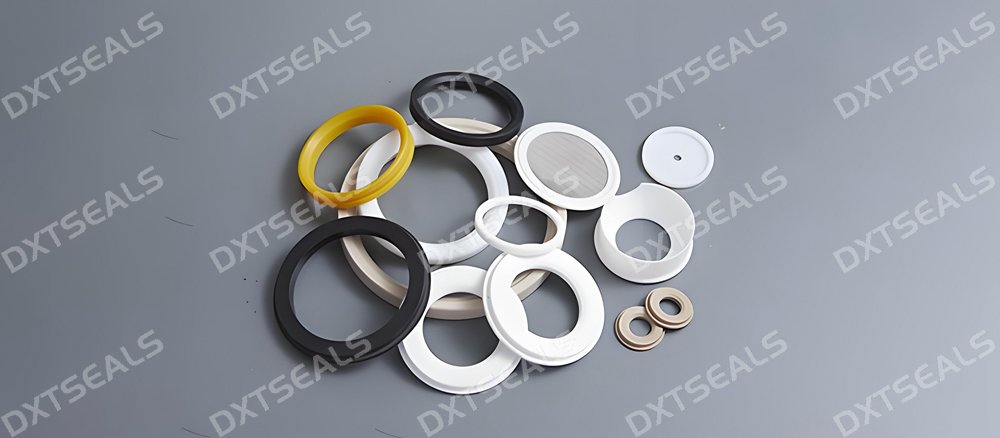
Selecting the right sealing materials is critical to ensuring the long-term reliability, safety, and efficiency of an air compressor. Because compressors operate under varying pressures, temperatures, lubrication conditions, and mechanical loads, choosing improper materials can quickly lead to leakage, component failure, or premature wear.
This guide compares the performance of commonly used sealing materials—focusing on high-temperature resistance, oil resistance, and wear resistance—to help you determine the most suitable option for your application.
As a professional sealing manufacturer, DXTSEALS offers customized materials and designs for industrial air compressor systems.
1. Key Performance Requirements for Air Compressor Seals
Air compressors rely on multiple types of seals—such as oil seals, O-rings, scraper rings, PTFE wear rings, and shaft seals—to prevent leakage and maintain system stability. Regardless of the seal design, three material properties matter most:
1. High-Temperature Resistance
Compressors generate heat from compression, friction, and continuous operation. Materials must maintain elasticity and sealing force at elevated temperatures.
2. Oil and Chemical Resistance
Seals are continuously exposed to lubricating oil, refrigerants, or compressed gas impurities. Poor material compatibility leads to swelling, hardening, or cracking.
3. Wear and Friction Resistance
Dynamic seals (sliding or rotating) require low friction and high wear resistance to ensure long service life.
2. Common Sealing Materials Used in Air Compressors
Below is an overview of the most frequently used materials for air compressor applications:
NBR (Nitrile Rubber)
-
Temperature range: –30°C to 120°C
-
Oil resistance: Good
-
Wear resistance: Moderate
-
Best for: Standard oil seals, O-rings, low to medium temperature compressors
FKM (Viton® / Fluororubber)
-
Temperature range: –20°C to 200°C
-
Oil resistance: Excellent
-
Wear resistance: Good
-
Best for: High-temperature and oil-rich environments, heavy-duty compressors
EPDM
-
Temperature range: –40°C to 150°C
-
Oil resistance: Poor
-
Wear resistance: Moderate
-
Best for: Non-oil systems, compressed air with moisture, chemical resistance
Silicone Rubber
-
Temperature range: –60°C to 220°C
-
Oil resistance: Fair
-
Wear resistance: Low
-
Best for: Static seals, extreme low or high temperature areas
PTFE (Polytetrafluoroethylene)
-
Temperature range: –70°C to 260°C
-
Oil resistance: Excellent
-
Wear resistance: Excellent (especially filled PTFE)
-
Best for: High-speed shafts, scraper rings, piston seals, high pressure & high temperature systems
Filled PTFE (Glass/Carbon/Bronze Filled)
-
Enhanced properties:
-
Higher wear resistance
-
Improved dimensional stability
-
Lower friction
-
-
Best for: Screw compressors, heavy-duty reciprocating compressors, long-life sealing solutions
3. Performance Comparison: High-Temperature, Oil-Resistant, and Wear-Resistant Materials
High-Temperature Resistance Ranking
-
PTFE / Filled PTFE (up to 260°C)
-
Silicone Rubber
-
FKM
-
EPDM
-
NBR
Oil Resistance Ranking
-
PTFE / Filled PTFE
-
FKM
-
NBR
-
Silicone Rubber
-
EPDM (not recommended for oil systems)
Wear Resistance Ranking
-
Filled PTFE (glass/bronze/carbon)
-
PTFE
-
FKM
-
NBR
-
Silicone Rubber
This comparison shows that PTFE and filled PTFE are the most versatile materials for high-performance compressor sealing systems. Meanwhile, NBR and FKM remain the most widely used rubbers due to their cost-effectiveness and stable oil resistance.
4. How to Choose the Right Material for Your Air Compressor?
1. Consider the Operating Temperature
-
Above 150°C → PTFE, FKM, Silicone
-
Standard compressors (<120°C) → NBR or FKM
2. Evaluate Oil Type and Chemical Exposure
-
Heavy lubricant exposure → FKM or PTFE
-
No oil / moisture-rich → EPDM
3. Match Wear Resistance to Motion Type
-
High-speed shaft → PTFE / Filled PTFE
-
Reciprocating motion → PTFE wear rings + O-rings
-
Static sealing → NBR/EPDM/Silicone
4. Review Cost vs Performance
-
Budget-friendly → NBR
-
Balanced performance → FKM
-
Premium long-life → PTFE / Filled PTFE
DXTSEALS supports custom formulations depending on your working pressure, temperature, medium, and motion type.
5. Why Material Selection Matters
Choosing the wrong sealing material may result in:
-
Oil leakage
-
Seal hardening or cracking
-
Excessive wear
-
Higher operating temperatures
-
Shortened service life
-
Increased maintenance costs
For industrial compressors, correct material selection directly affects the unit’s efficiency, stability, and lifespan.
Conclusion
Selecting materials for air compressor sealing parts requires a clear understanding of temperature limits, oil resistance, and wear performance. Materials like PTFE, FKM, and filled PTFE offer superior performance in demanding applications, while NBR remains a cost-effective option for standard operating conditions.
For customized sealing solutions tailored to specific air compressor models and working environments, DXTSEALS provides expert engineering support and high-quality manufacturing.