
1. Introduction
Industrial flange gaskets are essential sealing components used to prevent fluid and gas leakage between connected flanges. They are widely applied in piping systems, pumps, valves, heat exchangers, pressure vessels, water treatment equipment, chemical processing plants, and power generation facilities.
Selecting the right flange gasket is critical to achieving reliable sealing performance, maintaining system safety, and reducing maintenance costs. Different materials offer different levels of chemical resistance, temperature tolerance, compressibility, mechanical strength, and pressure-handling capability.
Common industrial flange gasket materials include EPDM, NBR, PTFE, graphite, compressed non-asbestos fiber, and metallic or semi-metallic constructions such as spiral wound gaskets. Each type is designed to meet different operating requirements.
This guide explains the main industrial flange gasket materials, their properties, and typical applications to help engineers, purchasing teams, and equipment manufacturers make informed sealing decisions.
2. What Is an Industrial Flange Gasket?
A flange gasket is a sealing element installed between two mating flange faces. When the flanges are bolted together, the gasket compresses to accommodate surface irregularities and establish a sealing barrier.
Depending on the design, flange gaskets may be manufactured from rubber sheets, PTFE, graphite, compressed fiber materials, metal, or combinations of different materials.
The gasket must maintain adequate sealing contact under the actual operating conditions. Its performance depends not only on the material but also on flange geometry, surface finish, bolt loading, gasket thickness, pressure, temperature, and the properties of the sealed medium.
Common Flange Gasket Designs
-
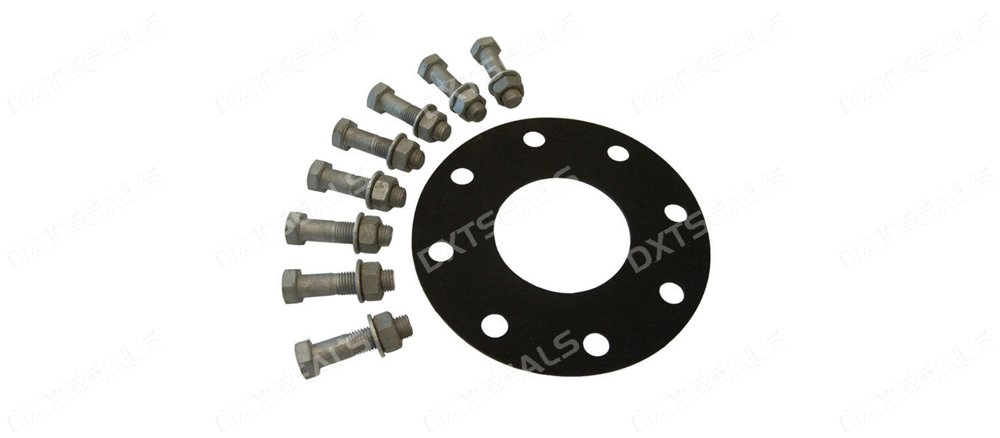
Full-face gaskets: Cover the flange face and generally include bolt holes. They are commonly used with flat-face flanges.
-
Ring gaskets: Fit within the sealing area of the flange and are often used with raised-face flange arrangements when the dimensions are appropriate.
-
Spiral wound gaskets: Combine a wound metallic strip with a filler material to provide a resilient sealing structure.
-
Metal-reinforced gaskets: Incorporate a metal core or reinforcement to improve structural stability.
-
Custom-shaped gaskets: Manufactured according to drawings, samples, or equipment-specific requirements.
The appropriate design must match the flange type and applicable dimensional standard.
3. EPDM Flange Gaskets: Water Resistance and Weather Durability
EPDM (ethylene propylene diene monomer) rubber is widely used for flange gaskets in water-based systems and outdoor installations.
Key Properties
-
Excellent resistance to ozone and weathering.
-
Good resistance to water and many aqueous media.
-
Good flexibility and sealing conformity.
-
Suitable for many hot-water and cooling-water applications when the correct compound is selected.
-
Available in different hardness levels and gasket thicknesses.
Typical Applications
EPDM flange gaskets are commonly used in:
-
Water supply and distribution systems.
-
HVAC and cooling-water pipelines.
-
Water treatment facilities.
-
Outdoor piping installations.
-
Selected chemical and industrial water systems.
Limitations
EPDM is generally unsuitable for petroleum-based oils and fuels. Compatibility with chemicals, steam, and elevated temperatures depends on the specific formulation and operating conditions.
For applications involving water, weather exposure, and compatible aqueous fluids, EPDM can provide a practical and economical sealing solution.
4. NBR Flange Gaskets: Oil and Hydraulic Fluid Compatibility
NBR, also known as nitrile rubber, is frequently selected for industrial applications involving oils and petroleum-based fluids.
Key Properties
-
Good resistance to many mineral oils and hydraulic fluids.
-
Good mechanical strength and abrasion resistance.
-
Useful sealing performance in many general industrial applications.
-
Available in different hardness grades and gasket configurations.
-
Often economical for routine replacement and maintenance.
Typical Applications
NBR flange gaskets may be used in:
-
Oil-handling equipment.
-
Industrial machinery.
-
Hydraulic systems.
-
Lubrication systems.
-
Equipment housings and compatible fluid connections.
Limitations
NBR generally has lower resistance to ozone, weathering, and elevated temperatures than many FKM compounds. Its compatibility with fuels, solvents, and other chemicals must be verified for the specific formulation.
NBR is a useful option when oil resistance and cost-effective sealing are key requirements.
5. PTFE Flange Gaskets: Chemical Resistance and Low Contamination
PTFE (polytetrafluoroethylene) is widely used in chemical processing and other applications where broad chemical resistance is required.
Key Properties
-
Excellent resistance to a broad range of chemicals.
-
Low friction and a non-stick surface.
-
Low moisture absorption.
-
Good resistance to many corrosive process media.
-
Suitable for applications where rubber compatibility may be inadequate.
Typical Applications
PTFE flange gaskets are commonly used in:
-
Chemical processing plants.
-
Acid and alkali handling systems.
-
Pharmaceutical and specialty chemical equipment.
-
Water treatment systems.
-
Industrial piping requiring chemical-resistant sealing.
PTFE Gasket Types
PTFE gaskets may include:
-
Virgin PTFE gaskets.
-
Modified PTFE gaskets.
-
Expanded PTFE gaskets.
-
Filled PTFE gaskets.
Different PTFE constructions offer different levels of compressibility, creep resistance, and dimensional stability.
Limitations
PTFE can undergo creep or cold flow under sustained compressive loading. Gasket design, flange condition, bolt loading, pressure, and temperature therefore require careful evaluation.
For demanding applications, modified or expanded PTFE may be considered when improved sealing conformity or resistance to deformation is needed.
6. Graphite Flange Gaskets: High-Temperature Sealing
Flexible graphite is an important sealing material for high-temperature industrial applications. It is frequently used in power generation, steam systems, chemical processing, and industrial equipment exposed to elevated temperatures.
Key Properties
-
Excellent thermal stability under suitable conditions.
-
Good conformability to flange surfaces.
-
Low friction.
-
Good sealing performance across many demanding industrial applications.
-
Compatibility with many process media, subject to chemical and environmental limitations.
Typical Applications
Graphite flange gaskets are used in:
-
Steam pipelines.
-
Power generation equipment.
-
Heat exchangers.
-
Industrial valves and pumps.
-
High-temperature process piping.
Limitations
Graphite can oxidize at elevated temperatures in oxygen-containing environments. Strongly oxidizing chemicals may also present compatibility concerns.
Reinforced graphite gaskets incorporate materials such as metal inserts or other structural supports to improve handling and mechanical stability, depending on the design.
When selecting graphite gaskets, evaluate the temperature, atmosphere, process medium, pressure, and required reinforcement.
7. Compressed Non-Asbestos Fiber Gaskets: General Industrial Sealing
Compressed non-asbestos fiber (CNAF) gaskets are manufactured from suitable fibers, fillers, and elastomeric binders. They are used in many general industrial flange connections.
Key Properties
-
Good compressibility and surface conformity.
-
Available in different material formulations.
-
Suitable for many general-purpose fluid sealing applications.
-
Available in sheet form for standard and custom gasket cutting.
Typical Applications
CNAF gaskets may be used in:
-
Industrial water systems.
-
Selected oil and fuel services.
-
Utility pipelines.
-
General machinery.
-
Industrial maintenance and replacement applications.
Limitations
Performance varies significantly by formulation. Chemical compatibility, temperature, pressure, and gasket stress must be checked against the manufacturer's specifications.
Where regulations or project requirements restrict certain fibers or binders, the gasket composition must be confirmed before use.
8. Spiral Wound Gaskets: Metal and Filler Combinations
Spiral wound gaskets are semi-metallic sealing components made by winding a metallic strip together with a filler material. The combination provides structural resilience and sealing conformity.
Common metallic winding materials include stainless steel and selected corrosion-resistant alloys. Filler materials may include graphite or PTFE, depending on the design and application.
Key Properties
-
Resilient sealing structure.
-
Suitable for many demanding pressure and temperature conditions when correctly specified.
-
Available with different metal and filler combinations.
-
Can be designed for specific flange standards and service conditions.
Typical Applications
Spiral wound gaskets are commonly used in:
-
Process piping.
-
Refineries and petrochemical facilities.
-
Power generation.
-
Heat exchangers.
-
Industrial valves and pressure equipment.
Selection Considerations
When specifying a spiral wound gasket, confirm:
-
Flange standard and nominal size.
-
Pressure class.
-
Flange facing and gasket dimensions.
-
Winding metal and filler material.
-
Inner ring and outer ring requirements.
-
Process medium and operating conditions.
For example, a gasket using a corrosion-resistant alloy winding may be required in a service where standard stainless steel is unsuitable. Material selection should be based on actual corrosion conditions rather than alloy designation alone.
9. Industrial Flange Gasket Material Comparison
The following table summarizes common gasket material options.
| Material | Main Strengths | Key Limitations | Typical Applications |
|---|---|---|---|
| EPDM | Water resistance, weather and ozone resistance | Generally unsuitable for petroleum oils and fuels | Water, HVAC, cooling systems |
| NBR | Resistance to many oils and hydraulic fluids | Limited weathering and high-temperature performance compared with many FKM compounds | Oil systems, machinery |
| PTFE | Broad chemical resistance, low friction | Creep and cold flow under sustained compression | Chemical processing, corrosive media |
| Graphite | High-temperature capability and conformability | Oxidation and strong-oxidizer concerns | Steam, power generation, heat exchangers |
| CNAF | General-purpose sealing and good compressibility | Performance depends on formulation | Utility piping, industrial equipment |
| Spiral wound | Resilient metal-and-filler construction | Requires correct specification and flange installation | Process piping, pressure equipment |
No single material is suitable for every application. The best choice depends on the complete operating environment and gasket construction.
10. How to Select the Right Industrial Flange Gasket
Selecting a suitable flange gasket requires a systematic evaluation of the equipment, operating conditions, and flange configuration.
Step 1: Identify the Process Medium
Determine whether the gasket will contact water, oil, steam, acids, alkalis, solvents, hydrocarbons, or a mixture of fluids.
Check chemical compatibility at the actual concentration and operating temperature.
Step 2: Confirm Operating Temperature
Identify the normal operating temperature, maximum continuous temperature, and any short-term temperature peaks.
Temperature affects material aging, compression recovery, creep, and overall sealing performance.
Step 3: Evaluate Pressure Conditions
Confirm normal operating pressure, pressure fluctuations, and any pressure surges. Ensure the gasket construction is suitable for the pressure and the applicable equipment design.
A material name alone does not establish a universal pressure rating.
Step 4: Identify the Flange Standard
Common flange specifications include ASME B16.5, ASME B16.47, and EN 1092 series, depending on the equipment and application.
Verify the correct standard, nominal size, pressure designation, and flange facing. American and European dimensional systems should not be assumed interchangeable.
Step 5: Select the Gasket Type
Choose between full-face, ring-type, rubber sheet, PTFE, graphite, CNAF, or spiral wound constructions according to the flange geometry and operating requirements.
Step 6: Confirm Dimensions and Thickness
Check the inner diameter, outer diameter, bolt-hole layout where applicable, and gasket thickness.
Incorrect dimensions can cause installation problems, inadequate sealing, or interference with the flow path.
Step 7: Consider Installation and Maintenance
Proper flange alignment, surface condition, bolt tightening sequence, and appropriate bolt loading are essential to reliable sealing.
Follow the equipment and gasket manufacturer's installation recommendations.
11. Standard and Custom Flange Gaskets
Standard flange gaskets are available in many common sizes, materials, and dimensional configurations. However, industrial equipment may require customized gasket solutions.
Custom flange gaskets may be needed for:
-
Non-standard flange dimensions.
-
Special equipment designs.
-
Unusual process media.
-
Specific temperature or pressure conditions.
-
Special material or reinforcement requirements.
-
Replacement parts manufactured from drawings or existing samples.
Gaskets can be produced in different shapes, thicknesses, and materials to meet specific application requirements.
For custom manufacturing, useful information includes the flange drawing, applicable standard, nominal size, pressure designation, operating temperature, process medium, and required gasket material.
A qualified manufacturer can use these details to evaluate material compatibility and produce gaskets that match the specified dimensions and service requirements.
12. Common Industrial Flange Gasket Selection Mistakes
Several mistakes can reduce gasket performance or lead to premature leakage.
Choosing material based only on price. A lower-cost material may be unsuitable for the operating medium or temperature, resulting in more frequent replacement.
Ignoring chemical compatibility. A gasket that performs well in water may not withstand oils, solvents, or aggressive chemicals.
Using the wrong gasket dimensions. Incorrect thickness, diameter, or bolt-hole placement can compromise installation and sealing.
Treating pressure classes as interchangeable. Flange standards and pressure designations must be verified rather than assumed equivalent.
Ignoring flange facing. Full-face and ring gaskets are designed for different flange configurations.
Overlooking installation quality. Incorrect bolt loading, poor flange alignment, and damaged sealing surfaces can cause leakage even when the material is appropriate.
Careful specification and correct installation are essential to achieving reliable flange sealing.
Conclusion
Industrial flange gaskets are available in a wide range of materials and constructions to meet different sealing requirements. EPDM is commonly used for water and weather-exposed applications, NBR is suitable for many oil-related services, PTFE provides broad chemical resistance, graphite supports many high-temperature applications, CNAF offers general-purpose sealing options, and spiral wound gaskets are widely used in demanding industrial systems.
The right selection depends on process media, temperature, pressure, flange standards, gasket dimensions, and installation conditions. Evaluating these factors together helps reduce leakage, extend service life, and improve equipment reliability.
Whether standard sizes or non-standard designs are required, a suitable industrial gasket manufacturer can provide material options and custom flange gasket solutions for a broad range of industrial sealing applications.