
Introduction
Manufacturing oversized custom components requires much more than simply using a larger CNC machine. As part dimensions and weights increase, almost every aspect of the machining process becomes more challenging, from machine capacity and workholding to thermal stability, cutting forces, dimensional accuracy, and final inspection.
Large-scale CNC machining is used for components that cannot be efficiently produced on conventional machining centers. These parts may include large industrial equipment components, structural parts, machine bases, plates, covers, housings, molds, energy equipment components, and oversized sealing components.
For manufacturers, the objective is not only to machine a large workpiece but also to maintain stable dimensions and acceptable geometric accuracy throughout the entire process.
This article explains the major challenges of large-scale CNC machining and the manufacturing considerations involved in producing oversized custom components.
What Is Large-Scale CNC Machining?
Large-scale CNC machining refers to the machining of components that exceed the typical work envelope of conventional CNC equipment or require specialized heavy-duty machining equipment.
The exact definition of "large-scale" varies between manufacturers and industries. A component may be considered large because of its:
-
Overall length
-
Width or height
-
Weight
-
Machining envelope
-
Complex geometry
-
Large number of machined features
-
Difficult workholding requirements
Large CNC machining can involve both turning and milling processes, but large-format CNC milling is particularly important for oversized plates, housings, structural components, covers, machine parts, and other large custom components.
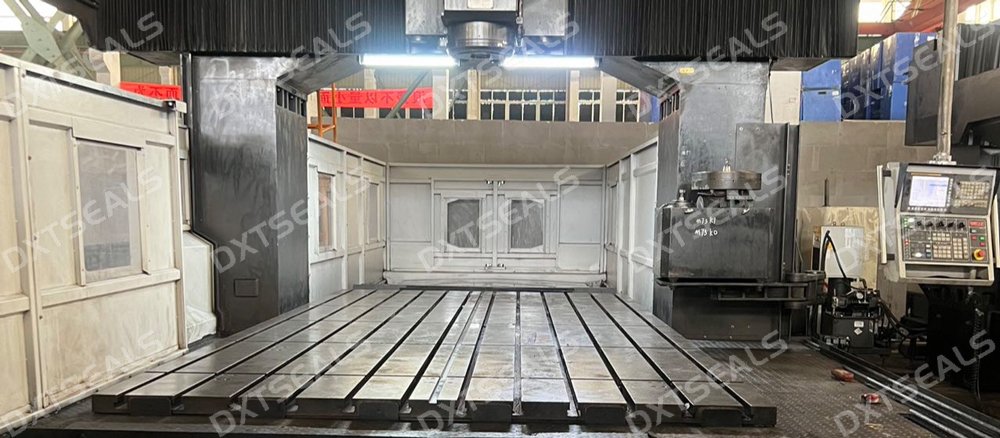
Large gantry-type CNC milling machines are commonly used when the workpiece requires a large machining envelope and stable support over a substantial area.
Why Is Oversized CNC Machining More Difficult?
The fundamental challenge is scale.
When a component becomes larger, manufacturing problems that may be negligible on a small part can become significant.
For example, a small part may experience only minor thermal expansion during machining. On a very large component, however, even a small temperature difference can produce measurable dimensional changes.
Similarly, a small workpiece can often be supported easily from several locations. A large plate or structural component may require carefully designed workholding to prevent sagging, vibration, or deformation.
Large-scale machining therefore requires the manufacturer to consider the entire process as a system.
1. Machine Size and Working Envelope
The first challenge is ensuring that the CNC machine can physically accommodate the component.
Important machine specifications include:
-
Maximum X-axis travel
-
Maximum Y-axis travel
-
Z-axis clearance
-
Table dimensions
-
Maximum workpiece weight
-
Spindle capacity
-
Gantry clearance
-
Fixture and workholding space
The workpiece should not simply fit within the nominal machine travel. There must also be enough space for tooling, fixtures, clamps, inspection references, and safe tool movement.
For oversized components, a large gantry CNC milling machine can provide the working envelope required for machining large surfaces and complex features.
2. Workpiece Weight and Workholding
Large custom components can weigh hundreds or thousands of kilograms depending on the material and dimensions.
Supporting such a workpiece is a major engineering consideration.
The workholding system must provide sufficient stability without introducing excessive deformation.
Potential problems include:
-
Workpiece sagging
-
Uneven support
-
Clamping deformation
-
Vibration
-
Part movement
-
Difficulty accessing machining areas
For large plates and relatively thin components, support locations are particularly important.
If the workpiece is clamped too aggressively, the part may deform during machining and then change shape after it is released.
For this reason, workholding should be designed around the actual stiffness and geometry of the component rather than simply maximizing clamping force.
3. Maintaining Dimensional Accuracy Over Large Distances
Achieving precision over a large machining envelope is significantly more demanding than maintaining the same tolerance over a small component.
Machine geometry, thermal expansion, axis alignment, tool deflection, workpiece deformation, and measurement uncertainty can all contribute to dimensional variation.
For oversized components, manufacturers may need to control:
-
Flatness
-
Parallelism
-
Perpendicularity
-
Straightness
-
Position tolerances
-
Hole location
-
Surface profile
-
Overall dimensions
A component can have individually accurate features while still failing to meet overall geometric requirements if the relationship between those features is not properly controlled.
4. Thermal Expansion and Temperature Control
Temperature is one of the most important considerations in large-scale precision machining.
Metal materials expand and contract with temperature changes. The larger the component, the more significant the dimensional effect can become.
Temperature variations may come from:
-
Machine operation
-
Spindle heat
-
Cutting processes
-
Coolant temperature
-
Workshop temperature changes
-
Direct sunlight or localized heating
-
Different temperatures between the workpiece and machine
For example, machining a large steel component in a changing workshop environment can create dimensional differences between machining and inspection.
Stable shop-floor temperature, thermal machine control, appropriate coolant management, and consistent inspection conditions can help reduce these effects.
5. Cutting Forces and Workpiece Deformation
Large components are not necessarily rigid components.
A large plate may have substantial overall dimensions while remaining relatively thin. Large housings may also contain large unsupported areas.
During machining, cutting forces can cause the workpiece to move or deform.
This is particularly important when:
-
Machining thin plates
-
Removing large amounts of material
-
Creating deep pockets
-
Machining large cavities
-
Finishing thin walls
-
Producing large flat surfaces
Material removal can also release internal stresses within the workpiece.
As a result, a component that appears stable before machining may gradually deform as material is removed.
6. Material Removal and Internal Stress
Large raw materials often contain residual or internal stresses generated during casting, forging, rolling, heat treatment, or other material processes.
When significant amounts of material are removed, the stress balance inside the workpiece can change.
This may result in:
-
Warping
-
Bowing
-
Twisting
-
Dimensional movement
-
Loss of flatness
For critical oversized components, the machining process may therefore need to be divided into roughing, stabilization or stress-relief stages where appropriate, semi-finishing, and final finishing.
The exact process depends on the material, starting condition, geometry, and tolerance requirements.
7. Tool Deflection and Long Tool Reach
Large components frequently contain deep cavities, recessed features, or difficult-to-access surfaces.
These features may require long cutting tools.
However, increasing tool length can increase tool deflection and vibration.
Potential consequences include:
-
Poor surface finish
-
Dimensional errors
-
Chatter
-
Reduced tool life
-
Inconsistent cutting performance
Tool selection should therefore balance reach and rigidity.
Whenever possible, the machining strategy should use the shortest practical tool extension while maintaining adequate clearance.
8. Large-Scale Surface Flatness
Large flat surfaces present a particular machining challenge.
A small local area may meet a flatness requirement while the complete surface contains gradual variation across the entire component.
Large-scale flatness can be affected by:
-
Machine geometry
-
Thermal changes
-
Workpiece deformation
-
Cutting strategy
-
Tool wear
-
Clamping conditions
-
Internal material stress
Manufacturers may use multiple finishing passes and carefully controlled toolpaths to improve large surface consistency.
Inspection equipment and measurement methodology are equally important because the result depends on how the flatness is measured.
9. Machining Large Holes and Complex Features
Oversized components often contain large holes, mounting patterns, pockets, slots, or other precision features.
Maintaining the correct position of these features over a large component can be challenging.
For example, a large structural plate may contain multiple mounting holes distributed over a substantial area. Even a small positional deviation can become significant when the component is assembled with other large components.
CNC programming, datum selection, machine positioning, probing, and inspection must therefore be coordinated carefully.
10. CNC Programming for Oversized Components
Programming a large CNC component requires more than simply generating a toolpath.
The programmer must consider:
-
Machine travel
-
Tool reach
-
Fixture interference
-
Workholding
-
Tool changes
-
Cutting direction
-
Material removal sequence
-
Thermal effects
-
Tool deflection
-
Surface finishing strategy
For very large components, machining may also involve multiple machining zones or carefully planned datum systems.
Simulation can help identify potential collisions and verify tool movement before machining begins.
Large Gantry CNC Milling for Oversized Parts
Gantry-type CNC milling machines are particularly suitable for large custom components because they can provide a large machining envelope while maintaining a rigid machine structure.
Depending on the machine configuration, large gantry milling equipment may be used for:
-
Large plates
-
Machine bases
-
Structural components
-
Large housings
-
Oversized covers
-
Industrial equipment components
-
Large molds
-
Custom PTFE components
-
Large graphite components
-
Heavy mechanical parts
The machine's actual travel, table size, spindle specifications, load capacity, and precision characteristics should always be evaluated against the specific component requirements.
Large-Scale CNC Machining of PTFE and Engineering Plastics
Oversized CNC machining is not limited to metals.
Large engineering plastic components can also require specialized CNC equipment.
PTFE is an important example because it is widely used for industrial sealing and chemical-resistant components.
Large PTFE custom components may include:
-
PTFE plates
-
PTFE covers
-
PTFE grid plates
-
Large sealing plates
-
Custom PTFE rings
-
Chemical-resistant components
-
Insulating components
Machining large PTFE components presents additional challenges because PTFE has a relatively high coefficient of thermal expansion and can deform under mechanical or thermal loads.
Therefore, large PTFE parts require careful attention to clamping, machining temperature, material condition, dimensional compensation, and inspection.
A large-format gantry milling machine can be particularly useful when the required PTFE component exceeds the working area of conventional CNC equipment.
Large-Scale CNC Machining of Graphite
Graphite and carbon graphite are also used in specialized industrial components, including sealing and high-temperature applications.
Large graphite components require appropriate tooling and machining methods because graphite can be brittle and generate fine machining dust.
Important considerations include:
-
Tool selection
-
Cutting parameters
-
Dust extraction
-
Workholding
-
Edge protection
-
Dimensional control
-
Surface requirements
Large graphite parts may also require careful handling after machining because thin sections and sharp edges can be susceptible to damage.
Inspection of Oversized Custom Components
Inspection is one of the biggest challenges in large-scale CNC manufacturing.
A small component can often be measured easily with conventional dimensional inspection equipment. Oversized components may exceed the physical measuring range of standard equipment.
Depending on the component, manufacturers may use:
-
Large-format CMM systems
-
Portable CMM equipment
-
Laser measurement systems
-
Precision height gauges
-
Digital measurement tools
-
CNC probing
-
Custom inspection fixtures
Inspection should be based on the drawing requirements and the functional importance of each feature.
For critical large components, measurement strategy should be planned before machining begins.
Large CNC Machining vs. Conventional CNC Machining
| Factor | Conventional CNC Machining | Large-Scale CNC Machining |
|---|---|---|
| Workpiece size | Small to medium | Large to oversized |
| Machine type | Standard CNC mill/lathe | Large gantry or heavy-duty CNC equipment |
| Workpiece weight | Usually easier to handle | May require specialized handling |
| Workholding | Relatively simple | More complex |
| Thermal effects | Usually easier to control | More significant |
| Material deformation | Often manageable | Can become a major concern |
| Inspection | Standard equipment often sufficient | May require large-scale measurement |
| Tool reach | Usually shorter | Long-reach tools may be required |
| Programming | Standard toolpaths | More complex process planning |
| Production challenges | Moderate | Higher process complexity |
How to Improve the Manufacturing Process
Successful large-scale CNC machining depends on controlling the entire manufacturing process rather than focusing only on the final cutting operation.
Start with the Part Drawing
Before production, the manufacturer should review:
-
Overall dimensions
-
Critical tolerances
-
Datum references
-
Material specification
-
Surface finish
-
Hole locations
-
Flatness requirements
-
Parallelism and perpendicularity
-
Inspection requirements
Plan the Machining Sequence
The machining sequence should minimize deformation and maintain suitable reference surfaces throughout production.
A typical process may include:
-
Material preparation
-
Initial setup and alignment
-
Rough machining
-
Stress management or stabilization where appropriate
-
Semi-finishing
-
Final finishing
-
Dimensional inspection
The exact sequence depends on the material and component design.
Select the Right Machine
The largest available machine is not automatically the best machine.
The equipment should provide adequate:
-
Working envelope
-
Load capacity
-
Spindle power
-
Axis travel
-
Machine rigidity
-
Positioning performance
-
Tooling capability
Consider Inspection During Process Planning
Inspection points should be integrated into the manufacturing plan.
For large components, it may be more efficient to verify critical datums and features during machining rather than discovering dimensional problems only after the entire process is completed.
Choosing a Large-Scale CNC Machining Manufacturer
When outsourcing oversized custom components, manufacturers should evaluate more than the company's advertised machine size.
Important questions include:
-
What is the maximum machining envelope?
-
What is the maximum workpiece weight?
-
What type of gantry CNC equipment is available?
-
Can the manufacturer machine large PTFE or engineering plastic components?
-
How are large workpieces supported and clamped?
-
How is thermal stability controlled?
-
What inspection equipment is available?
-
Can large parts be measured over their full dimensions?
-
Does the manufacturer have experience with custom oversized components?
-
Can the manufacturer handle prototypes as well as production orders?
A manufacturer with experience in large-scale CNC machining should be able to evaluate the complete process, including material preparation, workholding, machining sequence, finishing, and inspection.
Conclusion
Large-scale CNC machining is a specialized manufacturing process that combines conventional CNC technology with additional challenges related to size, weight, thermal behavior, workholding, deformation, tooling, programming, and inspection.
Producing oversized custom components requires more than a large machine. The manufacturer must control the relationship between the machine, workpiece, tooling, fixtures, material condition, machining sequence, and measurement system.
Large gantry CNC milling equipment can provide the working envelope required for oversized components, including large metal parts, custom PTFE plates and covers, graphite components, industrial machinery parts, and other large-format precision components.
For demanding custom projects, selecting a manufacturer with suitable large-scale CNC equipment, machining experience, workholding capability, and inspection resources is essential for achieving reliable dimensional and geometric results.