
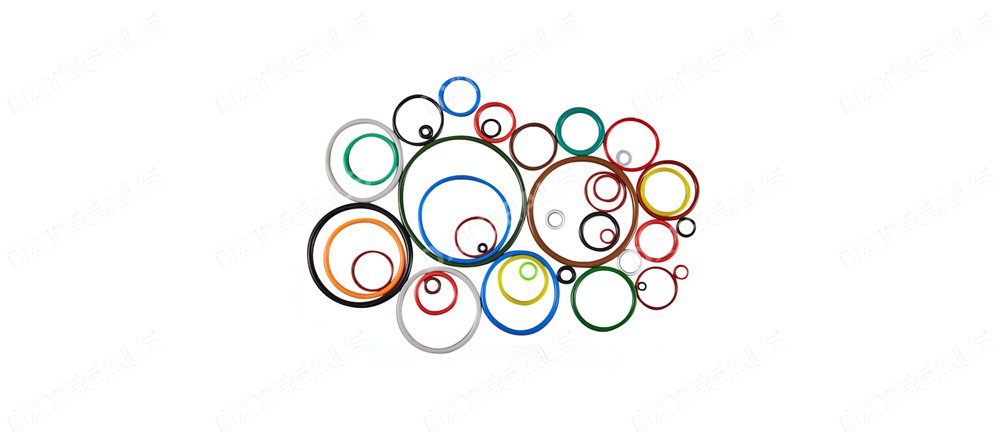
O-rings are among the most widely used sealing components in industrial equipment. Their simple circular design, compact size, relatively low manufacturing cost, and broad material availability make them suitable for countless sealing applications.
O-rings can be used for static and dynamic sealing in hydraulic systems, pneumatic equipment, pumps, valves, automotive components, industrial machinery, chemical equipment, and many other applications.
However, an O-ring is not simply a universal seal that can be used with any medium or under any operating condition. The sealing performance depends heavily on the selected elastomer or sealing material.
Common O-ring materials include NBR, FKM, EPDM, silicone, and PTFE. Each material has different characteristics in terms of temperature resistance, chemical compatibility, flexibility, wear resistance, compression set, and application range.
This article explains why O-rings are so versatile, how to select the appropriate material, and how common O-ring materials compare in industrial applications.
What Is an O-Ring Seal?
An O-ring is a circular sealing ring with a round cross-section. It is normally installed in a specially designed groove and compressed between two mating surfaces.
When properly compressed, the O-ring creates a sealing interface that prevents the passage of fluids or gases.
O-rings can be used in:
- Static sealing
- Reciprocating sealing
- Rotary sealing
- Hydraulic systems
- Pneumatic systems
- Valve sealing
- Pump sealing
- Cylinder sealing
- Pipe and fitting connections
The basic geometry is simple, but the final sealing performance depends on many factors, including groove design, compression, material hardness, temperature, pressure, surface finish, and operating medium.
Why Are O-Rings So Versatile?
The popularity of O-rings comes from several practical advantages.
Simple and Compact Design
O-rings have a relatively simple geometry and require little installation space compared with many more complicated sealing designs.
This makes them suitable for compact hydraulic valves, cylinders, pumps, fittings, and mechanical assemblies.
Wide Range of Materials
O-rings can be manufactured from many different elastomers and specialized materials.
Common choices include:
- NBR
- FKM
- EPDM
- Silicone
- HNBR
- FFKM
- PTFE and PTFE-based sealing materials
The wide range of materials allows O-rings to be adapted to different temperatures, chemicals, pressures, and environments.
Static and Dynamic Applications
O-rings are commonly used for static sealing, but specially designed O-ring applications can also involve reciprocating or rotary movement.
Dynamic applications require additional attention to:
- Friction
- Wear
- Lubrication
- Surface finish
- Groove design
- Clearance
- Pressure
- Operating speed
Standardized Sizes
Many O-rings are available in standardized dimensions, which simplifies replacement and maintenance.
At the same time, non-standard O-rings can be manufactured according to customer drawings, samples, or specific dimensional requirements.
Common O-Ring Applications
O-rings are used across a wide range of industries.
Hydraulic Systems
Hydraulic cylinders, valves, pumps, manifolds, and fittings frequently use O-rings for sealing hydraulic fluids.
NBR is commonly used in many general hydraulic applications, while FKM or other materials may be selected when higher temperature or specific fluid compatibility is required.
Pneumatic Systems
O-rings are used in pneumatic cylinders, valves, actuators, fittings, and air-handling equipment.
Low friction, elasticity, and resistance to the operating medium are important factors for pneumatic applications.
Pumps and Valves
O-rings can be used as static seals in pump housings, valve bodies, covers, connectors, and other components.
Material selection should consider the pumped or controlled medium, temperature, pressure, and possible chemical exposure.
Automotive and Transportation Equipment
O-rings are widely used in automotive fluid systems, fuel-related components, cooling systems, air-conditioning systems, and other equipment.
Different materials are selected depending on exposure to fuels, oils, refrigerants, coolants, and temperature fluctuations.
Chemical Processing Equipment
Chemical applications often require materials with strong chemical resistance.
FKM, EPDM, PTFE-based solutions, or specialty elastomers may be considered depending on the chemical, concentration, temperature, and pressure.
General Industrial Machinery
O-rings are also used in compressors, gearboxes, industrial machinery, instrumentation, fittings, and other mechanical equipment.
Their compact design makes them particularly useful when space is limited.
O-Ring Material Selection
Selecting the correct O-ring material is one of the most important steps in designing a reliable sealing system.
The main factors include:
- Operating temperature
- Process medium
- Operating pressure
- Static or dynamic application
- Chemical compatibility
- Required flexibility
- Compression set resistance
- Wear resistance
- Environmental exposure
- Installation conditions
The following materials are among the most commonly used options.
NBR O-Rings
NBR, or nitrile butadiene rubber, is one of the most widely used O-ring materials.
It offers a useful combination of mechanical strength, elasticity, wear resistance, and compatibility with many petroleum-based oils and hydraulic fluids.
Advantages of NBR
- Good resistance to petroleum-based oils
- Good abrasion resistance
- Good mechanical strength
- Good flexibility
- Cost-effective for many general applications
- Widely available in standard O-ring sizes
Typical NBR Applications
NBR O-rings are commonly used in:
- Hydraulic equipment
- Pneumatic equipment
- Oil systems
- Pumps
- Valves
- Automotive equipment
- Industrial machinery
NBR is often considered a practical general-purpose O-ring material when the operating conditions are compatible.
FKM O-Rings
FKM is a family of fluoroelastomers known for good high-temperature performance and resistance to many oils, fuels, and chemicals.
FKM O-rings are often considered when operating conditions exceed the capabilities of conventional general-purpose elastomers.
Advantages of FKM
- Good high-temperature performance
- Good resistance to many oils and fuels
- Good chemical resistance
- Good resistance to aging
- Good resistance to ozone and weathering
Typical FKM Applications
FKM O-rings are commonly used in:
- Automotive systems
- Fuel systems
- Oil systems
- Chemical equipment
- High-temperature industrial equipment
- Pumps and valves
- Aerospace and demanding industrial applications
FKM is not automatically suitable for every chemical or low-temperature application, so compatibility should always be verified for the actual operating conditions.
EPDM O-Rings
EPDM is an elastomer known for excellent resistance to water, weathering, ozone, and many environmental conditions.
Advantages of EPDM
- Excellent water resistance
- Excellent ozone resistance
- Excellent weather resistance
- Good aging resistance
- Good flexibility
- Suitable for many water and steam-related applications
Typical EPDM Applications
EPDM O-rings are commonly used in:
- Water systems
- HVAC equipment
- Cooling systems
- Water treatment equipment
- Outdoor equipment
- Brake-fluid applications using compatible fluids
- General industrial water systems
EPDM is generally not preferred for petroleum-based oils and fuels.
Silicone O-Rings
Silicone rubber offers excellent flexibility over a broad temperature range and is frequently used where temperature flexibility and environmental resistance are important.
Advantages of Silicone
- Wide temperature capability
- Excellent flexibility
- Good weather resistance
- Good ozone resistance
- Good resistance to aging
- Available in different grades for specialized applications
Silicone O-rings are commonly found in:
- Electrical equipment
- Food-related equipment using appropriate grades
- Medical and laboratory equipment
- Temperature-sensitive applications
- General industrial equipment
Silicone generally has lower mechanical strength and wear resistance than some other elastomers, so it should be carefully evaluated for demanding dynamic applications.
PTFE O-Rings and PTFE Sealing Rings
PTFE has exceptional chemical resistance and very low friction. However, PTFE behaves differently from conventional elastomeric O-ring materials.
PTFE is much less elastic than rubber, so PTFE O-rings or sealing rings require appropriate groove and installation design.
Advantages of PTFE
- Excellent chemical resistance
- Very low friction
- Excellent corrosion resistance
- Very low moisture absorption
- Wide temperature capability
- Good non-stick characteristics
PTFE sealing rings are commonly considered for:
- Chemical processing
- Aggressive chemical media
- High-purity applications
- Valves
- Pumps
- Specialized industrial equipment
For applications requiring elastic recovery, a conventional elastomer O-ring may be more suitable than a solid PTFE ring.
O-Ring Material Comparison
The following table provides a general comparison of common O-ring materials.
| Property | NBR | FKM | EPDM | Silicone | PTFE |
|---|---|---|---|---|---|
| Oil resistance | Excellent | Excellent | Poor | Limited | Excellent |
| Water resistance | Good | Good | Excellent | Good | Excellent |
| Chemical resistance | Good | Very good | Good | Good | Excellent |
| High-temperature performance | Good | Excellent | Good | Excellent | Excellent |
| Low-temperature flexibility | Good | Moderate | Good | Excellent | Material/design dependent |
| Ozone/weather resistance | Good | Excellent | Excellent | Excellent | Excellent |
| Abrasion resistance | Good | Good | Good | Moderate | Good |
| Elasticity | Good | Good | Excellent | Excellent | Low |
| Dynamic sealing | Good | Good | Good | Moderate | Application dependent |
| Typical use | Oil/hydraulic | Oil/fuel/high temp | Water/weather | Temperature/flexibility | Chemical/high-performance |
This table is a general material comparison. Actual performance depends on the specific compound, hardness, temperature, medium, pressure, and equipment design.
NBR vs FKM O-Rings
NBR and FKM are frequently compared because both are widely used in oil and industrial sealing applications.
NBR
NBR is often selected for general hydraulic, pneumatic, oil, and mechanical applications where cost-effectiveness and good mechanical performance are important.
FKM
FKM is often considered when higher temperature resistance, improved aging resistance, or broader resistance to oils and fuels is required.
However, FKM is not necessarily the better choice for every application. NBR may be sufficient where the operating conditions are moderate and compatible with NBR.
The correct choice depends on the actual operating environment.
EPDM vs NBR O-Rings
The choice between EPDM and NBR often depends heavily on the process medium.
EPDM is commonly suitable for water, outdoor exposure, ozone, and many water-based applications.
NBR is generally more suitable for petroleum-based oils and many hydraulic fluids.
Therefore, the same equipment may require completely different O-ring materials depending on the fluid being sealed.
FKM vs EPDM O-Rings
FKM and EPDM have different strengths.
FKM is commonly selected for applications involving oils, fuels, elevated temperatures, and demanding industrial environments.
EPDM is particularly useful for water, weather, ozone, and many water-based systems.
Neither material should be selected based solely on temperature. Chemical compatibility and the specific process medium are equally important.
O-Ring Hardness Selection
O-ring hardness is another important design factor.
Common elastomer hardness ranges are often specified using the Shore A scale.
A softer O-ring can provide good conformity to surface irregularities and may require lower installation force. A harder O-ring can provide improved resistance to extrusion under certain pressure conditions.
The appropriate hardness depends on:
- Operating pressure
- Groove design
- Clearance gap
- Static or dynamic sealing
- Temperature
- Installation method
- Material properties
Hardness should therefore be selected together with the material and sealing design.
Static vs Dynamic O-Ring Applications
Static O-Ring Sealing
In static applications, the mating components do not move relative to each other.
Examples include:
- Flange connections
- Valve covers
- Hydraulic manifolds
- Pipe fittings
- Housing seals
Static applications are generally less demanding in terms of friction and wear.
Dynamic O-Ring Sealing
Dynamic applications involve relative movement.
Examples include:
- Hydraulic cylinders
- Pneumatic cylinders
- Rotary shafts
- Moving valves
- Actuators
Dynamic O-ring applications require careful consideration of friction, wear, lubrication, surface finish, pressure, and extrusion clearance.
For demanding dynamic applications, specialized seal profiles may provide better performance than a conventional O-ring.
O-Ring Temperature and Pressure Considerations
Temperature and pressure directly affect O-ring performance.
High temperature can cause:
- Material softening
- Hardening
- Compression set
- Accelerated aging
- Chemical degradation
Low temperature can reduce elastomer flexibility and sealing effectiveness.
High pressure can cause:
- Extrusion
- Deformation
- Seal damage
For high-pressure applications, appropriate hardness, groove design, extrusion gaps, and backup rings may be required.
The maximum allowable temperature and pressure should always be determined from the specific material grade and application design rather than from a general material name.
O-Ring Groove and Installation
Even a high-quality O-ring may fail if the groove or installation method is incorrect.
Important design factors include:
- Groove dimensions
- Compression
- Stretch
- Clearance
- Surface finish
- Chamfer design
- Installation lubrication
- Assembly method
During installation, the O-ring should not be twisted, cut, stretched excessively, or damaged by sharp edges.
For dynamic applications, the shaft or bore surface condition is especially important.
Custom O-Ring Manufacturing
Although standard O-ring sizes cover many applications, industrial equipment sometimes requires non-standard dimensions or specialized materials.
Custom O-rings can be manufactured according to:
- Engineering drawings
- Samples
- Customer specifications
- Non-standard dimensions
- Special material requirements
- OEM requirements
- Existing equipment dimensions
Custom manufacturing may involve selecting the appropriate compound, hardness, cross-section, and dimensional tolerances for the specific sealing application.
Common O-Ring Selection Mistakes
Choosing the Material Without Checking the Fluid
A material may perform well in one application but fail quickly in another because of chemical incompatibility.
Selecting Only by Temperature
Temperature resistance alone does not determine suitability. Pressure, fluid compatibility, movement, and installation conditions must also be considered.
Using the Same O-Ring Material Everywhere
Different equipment may require different materials. NBR, FKM, EPDM, silicone, and PTFE each have specific advantages and limitations.
Ignoring Dynamic Conditions
An O-ring suitable for static sealing may not provide the desired service life in a high-speed dynamic application.
Ignoring Groove Design
Incorrect compression, excessive clearance, or improper groove dimensions can cause leakage even when the O-ring material is appropriate.
Standard and Custom O-Ring Solutions
O-rings remain one of the most versatile sealing components because they combine simple geometry with a wide range of available materials and sizes.
Standard O-rings can meet common industrial requirements, while custom O-rings can be produced for non-standard equipment, OEM replacement applications, and specialized operating conditions.
A complete O-ring solution should consider material, hardness, dimensions, temperature, pressure, medium, movement, groove design, and installation conditions together.
Conclusion
O-ring seals are widely used because of their compact design, simple installation, broad material selection, and suitability for many static and dynamic sealing applications.
NBR O-rings are commonly used for oils, hydraulic fluids, and general industrial applications. FKM O-rings are often selected for higher-temperature, oil, fuel, and demanding industrial environments. EPDM O-rings are well suited to water, weather, and ozone exposure. Silicone O-rings provide excellent flexibility and broad temperature performance, while PTFE sealing rings offer exceptional chemical resistance and low friction.
There is no single O-ring material suitable for every application. Proper selection requires consideration of the process medium, temperature, pressure, movement, material compatibility, hardness, groove design, and installation conditions.
Manufacturers offering both standard and custom O-ring solutions can provide sealing products tailored to different industrial equipment and operating requirements.