
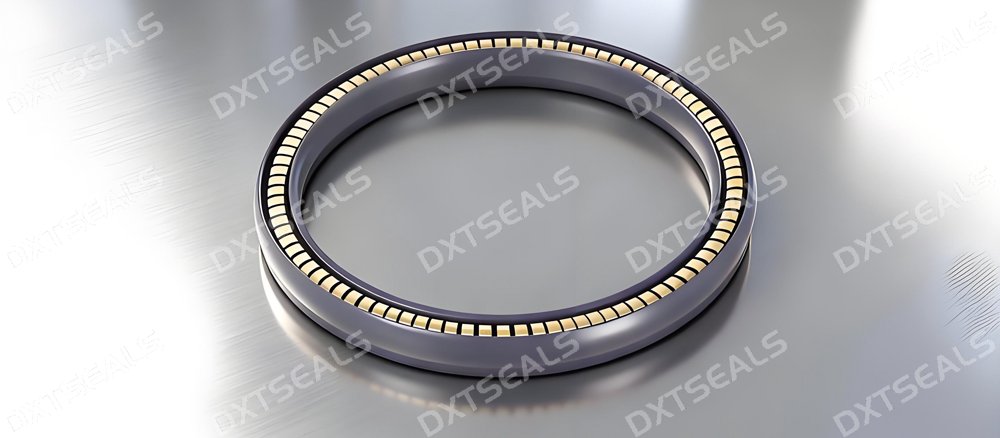
Spring Seals are one of the most widely used dynamic seals in hydraulic and pneumatic equipment. Their performance heavily depends on the type of PTFE material chosen for the sealing ring. While all PTFE types share advantages such as low friction, broad chemical resistance, and excellent temperature stability, their mechanical and wear properties vary significantly.
This article compares virgin PTFE, modified PTFE, and filled PTFE, helping engineers and buyers choose the right material for specific working conditions.
(Custom PTFE seals available from DXTSEALS.)
1️⃣ Why PTFE Is the Preferred Material for Spring Seals
PTFE offers a combination of characteristics ideal for dynamic sealing:
-
Extremely low friction coefficient
-
Excellent chemical inertness
-
Wide temperature range (-60°C to +260°C)
-
No stick-slip effect
-
Low water absorption
-
Good compatibility with most hydraulic fluids
However, PTFE’s performance can be tailored by modifying or filling it with various additives—this is why several PTFE grades exist.
2️⃣ Overview of Common PTFE Materials for Spring Seals
Spring Seals typically use three major categories of PTFE materials:
-
Virgin PTFE (Pure PTFE)
-
Modified PTFE (Reprocessed molecular structure)
-
Filled PTFE (Reinforced with additives such as bronze, carbon, glass fiber, etc.)
Each type has distinct strengths and weaknesses.
3️⃣ Virgin PTFE (Pure PTFE)
Key Features
-
Highest chemical resistance
-
Very low friction
-
Non-contaminating and highly clean
-
Most stable temperature resistance
-
Soft and prone to creep under pressure
-
Lowest wear resistance among PTFE types
Recommended Applications
-
Chemical processing machines
-
Semiconductor or food-grade equipment
-
Low-pressure pneumatic cylinders
-
Systems requiring ultra-clean materials
Avoid For
-
High-pressure hydraulic cylinders
-
High-load reciprocating motion
Virgin PTFE is ideal when chemical resistance is critical but mechanical load is low.
4️⃣ Modified PTFE (PTFE with Modified Molecular Structure)
Modified PTFE is engineered to enhance certain characteristics without adding external fillers.
Key Features
-
Better creep resistance than virgin PTFE
-
Lower porosity, more uniform structure
-
Improved resistance to cold flow
-
Smoother surface and lower friction
-
Slightly improved wear resistance
-
Maintains high chemical resistance
Recommended Applications
-
Medium-pressure hydraulic and pneumatic cylinders
-
High-speed motion requiring ultra-low friction
-
Precision sealing components
-
Valves and actuators
Advantages Over Virgin PTFE
-
Better durability
-
Better sealability under moderate pressure
-
Reduced leakage risk
Modified PTFE is a great middle-ground option when both chemical resistance and mechanical stability are important.
5️⃣ Filled PTFE (PTFE + Reinforcing Additives)
Filled PTFE contains materials added to enhance strength, wear resistance, or thermal stability. Common fillers include:
-
Bronze (40%) → High load capacity
-
Carbon (10–35%) → Excellent dry-running performance
-
Glass Fiber (15–25%) → High pressure resistance
-
Graphite → Low friction at high speed
Key Features
-
Greatly improved wear resistance
-
Higher compressive strength
-
Reduced creep deformation
-
Better stability for heavy-duty operations
-
Moderate friction (varies by filler)
-
Reduced chemical resistance compared to pure/modified PTFE
Recommended Applications
-
Heavy-duty hydraulic cylinders
-
Construction and mining machinery
-
Injection molding machines
-
High-pressure linear actuators
-
High-temperature or high-speed sealing
Most Popular Grade
-
Bronze-Filled PTFE (40% Bronze)
Extremely strong and durable, ideal for demanding hydraulic systems.
Filled PTFE is the best choice when performance and durability are more important than chemical purity.
6️⃣ Comparison Table: Virgin vs. Modified vs. Filled PTFE
| Performance Indicator | Virgin PTFE | Modified PTFE | Filled PTFE |
|---|---|---|---|
| Wear Resistance | ★★ | ★★★ | ★★★★★ |
| Creep Resistance | ★★ | ★★★★ | ★★★★★ |
| Chemical Resistance | ★★★★★ | ★★★★★ | ★★★ |
| Pressure Suitability | Low | Medium | High |
| Friction Coefficient | ★★★★★ | ★★★★★ | ★★★★ |
| Temperature Resistance | ★★★★★ | ★★★★★ | ★★★★ |
| Best For | Chemical, clean industries | Medium load, high speed | Heavy-duty hydraulics |
7️⃣ How to Choose the Right PTFE for Your Glyd Ring
✔ Low pressure, chemical environment → Virgin PTFE
Best purity and chemical inertness.
✔ Medium pressure, precision control → Modified PTFE
Better stability, lower deformation, superior sealing.
✔ High pressure, heavy load → Filled PTFE
Especially bronze-filled or carbon-filled PTFE.
✔ High-speed or low lubrication → Carbon-filled or graphite-filled PTFE
✔ Water-based fluids → Glass fiber-filled PTFE
8️⃣ Why Choose DXTSEALS for PTFE Spring Seals
DXTSEALS provides:
-
High-quality virgin, modified, and filled PTFE materials
-
Custom dimensions for Spring Seals, piston rings, and wear rings
-
Excellent machining precision
-
Material certification, hardness reports, and batch traceability
-
Engineering guidance for material selection
Whether for hydraulic, pneumatic, chemical, or high-speed applications, DXTSEALS delivers reliable and long-lasting sealing solutions.
✅ Conclusion
Choosing the right PTFE material is essential for achieving optimal performance in Spring Seals.
-
Virgin PTFE offers unmatched chemical resistance,
-
Modified PTFE provides a balance of stability and friction,
-
Filled PTFE delivers superior strength and wear resistance for heavy-duty systems.
Understanding your system’s pressure, speed, temperature, and fluid type will ensure you select the ideal material and achieve maximum seal life.
If you need a shortened product description, Alibaba listing version, or PDF brochure, I can create it as well—just let me know!