
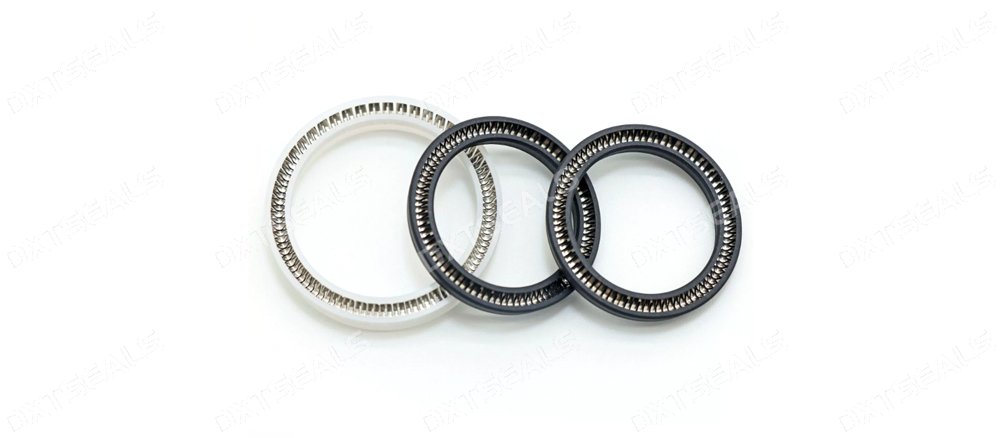
PTFE-based sealing products are widely used in hydraulic systems, pneumatic equipment, chemical processing machinery, pumps, valves, and other industrial applications. Among the most common designs are PTFE spring energized seals, Glyd rings, and Step Seals.
All three can use PTFE or other engineered polymers as the primary sealing material, but their structures and sealing mechanisms are different. Spring energized seals use a metal spring to maintain sealing force, while Glyd rings and Step Seals typically use an elastomer energizer.
Understanding these differences is important when selecting a seal for pressure, temperature, chemical exposure, reciprocating movement, or other demanding operating conditions.
What Is a PTFE Spring Energized Seal?
A PTFE spring energized seal consists of a polymer sealing jacket and a spring energizer.
The sealing jacket is commonly made from PTFE or a PTFE-based compound, while the spring is usually manufactured from a corrosion-resistant metal.
The spring continuously pushes the sealing lip against the mating surface, helping maintain sealing contact.
A typical structure includes:
- PTFE sealing jacket
- Metal spring energizer
- Sealing lip
- Dynamic or static sealing surface
Different spring designs can be selected according to the application.
Common spring configurations include:
- Helical springs
- V-shaped springs
- C-shaped springs
- Other specialized energizers
Main Advantages of PTFE Spring Energized Seals
Low Friction
PTFE provides very low friction compared with many conventional elastomers.
This makes spring energized seals suitable for applications where low starting and running friction are important.
Excellent Chemical Resistance
PTFE is highly resistant to many chemicals, solvents, oils, and aggressive process media.
This is one of the main reasons spring energized PTFE seals are used in chemical processing and specialized industrial equipment.
Wide Temperature Capability
PTFE-based materials can operate over a broad temperature range, depending on the compound and application.
The spring material must also be selected according to the required temperature and chemical environment.
Reliable Sealing at Low Pressure
The spring provides sealing force independently of system pressure.
As a result, spring energized seals can provide effective sealing even when system pressure is low or fluctuating.
Long-Term Dynamic Performance
With the correct material, spring design, surface finish, and operating conditions, spring energized seals can provide reliable performance in demanding dynamic applications.
What Is a Glyd Ring?
A Glyd ring is generally used as a dynamic piston seal in hydraulic and pneumatic cylinders.
A typical Glyd ring consists of:
- PTFE or polymer sealing ring
- Elastomer O-ring energizer
The O-ring provides the radial force that pushes the PTFE ring against the cylinder bore.
The PTFE ring provides the primary sealing surface and sliding performance.
This design combines the elasticity of an elastomer with the low friction and chemical resistance of PTFE.
Main Advantages of Glyd Rings
Glyd rings are widely used because they provide a good balance between sealing reliability and dynamic performance.
Key advantages include:
- Low friction
- Good wear resistance
- Good chemical resistance
- Smooth reciprocating movement
- Good dimensional stability
- Suitable for hydraulic and pneumatic cylinders
They are particularly suitable for piston sealing applications where repeated reciprocating movement occurs.
What Is a Step Seal?
A Step Seal is commonly used as a dynamic rod seal in hydraulic and pneumatic cylinders.
A typical Step Seal uses:
- PTFE or polymer sealing ring
- Elastomer energizer
The polymer ring provides the main sealing function, while the elastomer energizer maintains contact with the rod.
Step Seals are designed for dynamic reciprocating applications and are commonly used in hydraulic cylinders.
Main Advantages of Step Seals
Step Seals provide several important advantages:
- Low friction
- Good wear resistance
- Good dynamic sealing
- Suitable for high-pressure applications when correctly designed
- Compact installation
- Wide material options
They are particularly useful for hydraulic rod sealing where low friction and reliable leakage control are required.
Design Comparison
The main difference between these three seal types is their energizing mechanism and typical sealing position.
| Feature | PTFE Spring Energized Seal | Glyd Ring | Step Seal |
|---|---|---|---|
| Primary Sealing Material | PTFE/Polymer | PTFE/Polymer | PTFE/Polymer |
| Energizer | Metal spring | Elastomer O-ring | Elastomer energizer |
| Typical Application | Static/Dynamic | Piston sealing | Rod sealing |
| Movement | Rotary/Reciprocating/Static | Reciprocating | Reciprocating |
| Low-Pressure Sealing | Excellent | Good | Good |
| Chemical Resistance | Excellent | Good to Excellent | Good to Excellent |
| Friction | Very Low | Low | Low |
| Wear Resistance | Material dependent | Good to Excellent | Good to Excellent |
| Temperature Capability | Very broad, material dependent | Material dependent | Material dependent |
| Typical Industry | Chemical, industrial, hydraulic | Hydraulic/Pneumatic | Hydraulic/Pneumatic |
The exact performance depends on the seal profile, PTFE compound, energizer material, hardware geometry, and operating conditions.
Sealing Mechanism Comparison
Spring Energized Seal
The spring continuously applies force to the sealing lip.
At low pressure, the spring provides the primary contact force. As system pressure increases, pressure can further improve the sealing contact.
This makes spring energized seals particularly useful for applications where reliable sealing is required across a wide pressure range.
Glyd Ring
The elastomer O-ring energizes the PTFE sealing ring.
When installed in the groove, the O-ring is compressed and applies radial force to the polymer sealing ring.
System pressure can then further improve the sealing effect.
Step Seal
The elastomer energizer maintains contact between the polymer sealing ring and the rod.
The seal is designed to provide reliable sealing during reciprocating rod movement.
Friction and Motion Performance
Friction is an important consideration for dynamic seals.
PTFE-based materials generally provide low friction, which can help reduce:
- Starting resistance
- Running friction
- Heat generation
- Energy consumption
- Wear
Spring energized seals can provide particularly low friction when the spring force and sealing geometry are properly optimized.
Glyd rings and Step Seals also provide low-friction performance and are widely used in hydraulic and pneumatic cylinders.
However, actual friction depends on more than the seal material.
Important factors include:
- Seal profile
- Surface finish
- Pressure
- Speed
- Temperature
- Lubrication
- Installation dimensions
- Material compound
Pressure Performance
Pressure capability depends on the complete sealing system rather than the material alone.
Important factors include:
- Seal geometry
- PTFE compound
- Extrusion gap
- Mating surface
- Installation groove
- Operating temperature
- Pressure cycles
Glyd rings and Step Seals are widely used in hydraulic systems, while spring energized seals can be selected for both high-pressure and specialized low-pressure applications.
For very high-pressure applications, backup rings or specially designed profiles may be required.
Temperature Performance
PTFE provides excellent temperature resistance compared with many conventional elastomers.
This gives spring energized PTFE seals an advantage in applications where temperature exceeds the practical range of common elastomer seals.
However, Glyd rings and Step Seals can also be designed for elevated-temperature applications by selecting appropriate PTFE and energizer materials.
The temperature limit of the complete sealing assembly should always be considered.
The elastomer energizer may become the limiting component in some designs.
Chemical Resistance
Chemical compatibility is another major difference.
PTFE provides excellent resistance to a wide range of aggressive chemicals.
Therefore, PTFE spring energized seals are often selected for:
- Chemical processing equipment
- Pumps
- Valves
- Laboratory equipment
- Semiconductor equipment
- Special fluid systems
Glyd rings and Step Seals can also provide good chemical resistance when appropriate PTFE and elastomer materials are selected.
The compatibility of the energizer must not be overlooked.
Material Selection
PTFE
PTFE is commonly selected because of:
- Low friction
- Chemical resistance
- Temperature resistance
- Low moisture absorption
- Non-stick properties
Filled PTFE
Different fillers can improve specific properties.
Common fillers include:
- Glass fiber
- Carbon
- Graphite
- Bronze
Depending on the formulation, filled PTFE can improve wear resistance, compressive strength, dimensional stability, or thermal conductivity.
NBR
NBR is widely used as an elastomer energizer because of its good oil resistance and elasticity.
FKM
FKM is often selected for higher-temperature applications and environments involving oils, fuels, and many chemicals.
EPDM
EPDM provides good resistance to water, steam, weathering, and many chemicals, but its compatibility with petroleum-based fluids must be carefully considered.
When Should You Choose a Spring Energized Seal?
A PTFE spring energized seal may be a suitable choice when the application requires:
- Very low friction
- Excellent chemical resistance
- Wide temperature capability
- Reliable low-pressure sealing
- Specialized dynamic sealing
- Long-term storage or intermittent operation
- Compatibility with aggressive media
It is especially useful when a conventional elastomer seal cannot provide the required combination of chemical, temperature, and friction performance.
When Are Glyd Rings a Better Choice?
Glyd rings are generally suitable for:
- Hydraulic pistons
- Pneumatic pistons
- Reciprocating cylinders
- Industrial actuators
- Mobile hydraulic equipment
They offer a practical combination of low friction, sealing reliability, and ease of installation.
When Are Step Seals a Better Choice?
Step Seals are commonly selected for:
- Hydraulic cylinder rods
- Pneumatic cylinder rods
- Reciprocating shafts
- Industrial actuators
- High-cycle dynamic applications
They provide low-friction rod sealing and can be manufactured in different materials and profiles for different operating conditions.
How to Select the Right Seal
Before selecting a PTFE seal, Glyd ring, or Step Seal, evaluate the following parameters:
Operating Pressure
Consider both normal and maximum pressure, including pressure spikes.
Temperature
Evaluate minimum, normal, and maximum operating temperatures.
Working Medium
Check compatibility with:
- Hydraulic oil
- Water
- Air
- Steam
- Fuels
- Solvents
- Chemicals
Movement
Determine whether the seal is used for:
- Static sealing
- Reciprocating movement
- Rotary movement
Speed
High-speed applications require careful consideration of friction and heat generation.
Groove Dimensions
The seal must match the actual:
- Shaft diameter
- Bore diameter
- Groove width
- Groove depth
- Installation clearance
Surface Finish
The mating surface must have an appropriate surface finish for the selected sealing profile.
Incorrect surface conditions can significantly reduce seal life.
Standard and Custom PTFE Seals
Standard PTFE spring energized seals, Glyd rings, and Step Seals are available in many commonly used dimensions.
Standard products are suitable when the equipment uses conventional grooves and dimensions.
However, custom seals may be required when the application involves:
- Non-standard dimensions
- Special pressure requirements
- Unusual temperatures
- Aggressive chemicals
- Special groove designs
- Limited installation space
Custom PTFE seals can be manufactured according to technical drawings, samples, or OEM specifications.
Conclusion
PTFE spring energized seals, Glyd rings, and Step Seals all provide low-friction polymer sealing solutions, but they are designed for different requirements.
PTFE spring energized seals use a metal spring to maintain sealing force and are particularly suitable for demanding applications involving low friction, chemical resistance, temperature variation, and low-pressure sealing.
Glyd rings generally use an elastomer O-ring energizer and are widely used for piston sealing in hydraulic and pneumatic cylinders.
Step Seals are commonly used for rod sealing and provide reliable low-friction performance during reciprocating movement.
The best choice depends on the complete operating environment, including pressure, temperature, fluid, speed, movement, groove geometry, surface finish, and material compatibility.
For standard applications, standard-size seals offer a cost-effective solution. For specialized equipment, manufacturers with PTFE machining and sealing expertise can provide custom spring energized seals, Glyd rings, Step Seals, and other non-standard PTFE sealing components according to specific drawings and application requirements.