
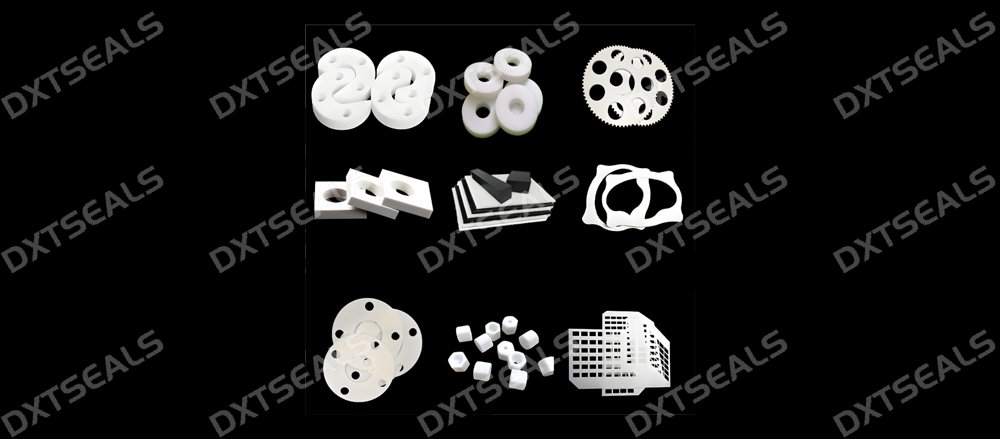
PTFE is one of the most widely used high-performance engineering plastics because of its excellent chemical resistance, low friction, non-stick properties, electrical insulation, and broad temperature resistance. These characteristics make PTFE suitable for many demanding industrial applications.
However, manufacturing ultra-large PTFE custom parts is significantly more challenging than producing conventional small or medium-sized components. As the component size increases, dimensional stability, flatness, thermal expansion, machining stress, workholding, and inspection become increasingly important.
For large PTFE plates, covers, liners, grid structures, and other oversized components, advanced CNC machining equipment and experienced manufacturing processes are essential to achieve reliable results.
What Are Ultra-Large PTFE Custom Parts?
Ultra-large PTFE custom parts are oversized components manufactured from PTFE according to specific technical requirements rather than standard catalog dimensions.
Typical products include:
- Large PTFE plates
- Ultra-large PTFE covers
- PTFE grid plates
- Large PTFE liners
- PTFE support plates
- Large PTFE insulation components
- PTFE structural parts
- Custom PTFE equipment components
These parts can be manufactured according to customer drawings, CAD models, samples, or OEM specifications.
Why Is Ultra-Large PTFE Machining Difficult?
PTFE has unique physical properties that make machining large components more complicated than machining metals or more rigid engineering plastics.
High Thermal Expansion
PTFE has a relatively high coefficient of thermal expansion. Temperature changes during machining can therefore affect dimensions.
For an ultra-large component, even a small percentage of dimensional change can result in a noticeable difference in actual size.
Therefore, temperature management and dimensional compensation are important during large-scale PTFE machining.
Low Rigidity
PTFE is relatively soft and flexible.
Large and thin PTFE components may deform under:
- Cutting forces
- Clamping forces
- Their own weight
- Temperature changes
- Internal material stress
The larger the component, the more important it becomes to control these factors.
Internal Stress and Deformation
PTFE components may contain internal stresses resulting from material production and previous processing.
During machining, material removal can release these stresses and cause:
- Warping
- Bending
- Dimensional changes
- Loss of flatness
A carefully controlled machining sequence can reduce these risks.
Large-Format CNC Machining
Ultra-large PTFE components require equipment with a sufficiently large working envelope.
Large CNC milling machines and large gantry milling equipment can provide the necessary machining space for oversized PTFE components.
This allows manufacturers to machine large parts as a complete component rather than dividing them into several smaller pieces.
Potential benefits include:
- Better dimensional consistency
- Reduced assembly errors
- Improved hole-position accuracy
- More consistent surface finish
- Reduced need for secondary joining
For extremely large components, the available machine size can be a critical factor when selecting a manufacturing supplier.
Precision Requirements for Ultra-Large PTFE Parts
Precision requirements depend on the component's function.
Important specifications may include:
- Overall length and width
- Thickness
- Flatness
- Parallelism
- Hole diameter
- Hole positioning
- Groove dimensions
- Surface finish
- Profile tolerances
Not every dimension requires the same tolerance. Critical functional dimensions should be clearly identified on the technical drawing so that the machining process can be optimized accordingly.
Flatness Control
Flatness is one of the most important considerations for large PTFE plates and covers.
An oversized PTFE plate can develop deformation during machining or after it is removed from the machine.
Factors affecting flatness include:
- Material thickness
- Workpiece size
- Clamping method
- Cutting forces
- Machining temperature
- Internal stress
- Material grade
Manufacturers may use staged machining and controlled finishing processes to improve flatness and dimensional stability.
Workholding for Large PTFE Components
Workholding is particularly important for ultra-large PTFE parts.
Excessive clamping force can deform the material, while insufficient support can result in vibration or movement during machining.
An appropriate fixture should provide:
- Stable support
- Even load distribution
- Controlled clamping force
- Sufficient accessibility for cutting tools
- Minimal deformation
The workholding strategy should be developed according to the component's size, thickness, geometry, and machining requirements.
Machining Process for Ultra-Large PTFE Parts
A typical manufacturing process may include:
Step 1: Material Inspection
The PTFE material is checked for grade, dimensions, appearance, and other specified requirements.
Step 2: Initial Rough Machining
Material is removed while maintaining sufficient allowance for subsequent operations.
Step 3: Stress Stabilization
Depending on the component and material condition, a controlled stabilization stage may be used to reduce the impact of internal stress.
Step 4: Semi-Finishing
The component is brought closer to the final dimensions while controlling deformation.
Step 5: Precision Finishing
Critical surfaces, holes, grooves, and profiles are machined to the required specifications.
Step 6: Final Inspection
The completed component is inspected for dimensions, flatness, hole positioning, surface quality, and other critical requirements.
The exact process should be customized according to the component geometry and application.
PTFE Material Selection
Material selection is another important consideration for ultra-large components.
Virgin PTFE
Virgin PTFE provides:
- Excellent chemical resistance
- Very low friction
- Excellent electrical insulation
- Good temperature resistance
It is suitable for many chemical processing and general industrial applications.
Glass-Filled PTFE
Glass fiber reinforcement can improve:
- Mechanical strength
- Wear resistance
- Dimensional stability
- Compressive performance
Carbon-Filled PTFE
Carbon-filled PTFE can provide improved:
- Wear resistance
- Mechanical properties
- Thermal conductivity
Bronze-Filled PTFE
Bronze-filled PTFE can provide improved:
- Load-bearing capability
- Wear resistance
- Thermal conductivity
- Dimensional stability
The most suitable material depends on the actual operating environment and functional requirements.
Applications of Ultra-Large PTFE Custom Parts
Ultra-large PTFE components are used in various industries.
Chemical Processing Equipment
PTFE's excellent chemical resistance makes it suitable for large custom components used in:
- Chemical processing systems
- Corrosive media handling equipment
- Tanks and process equipment
- Chemical protection systems
Semiconductor and Electronics Equipment
PTFE components can be used where chemical resistance, purity, and electrical insulation are important.
Applications may include:
- Process equipment
- Protective components
- Insulation structures
- Chemical handling systems
Industrial Machinery
Large custom PTFE parts can be used as:
- Covers
- Liners
- Support plates
- Protective plates
- Insulation components
Fluid Handling Systems
Large PTFE components are also used in equipment requiring resistance to chemicals, moisture, and friction.
Custom PTFE Covers and Grid Plates
Large PTFE covers and grid plates are particularly challenging because they may contain many holes, slots, grooves, or mounting features.
For these components, manufacturers must control:
- Hole positioning
- Grid spacing
- Overall dimensions
- Flatness
- Thickness
- Surface finish
Large-format CNC machining can help maintain consistency across the entire component.
Quality Inspection of Ultra-Large Components
Inspection becomes increasingly important as component dimensions increase.
Typical inspection items include:
- Overall dimensions
- Thickness
- Flatness
- Parallelism
- Hole diameter
- Hole position
- Groove dimensions
- Surface finish
- Critical tolerances
For large parts, measurements should be taken at multiple locations to identify potential deformation or dimensional variation.
OEM and Non-Standard PTFE Manufacturing
Ultra-large PTFE components are often customized for specific equipment. Manufacturers should therefore be capable of producing parts according to customer drawings and non-standard specifications.
Custom services can include:
- OEM manufacturing
- 2D drawing production
- 3D CAD-based machining
- Sample-based manufacturing
- Custom material selection
- Prototype production
- Small-batch production
- Large-scale production
An experienced supplier can also assist with machining process optimization when the component has demanding flatness or dimensional requirements.
How to Choose an Ultra-Large PTFE Machining Manufacturer
When selecting a supplier, consider:
- Maximum machining dimensions
- Large CNC machining capabilities
- Large gantry milling equipment
- Experience with PTFE machining
- Ability to control deformation
- Material selection capabilities
- Dimensional inspection equipment
- OEM customization experience
For ultra-large components, having the appropriate machine size and manufacturing experience is particularly important.
Conclusion
Ultra-large PTFE custom parts present unique manufacturing challenges because PTFE has relatively high thermal expansion, low rigidity, and sensitivity to machining stress and clamping forces. As component dimensions increase, controlling deformation, flatness, dimensional accuracy, and machining temperature becomes increasingly important.
With large-format CNC machining equipment, advanced gantry milling capabilities, carefully designed machining processes, and strict quality inspection, manufacturers can produce large PTFE plates, covers, grid structures, liners, and other customized components according to demanding industrial requirements.
For chemical processing, semiconductor equipment, fluid handling, industrial machinery, and other specialized applications, professional ultra-large PTFE machining provides a reliable solution when standard components cannot meet the required dimensions or performance specifications.