
Oversized custom parts are widely used in heavy machinery, industrial equipment, energy systems, large hydraulic systems, and other demanding applications. Unlike conventional CNC machined components, large and extra-large custom parts require much more than simply increasing the machining dimensions.
The size and weight of a workpiece can create significant challenges throughout the entire manufacturing process. Equipment capacity, workpiece transportation, material handling, machining stability, dimensional accuracy, deformation control, and inspection all become more complicated as part dimensions increase.
For manufacturers, machining an oversized custom part is therefore a comprehensive engineering challenge rather than a standard CNC machining job.
What Are Oversized Custom Machined Parts?
Oversized custom parts are components whose dimensions, weight, or overall structure exceed the normal working range of conventional CNC machining equipment.
Depending on the application, these parts may include:
-
Large PTFE plates and covers
-
Oversized sealing components
-
Large machine bases
-
Industrial equipment frames
-
Large flanges and rings
-
Hydraulic and pneumatic components
-
Large structural components
-
Custom components for energy equipment
-
Large-diameter sealing parts
-
Special-purpose machinery components
The exact definition of "oversized" varies between manufacturers because CNC machines have different working envelopes. A component that is considered large on a standard machining center may still be relatively small for a manufacturer equipped with a large gantry milling machine.
This is why machining capability should be evaluated according to the actual machine size, load capacity, travel range, and manufacturing process rather than simply the nominal dimensions of the part.
1. Oversized Parts Require Specialized Machining Equipment
The first major challenge is equipment capacity.
Standard CNC machining centers are designed for relatively compact workpieces. When the dimensions of a custom component exceed the machine's X, Y, or Z travel, the part cannot simply be placed on the machine and processed normally.
Large components may require specialized equipment such as:
-
Large gantry milling machines
-
Heavy-duty CNC milling machines
-
Large CNC lathes
-
Large horizontal boring machines
-
Heavy-load turning equipment
-
Specialized lifting and positioning systems
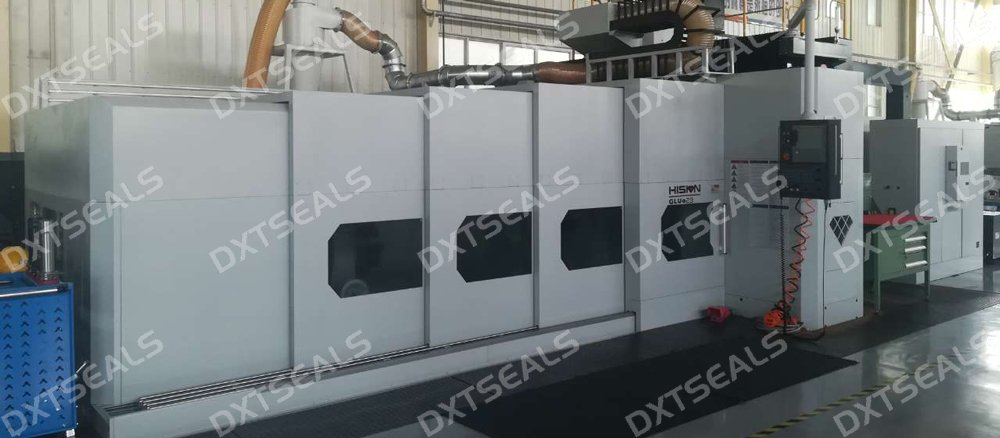
A large gantry milling machine is particularly useful for oversized flat or structural components because the machine can provide a much larger working area while maintaining controlled tool movement over the workpiece.
For example, an extra-large PTFE plate may require a machining platform significantly larger than the dimensions available on a conventional CNC machining center. Without sufficient machine travel and table capacity, manufacturing the component may require multiple setups or alternative processing methods.
2. Machine Size Is Not the Only Equipment Limitation
Having a large enough machining envelope is only the starting point.
The machine must also be capable of handling the weight and physical characteristics of the workpiece.
Important factors include:
Working Envelope
The machine must have sufficient X, Y, and Z travel to accommodate the complete component and the required tool movements.
Table Load Capacity
A large workpiece can weigh hundreds or even thousands of kilograms. The machine table and supporting structure must be designed to safely carry the load.
Spindle Capacity
Large parts may require substantial cutting forces, especially when machining metals or other difficult materials. The spindle must provide sufficient power and rigidity.
Machine Rigidity
Large components can amplify the effects of vibration and cutting forces. A rigid machine structure is essential for maintaining dimensional stability.
Tool Reach
Deep cavities, large surfaces, and complex geometries may require extended tools or specialized tooling. Tool deflection becomes an important consideration as tool length increases.
Therefore, oversized machining requires the right combination of machine size, rigidity, load capacity, spindle performance, tooling, and workholding.
3. Transportation of Oversized Parts Can Be a Major Challenge
Machining is only one part of the manufacturing process.
Before machining begins, the raw material must be transported to the factory. After machining, the finished component must often be transported to the customer's facility.
For oversized custom parts, transportation can become a significant engineering problem.
The manufacturer may need to consider:
-
Overall dimensions
-
Total weight
-
Truck loading limitations
-
Road transportation restrictions
-
Loading and unloading equipment
-
Factory entrance dimensions
-
Workshop door height and width
-
Crane capacity
-
Packaging requirements
-
Delivery route limitations
A component may physically fit inside a workshop but still be difficult to move from the receiving area to the machining area.
This means manufacturers need to consider logistics during the early stages of production rather than treating transportation as an afterthought.
4. Loading and Unloading Require Careful Planning
Heavy oversized parts cannot always be moved using conventional forklifts.
Depending on the weight and dimensions, manufacturers may need overhead cranes, gantry cranes, heavy-duty forklifts, lifting beams, slings, or other specialized handling equipment.
Improper lifting can cause several problems.
The component may be damaged during handling, the lifting equipment may be overloaded, or the workpiece may become difficult to position accurately on the machining table.
For precision components, even minor deformation or impact during handling can affect subsequent machining operations.
A professional manufacturer therefore needs to plan:
-
How the raw material enters the facility
-
How it is unloaded
-
How it is transferred to the machining area
-
How it is positioned on the machine
-
How it is removed after machining
-
How it is packaged for shipment
For extremely large custom components, these handling procedures can be almost as important as the cutting process itself.
5. Maintaining Precision on Large Workpieces Is More Difficult
Precision machining becomes increasingly challenging as part dimensions increase.
A small component can often be machined in a single setup with relatively straightforward dimensional control. A very large component may experience temperature changes, material deformation, machine positioning errors, fixture limitations, and other factors across a much larger working area.
Even a small deviation accumulated over a large dimension can become significant.
For example, maintaining a tight tolerance across a small sealing surface is relatively straightforward. Maintaining the same level of flatness across a very large sealing surface requires much greater process control.
This is especially important for large sealing components, flange surfaces, equipment covers, and other parts where dimensional accuracy directly affects assembly and sealing performance.
6. Thermal Expansion Can Affect Large-Format Machining
Temperature is another important factor in precision machining.
Large components have greater physical dimensions, so thermal expansion can become more noticeable.
Both the workpiece and the machine structure can be affected by temperature changes.
Materials such as metals can expand or contract with changes in temperature. Plastics such as PTFE can also experience dimensional changes because of their thermal characteristics.
For this reason, manufacturers may need to control:
-
Workshop temperature
-
Material temperature
-
Machine operating temperature
-
Measurement conditions
-
Time between machining and inspection
When extremely tight tolerances are required, machining and inspection should be performed under controlled and consistent conditions whenever practical.
7. Workpiece Deformation Is a Critical Issue
Oversized components can be particularly sensitive to deformation.
A large plate, for example, may appear rigid because of its size, but it can still deform under its own weight or as a result of internal stresses.
Machining can also change the stress distribution within the material.
This can create a difficult situation: a workpiece may meet dimensional requirements while clamped on the machine but change shape after being removed.
To minimize this risk, manufacturers may use appropriate machining sequences, controlled material removal, optimized fixturing, and intermediate inspection.
For large custom components, machining strategy is therefore closely connected to material behavior.
8. Multiple Setups Increase Manufacturing Difficulty
When a component is too large for a single machining operation, it may need to be repositioned or processed in multiple setups.
Every additional setup introduces another opportunity for positioning errors.
For example, a large component may require:
-
Initial rough machining
-
Repositioning
-
Secondary machining
-
Precision finishing
-
Final dimensional inspection
Maintaining the relationship between different machined surfaces becomes more difficult as the number of setups increases.
This is one reason why a sufficiently large machine can provide a major advantage. If a large custom part can be machined within a single setup or with fewer setups, the manufacturer can reduce accumulated positioning errors and improve consistency.
9. Oversized PTFE Parts Present Additional Challenges
Large PTFE custom parts deserve special attention.
PTFE is widely used for sealing components because of its excellent chemical resistance, low friction, and broad operating temperature range. However, large PTFE components can be more challenging to machine than smaller parts.
The material has a relatively high coefficient of thermal expansion and can deform under certain conditions. Large thin plates, covers, rings, and sealing components therefore require careful control of machining parameters and workholding.
For oversized PTFE components, manufacturers need to consider:
-
Material dimensions
-
Material thickness
-
Thermal expansion
-
Workpiece deformation
-
Cutting parameters
-
Tool geometry
-
Clamping force
-
Flatness requirements
-
Final inspection conditions
These factors become particularly important when manufacturing large sealing surfaces where flatness and dimensional consistency are critical.
10. Precision Inspection Becomes More Complicated
Inspection of an oversized part can be just as difficult as machining it.
A large component may not fit conventional inspection equipment, and measuring its entire surface can require specialized tools and procedures.
Depending on the component, inspection may involve:
-
Large-coordinate measurement systems
-
Precision height gauges
-
Surface measurement equipment
-
Laser measurement systems
-
Large-format dimensional inspection
-
Multiple-point measurement
-
Customized inspection fixtures
The manufacturer must also establish appropriate measurement references.
For example, measuring a small component from a single reference surface is relatively simple. Measuring the flatness or positional accuracy of a large component requires a carefully established datum system.
11. Custom Manufacturing Requires More Engineering Before Production
Oversized custom machining usually requires more preparation than standard-size components.
Before production begins, engineers may need to evaluate:
-
Part drawings
-
Material specifications
-
Overall dimensions
-
Weight
-
Machining tolerances
-
Surface requirements
-
Machining sequence
-
Tool accessibility
-
Workholding method
-
Transportation requirements
-
Inspection method
For particularly large components, the manufacturing process should be evaluated before the quotation is finalized.
A part may be technically manufacturable but require multiple setups, special tooling, additional handling, or complex transportation arrangements.
Early engineering evaluation helps identify these challenges before production begins.
12. Why Large Gantry Milling Machines Are Important
Large gantry milling machines can provide significant advantages for oversized custom parts.
Their large working envelope allows manufacturers to process components that cannot be accommodated by conventional CNC machining centers.
Depending on the machine configuration, gantry milling can be suitable for:
-
Large plates
-
Oversized covers
-
Large sealing components
-
Machine bases
-
Structural parts
-
Large industrial components
-
Custom components with large planar surfaces
The ability to machine a large component on a sufficiently large platform can reduce the need for multiple setups and improve overall dimensional consistency.
For manufacturers producing oversized custom parts, investment in large-scale machining equipment can therefore expand the range of components they can manufacture in-house.
13. Choosing an Oversized Custom Machining Manufacturer
When selecting a supplier for an oversized custom component, buyers should look beyond the manufacturer's general statement that it provides CNC machining services.
Important questions include:
-
What is the maximum machining size?
-
What is the maximum workpiece weight?
-
Does the manufacturer have large gantry milling equipment?
-
Can the part be machined in one setup?
-
How is oversized material handled?
-
What lifting equipment is available?
-
How are large parts inspected?
-
How are deformation and thermal expansion controlled?
-
Can the manufacturer manage packaging and transportation?
-
Does the company have experience with similar oversized components?
These questions help determine whether the manufacturer has genuine large-part machining capabilities rather than simply offering conventional CNC machining.
Conclusion
Oversized custom parts are difficult to machine because their challenges extend far beyond cutting metal or plastic.
Equipment capacity, workpiece weight, transportation, lifting, fixturing, thermal expansion, material deformation, multiple setups, dimensional accuracy, and final inspection all become more demanding as component size increases.
For large custom parts, the right manufacturing partner needs more than CNC programming experience. It needs suitable large-format machining equipment, heavy-duty material handling capabilities, engineering expertise, and a reliable quality-control process.
Large gantry milling machines and other heavy-duty machining equipment can make it possible to manufacture extra-large custom components that are beyond the practical capacity of conventional CNC equipment. When combined with proper process planning and precision inspection, these capabilities allow manufacturers to produce large custom parts with the dimensional accuracy and consistency required for demanding industrial applications.
For customers requiring oversized PTFE components, large sealing parts, industrial plates, covers, flanges, or other custom-machined components, working with a manufacturer experienced in large-format machining can significantly reduce manufacturing and logistical risks.