
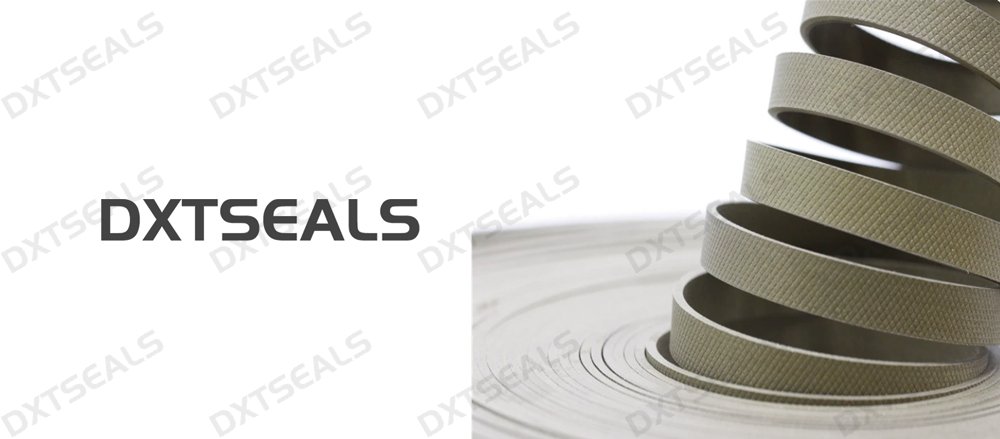
PTFE guide bands are essential components in hydraulic cylinders and pneumatic systems, providing accurate guidance for moving parts while preventing direct metal-to-metal contact. Their excellent wear resistance, low friction, and high load-bearing capacity make them an ideal solution for improving equipment reliability and extending service life.
Manufactured from high-quality PTFE or filled PTFE materials, guide bands help reduce friction, protect sealing components, and maintain smooth reciprocating movement under demanding operating conditions.
What Are PTFE Guide Bands?
A PTFE guide band is a wear-resistant guiding element installed in grooves on hydraulic pistons or piston rods. Unlike seals, guide bands do not retain hydraulic pressure. Instead, they guide moving components, absorb side loads, and protect cylinder surfaces from wear.
PTFE guide bands are commonly used in:
- Hydraulic cylinders
- Pneumatic cylinders
- Construction machinery
- Industrial automation equipment
- Injection molding machines
- Material handling systems
- Agricultural machinery
- Heavy industrial equipment
They are available in continuous rolls, cut-to-length strips, and custom-machined guide rings to suit different cylinder designs.
Functions of PTFE Guide Bands
Guide bands perform several important functions in hydraulic and pneumatic systems.
Their primary roles include:
- Preventing metal-to-metal contact
- Supporting radial and side loads
- Guiding piston and rod movement
- Reducing friction during reciprocating motion
- Protecting cylinder walls from damage
- Extending seal service life
Without guide bands, excessive side loading can cause premature seal failure, cylinder scoring, and increased maintenance costs.
Why PTFE Is an Excellent Guide Band Material
PTFE (Polytetrafluoroethylene) is one of the most widely used engineering plastics for guiding applications due to its unique combination of physical and chemical properties.
Key advantages include:
- Extremely low coefficient of friction
- Excellent wear resistance
- High chemical resistance
- Wide operating temperature range
- Low moisture absorption
- Good dimensional stability
- Long service life
These characteristics make PTFE suitable for continuous reciprocating movement in both hydraulic and pneumatic equipment.
Key Benefits of PTFE Guide Bands
Low Friction
PTFE has one of the lowest friction coefficients among engineering materials.
Benefits include:
- Smooth piston movement
- Reduced operating resistance
- Lower energy consumption
- Reduced heat generation
Low friction also minimizes wear on cylinder components and improves overall system efficiency.
Excellent Wear Resistance
Guide bands experience continuous contact with cylinder surfaces during operation.
High-quality PTFE materials provide excellent resistance to abrasion, helping maintain guiding accuracy over long operating periods.
High Load Capacity
Filled PTFE guide bands can withstand significant side loads while maintaining dimensional stability.
This helps:
- Keep pistons properly aligned
- Reduce uneven seal wear
- Improve cylinder performance
Protection of Sealing Components
Guide bands reduce lateral movement of the piston and rod, allowing hydraulic seals to operate under optimal conditions.
As a result:
- Seal life is extended.
- Leakage risk is reduced.
- Maintenance intervals become longer.
Chemical Resistance
PTFE resists a wide variety of industrial fluids, including:
- Hydraulic oils
- Lubricants
- Water-based fluids
- Many acids
- Alkalis
- Industrial chemicals
This makes PTFE guide bands suitable for harsh industrial environments.
Common PTFE Guide Band Materials
Different applications require different PTFE formulations.
Virgin PTFE
Offers excellent chemical resistance and the lowest friction coefficient.
Suitable for:
- Light-load applications
- Corrosive environments
- Precision equipment
Bronze-Filled PTFE
Adding bronze improves:
- Wear resistance
- Load-bearing capacity
- Thermal conductivity
- Mechanical strength
Bronze-filled PTFE is widely used in heavy-duty hydraulic cylinders.
Glass-Filled PTFE
Glass fiber reinforcement provides:
- Increased rigidity
- Better dimensional stability
- Improved compressive strength
Suitable for applications requiring higher mechanical stability.
Carbon-Filled PTFE
Carbon-filled PTFE offers:
- Enhanced wear resistance
- Improved thermal conductivity
- Excellent performance in high-speed applications
Material selection depends on operating conditions and equipment requirements.
Applications in Hydraulic Cylinders
Hydraulic cylinders require precise movement and reliable component protection.
PTFE guide bands are commonly installed on:
- Hydraulic pistons
- Piston rods
- Guide sleeves
Typical applications include:
- Excavators
- Bulldozers
- Hydraulic presses
- Mobile hydraulic equipment
- Construction machinery
Guide bands help maintain proper alignment while reducing wear on both the cylinder and sealing components.
Applications in Pneumatic Systems
Pneumatic cylinders also benefit from PTFE guide bands due to their low friction and smooth movement.
Typical applications include:
- Industrial automation
- Packaging machinery
- Assembly equipment
- Robotics
- Pneumatic actuators
Low friction allows pneumatic cylinders to operate efficiently while minimizing component wear.
PTFE Guide Bands vs. Metal Guide Rings
Compared with traditional metal guide components, PTFE guide bands offer several advantages.
| Feature | PTFE Guide Bands | Metal Guide Rings |
|---|---|---|
| Friction | Very Low | Higher |
| Wear on Cylinder | Minimal | Higher |
| Lubrication Requirement | Minimal | Often Required |
| Corrosion Resistance | Excellent | Material Dependent |
| Noise During Operation | Low | Higher |
| Weight | Lightweight | Heavier |
For many hydraulic and pneumatic systems, PTFE guide bands provide a better balance of performance and equipment protection.
Precision Manufacturing
High-quality PTFE guide bands are manufactured using advanced machining and processing technologies.
Typical production methods include:
- Precision skiving
- CNC turning
- CNC milling
- Cutting to size
- Surface finishing
- Dimensional inspection
Strict manufacturing control ensures accurate dimensions, consistent quality, and reliable installation.
OEM and Custom PTFE Guide Bands
Many hydraulic cylinder manufacturers require guide bands with customized dimensions or material formulations.
Custom manufacturing services include:
- OEM production
- Manufacturing from customer drawings
- Custom widths and thicknesses
- Special filled PTFE materials
- Prototype development
- Small and large production runs
Custom guide bands provide an optimal fit and reliable performance for both standard and non-standard hydraulic systems.
Choosing the Right PTFE Guide Band
When selecting a guide band, consider the following factors:
- Cylinder dimensions
- Groove size
- Operating pressure
- Side load
- Reciprocating speed
- Working temperature
- Hydraulic or pneumatic media
- Required service life
Working with an experienced manufacturer helps ensure the correct material and dimensions are selected for each application.
Conclusion
PTFE guide bands are an ideal solution for hydraulic cylinders and pneumatic systems because they provide excellent guidance, low friction, high wear resistance, and reliable protection against metal-to-metal contact. Their ability to support side loads while reducing seal wear makes them an essential component in modern fluid power systems.
Whether manufactured from virgin PTFE or filled PTFE materials such as bronze, glass fiber, or carbon, precision-engineered guide bands help improve equipment efficiency, extend maintenance intervals, and enhance the long-term reliability of hydraulic and pneumatic equipment.