
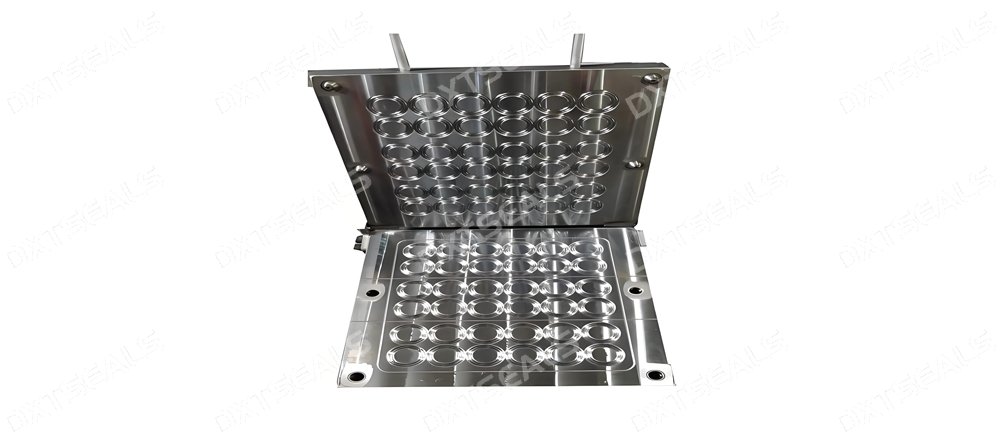
Custom rubber seals are widely used in automotive, machinery, industrial equipment, compressors, pumps, and hydraulic systems. Whether the product is an O-ring, gasket, oil seal, or complex rubber component, the first and most critical step is always confirming the rubber material before mold manufacturing begins.
Many customers wonder:
“Why can’t we start making the mold first?”
The reason is simple — different rubber materials behave completely differently during molding, curing, shrinkage, and long-term use.
This article explains why material confirmation is mandatory before opening a mold and outlines the key engineering steps that ensure successful custom-made rubber seals.
(Manufacturing and engineering support provided by DXTSEALS.)
1️⃣ Why Material Confirmation Comes Before Mold Production
Mold design is not universal.
Every rubber material — NBR, FKM, EPDM, Silicone, HNBR, CR, FFKM — has unique molding properties such as:
-
shrinkage rate
-
curing characteristics
-
hardness range
-
compression set
-
elasticity
-
chemical resistance
-
temperature capability
If the rubber material is not confirmed before tooling begins, the mold dimensions, cavity structure, venting system, and curing parameters may all be incorrect, resulting in:
-
improper product dimensions
-
deformation or flashing
-
poor sealing performance
-
need to rebuild the mold
-
wasted time and cost
This is why confirming the rubber material is the foundation of high-quality custom seals.
2️⃣ Different Rubber Materials Have Completely Different Shrinkage Rates
Rubber shrinks after vulcanization. The shrinkage rate is not the same:
-
NBR: 1.5% – 2.0%
-
EPDM: 1.2% – 2.5%
-
Silicone (VMQ): 2.5% – 4.0%
-
FKM: 1.5% – 3.0%
-
HNBR: 1.5% – 2.0%
If the mold is designed based on the wrong shrinkage rate, the final product will not meet tolerance requirements.
Example:
If a gasket requires a final OD of 100 mm:
-
Using silicone instead of NBR could result in size errors of 1–2 mm, which is unacceptable for precision sealing.
Thus, the mold must be dimensioned based on the exact material.
3️⃣ Material Hardness Determines the Mold Cavities and Parting Line
Harder materials (e.g., 90 Shore A NBR or HNBR) require:
-
stronger mold structure
-
tighter cavity reinforcement
-
different injection or compression pressure
Softer materials (e.g., Silicone 40–50 Shore A) require:
-
optimized cavity support
-
modified parting line design
-
different venting positions
Without confirming the hardness range in advance, the mold may:
-
deform under pressure
-
produce uneven surfaces
-
fail to fill correctly
Material hardness selection is a core parameter for mold design.
4️⃣ Curing Behavior Affects Mold Temperature and Cycle Time
Rubber curing properties directly influence:
-
mold temperature
-
curing time
-
pressure
-
production efficiency
-
product stability
For example:
-
FKM requires higher curing temperature and longer cycles
-
Silicone cures quickly and requires different venting
-
NBR and EPDM require moderate curing conditions
If the wrong curing assumptions are used during mold design, seal quality will be inconsistent or unstable.
5️⃣ Long-Term Performance Depends on Correct Material Selection
Material selection must match the application:
| Working Condition | Recommended Material |
|---|---|
| Oils & fuels | NBR, FKM |
| High temperature | FKM, Silicone |
| Low temperature | Silicone, EPDM |
| Chemical exposure | FKM, FFKM |
| Steam or hot water | EPDM |
| High wear or dynamic load | HNBR |
If the material is chosen incorrectly:
-
seals swell or harden
-
cracks develop
-
leakage occurs
-
service life drops drastically
This is why confirming the material early prevents field failures.
6️⃣ Cost Calculation Requires Material Confirmation
Different rubber materials have different pricing:
-
FKM ≈ 3–5× the cost of NBR
-
Silicone ≈ 1.5–3× the cost of EPDM
-
FFKM is the highest (>20× NBR)
Manufacturers cannot calculate:
-
mold cost
-
part cost
-
material consumption
-
production method
…without knowing the exact rubber type.
7️⃣ Key Pre-Molding Steps Before Opening the Mold
Before starting mold manufacturing, DXTSEALS typically follows these engineering steps:
✔ Step 1: Confirm Application Requirements
-
temperature
-
media (oil, chemical, gas, water, etc.)
-
pressure
-
dynamic vs static use
-
expected lifetime
✔ Step 2: Select the Correct Rubber Material
Choose from NBR, FKM, EPDM, HNBR, Silicone, CR, or special blends.
✔ Step 3: Define Hardness (Shore A)
Common choices: 50A, 60A, 70A, 80A, 90A.
✔ Step 4: Determine Shrinkage Rate
Used to calculate mold cavity size.
✔ Step 5: Approve the 2D/3D Drawings
Including tolerances and mold parting line.
✔ Step 6: Confirm Production Method
Injection molding, compression molding, transfer molding, etc.
✔ Step 7: Final Mold Design & Production
Once all materials and parameters are confirmed, mold manufacturing begins.
⭐ Conclusion
Rubber material confirmation is not just a formality — it is the core engineering step that determines:
-
mold accuracy
-
sealing performance
-
product stability
-
service life
-
overall production cost
Without confirming the rubber material, mold design becomes guesswork, and the risk of product failure increases dramatically.
To ensure precision and long-term durability, always finalize the material before opening the mold.
For custom rubber sealing solutions, material guidance, and mold design assistance, DXTSEALS provides full engineering support.