
Introduction
As industrial designs become increasingly sophisticated, the demand for complex metal components with tight tolerances and intricate geometries continues to grow. Traditional 3-axis machining often struggles to meet these requirements efficiently.
5-axis CNC machining has emerged as a powerful solution for manufacturing complex metal parts with higher precision, improved efficiency, and superior surface quality. This article explores the key advantages of 5-axis CNC machining in modern manufacturing.
What Is 5-Axis CNC Machining?
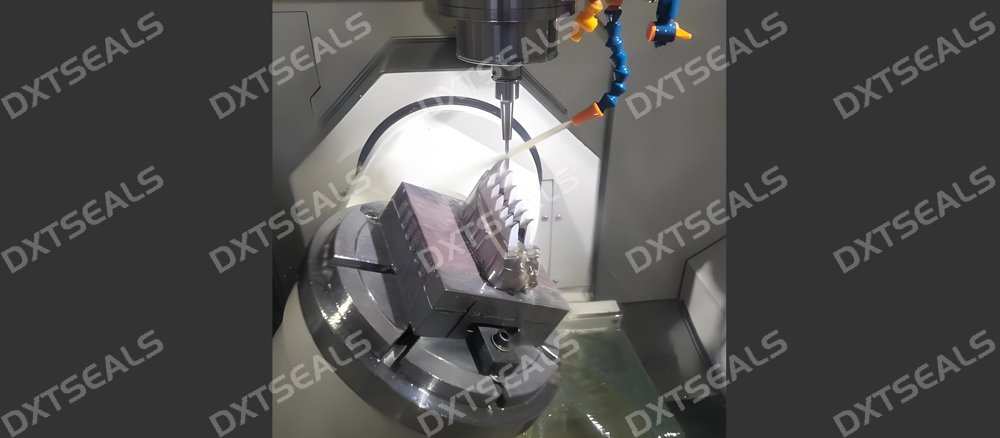
5-axis CNC machining refers to a process in which the cutting tool and/or workpiece can move along five different axes simultaneously. In addition to the standard X, Y, and Z linear axes, two rotational axes allow machining from virtually any angle in a single setup.
This capability makes 5-axis machining ideal for producing complex structural components with minimal repositioning.
Key Advantages of 5-Axis CNC Machining
1. Reduced Setup and Improved Accuracy
One of the greatest advantages of 5-axis machining is the ability to complete multiple operations in a single setup.
Fewer setups mean:
-
Reduced alignment errors
-
Improved dimensional accuracy
-
Better part consistency
At DXTSEALS, 5-axis machining ensures high precision for complex structural and sealing-related metal components.
2. Capability to Machine Complex Geometries
5-axis CNC machines can easily handle:
-
Deep cavities
-
Undercuts
-
Curved surfaces
-
Multi-angle features
This flexibility allows engineers to design more advanced and integrated components without being limited by machining constraints.
3. Superior Surface Finish
By maintaining optimal tool orientation relative to the workpiece, 5-axis machining improves cutting conditions and reduces tool marks.
This results in smoother surfaces and reduced need for secondary finishing processes.
4. Increased Production Efficiency
Although machine investment may be higher, 5-axis machining reduces overall production time by:
-
Eliminating multiple repositioning steps
-
Shortening machining cycles
-
Minimizing manual intervention
For complex parts, this significantly improves overall manufacturing efficiency.
5. Better Tool Life and Heat Management
Optimized tool angles improve chip evacuation and reduce heat concentration, extending tool life and improving process stability.
Applications in Complex Metal Part Manufacturing
5-axis CNC machining is widely used in:
Aerospace Components
Lightweight structural parts with complex contours and tight tolerances.
Energy and Power Equipment
High-strength components operating under extreme conditions.
Medical and Precision Equipment
Intricate parts requiring high dimensional accuracy and surface quality.
Industrial Automation and Robotics
Compact and lightweight structural components with multi-angle features.
High-Performance Sealing and Hardware Systems
Complex housings and support structures requiring high precision and reliability.
Comparison with 3-Axis Machining
| Feature | 3-Axis Machining | 5-Axis Machining |
|---|---|---|
| Setup Count | Multiple | Single or minimal |
| Geometry Capability | Limited | Highly complex |
| Surface Finish | Moderate | Superior |
| Production Efficiency | Standard | High for complex parts |
Quality Control and Process Stability
Modern 5-axis CNC machining integrates advanced simulation software and precision measurement systems to ensure stable and repeatable production results. Strict quality control guarantees consistency for high-end industrial applications.
Conclusion
5-axis CNC machining offers significant advantages in manufacturing complex metal parts, including improved accuracy, enhanced surface finish, reduced setups, and greater efficiency.
As component designs continue to evolve toward higher complexity and performance demands, 5-axis machining becomes an essential technology for advanced manufacturing.
By leveraging advanced multi-axis capabilities, manufacturers can achieve precision, reliability, and innovation in complex metal component production.