
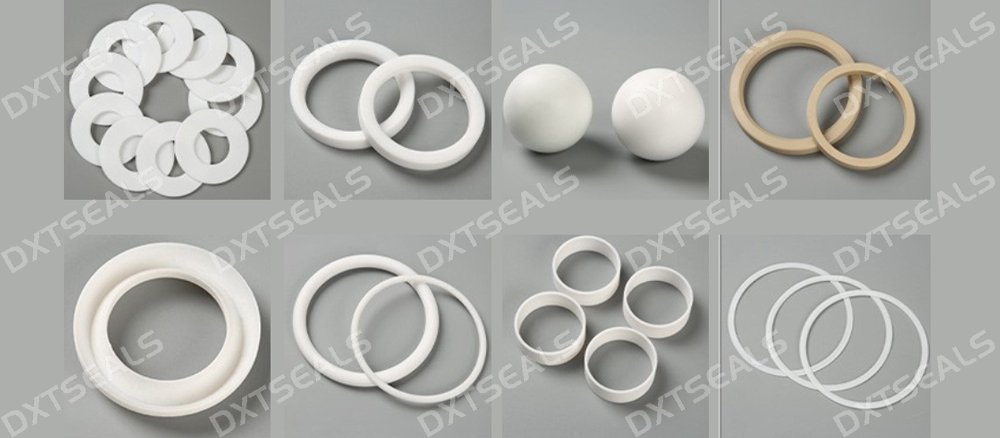
PTFE is a high-performance engineering material widely used in industries where chemical resistance, low friction, electrical insulation, and temperature resistance are essential. In addition to conventional seals and small machined components, PTFE can also be manufactured into large and highly customized products such as PTFE grating, covers, plates, liners, and ultra-large industrial components.
However, producing oversized PTFE parts requires significantly more than standard plastic machining. Large dimensions, thermal expansion, material flexibility, machining stress, flatness requirements, and complex geometries all create additional manufacturing challenges.
With suitable CNC machining technology, large-format equipment, and experienced process control, custom PTFE grating, covers, and ultra-large components can be manufactured according to demanding industrial specifications.
What Is Custom PTFE Grating?
Custom PTFE grating refers to PTFE plates or panels containing a designed pattern of holes, slots, openings, or other geometric structures.
Depending on the application, PTFE grating can be designed as:
- Perforated PTFE plates
- Grid plates
- PTFE support panels
- PTFE screening components
- Custom protective panels
- Special equipment plates
The hole pattern, spacing, thickness, overall dimensions, and mounting features can all be customized according to the customer's technical drawing.
PTFE Covers and Large Custom Components
PTFE covers are used in industrial equipment for protection, insulation, chemical resistance, and customized equipment interfaces.
Large PTFE covers may include:
- Mounting holes
- Sealing grooves
- Slots
- Counterbores
- Custom contours
- Special installation interfaces
For oversized equipment, the cover may need to be manufactured as a single large component. This requires machining equipment with a sufficiently large working envelope.
Key Material Features of PTFE
The unique properties of PTFE make it suitable for a wide variety of demanding applications.
Excellent Chemical Resistance
PTFE has excellent resistance to many acids, alkalis, solvents, and aggressive chemicals.
This makes it particularly useful for:
- Chemical processing equipment
- Corrosive fluid handling
- Laboratory equipment
- Semiconductor processing systems
Low Friction
PTFE has a very low coefficient of friction, allowing components to slide smoothly against mating surfaces.
This property is useful for:
- Sliding components
- Liners
- Guide components
- Moving equipment interfaces
Wide Temperature Resistance
PTFE can maintain useful performance over a broad temperature range, making it suitable for equipment exposed to both elevated and low temperatures.
Actual temperature limits depend on the specific PTFE grade and application.
Excellent Electrical Insulation
PTFE provides excellent dielectric properties and electrical insulation.
It can therefore be used in:
- Electrical equipment
- Semiconductor machinery
- Insulation components
- Specialized industrial systems
Low Moisture Absorption
PTFE absorbs very little moisture, which can be beneficial in applications exposed to humidity, water, or changing environmental conditions.
Filled PTFE Materials for Custom Components
While virgin PTFE is suitable for many applications, filled PTFE can provide improved mechanical properties.
Common filler materials include:
- Glass fiber
- Carbon
- Graphite
- Bronze
- Other specialized fillers
Depending on the formulation, filled PTFE can improve:
- Wear resistance
- Compressive strength
- Dimensional stability
- Thermal conductivity
- Load-bearing performance
Material selection should be based on the working conditions of the finished component.
Why Ultra-Large PTFE Machining Is Challenging
Manufacturing ultra-large PTFE components presents several technical challenges.
Thermal Expansion
PTFE has a relatively high coefficient of thermal expansion.
During machining, cutting heat can cause dimensional changes. This becomes particularly important when processing very large components.
For example, a dimensional variation that is insignificant on a small part can become much more noticeable across a large PTFE plate.
Low Rigidity
PTFE is softer and more flexible than most metals.
Large components may deform because of:
- Clamping forces
- Cutting forces
- Uneven support
- Internal stress
- Component weight
- Temperature changes
Proper workholding is therefore essential.
Flatness Control
Large PTFE plates and covers may require strict flatness.
Maintaining flatness can be challenging because material stress may be released during machining.
A controlled machining sequence can help reduce distortion.
Large-Format CNC Machining Capabilities
Large PTFE components require machining equipment with sufficient working dimensions.
Large gantry milling machines are particularly suitable for oversized PTFE plates, covers, grating, and other large custom components.
Large-format CNC machining can provide:
- Large working envelopes
- Stable workpiece support
- Consistent tool positioning
- One-piece machining capability
- Flexible processing of complex geometries
For extremely large components, machining the part as a single piece can reduce the alignment and assembly problems associated with manufacturing multiple smaller sections.
Precision Machining of PTFE Grating
PTFE grating often contains a large number of holes or slots.
Precision CNC machining must control:
- Hole diameter
- Hole position
- Hole spacing
- Pattern consistency
- Plate thickness
- Flatness
- Overall dimensions
For large grating panels, maintaining consistent positioning across the entire workpiece is especially important.
Advanced CNC programming and appropriate inspection methods can help minimize accumulated positioning errors.
Machining Large PTFE Covers
Large PTFE covers may require multiple machining operations.
Typical processes include:
- Face milling
- Contour milling
- Drilling
- Boring
- Groove machining
- Slot machining
- Counterboring
- Chamfering
- Precision finishing
The machining sequence should be designed to reduce deformation while maintaining the required dimensions.
Workholding and Deformation Control
Workholding is one of the most important factors in large PTFE machining.
Excessive clamping pressure can deform the material, while insufficient support may cause movement or vibration.
An appropriate setup should provide:
- Even support
- Controlled clamping force
- Stable positioning
- Minimal deformation
- Adequate access for cutting tools
For large and thin PTFE components, the support strategy is particularly important.
Typical Manufacturing Process
A typical process for custom large PTFE components may include:
1. Drawing and Technical Review
The manufacturer reviews:
- Overall dimensions
- Material grade
- Tolerances
- Flatness
- Hole patterns
- Surface finish
- Critical functional features
2. Material Preparation
The PTFE blank is inspected for material grade, dimensions, and surface condition.
3. Rough Machining
Excess material is removed while leaving sufficient allowance for subsequent operations.
4. Stabilization
Where required, the component may be allowed to stabilize after rough machining to reduce the influence of internal material stress.
5. Precision Machining
Critical surfaces, holes, grooves, and profiles are machined to final specifications.
6. Final Inspection
The finished component is inspected for dimensional accuracy, flatness, hole positioning, and other specified requirements.
Applications of Custom PTFE Grating and Covers
Custom PTFE components are used in many industrial sectors.
Chemical Processing
PTFE grating, plates, and covers can be used in equipment exposed to corrosive chemicals and aggressive fluids.
Semiconductor Equipment
PTFE components are suitable for systems where chemical resistance, insulation, and material cleanliness are important.
Industrial Machinery
Large PTFE components can function as:
- Protective covers
- Liners
- Insulation plates
- Support components
- Equipment interfaces
Fluid Handling Systems
PTFE's chemical resistance makes it useful for customized components used in fluid processing and transportation systems.
Specialized Equipment
Ultra-large PTFE components can also be produced for specialized machinery where standard catalog components cannot meet the required dimensions or design.
Custom OEM PTFE Manufacturing
Large PTFE grating, covers, and components are often non-standard products.
Custom manufacturing can be based on:
- 2D technical drawings
- 3D CAD models
- Physical samples
- OEM specifications
- Customer-defined dimensions
Manufacturing services can include:
- Standard PTFE parts
- Non-standard PTFE parts
- Ultra-large components
- Custom material grades
- Prototype production
- Small-batch production
- Mass production
Quality Control for Ultra-Large PTFE Components
Large components require comprehensive inspection because dimensional variation may occur across different areas of the workpiece.
Typical inspection items include:
- Overall dimensions
- Thickness
- Flatness
- Parallelism
- Hole diameter
- Hole position
- Groove dimensions
- Surface finish
- Critical tolerances
For large PTFE components, multiple measurement points may be required to properly evaluate dimensional consistency.
How to Choose a Custom PTFE Machining Manufacturer
When selecting a supplier for large PTFE components, consider:
- Experience with PTFE machining
- Maximum machining dimensions
- Large gantry milling capability
- CNC machining accuracy
- Deformation control methods
- Material selection capabilities
- Inspection equipment
- OEM customization experience
For ultra-large components, machine capacity is particularly important. A manufacturer must have sufficient working space and appropriate equipment to process the component without unnecessary splitting or assembly.
Conclusion
Custom PTFE grating, covers, and ultra-large components combine the excellent material properties of PTFE with the flexibility of precision CNC manufacturing. PTFE offers outstanding chemical resistance, low friction, electrical insulation, and broad temperature resistance, while filled PTFE grades can provide improved mechanical and dimensional properties.
However, large-scale PTFE machining requires careful control of thermal expansion, material deformation, workholding, flatness, and machining stress.
With large-format CNC machining and large gantry milling equipment, manufacturers can process oversized PTFE plates, grating, covers, liners, and other custom components with greater flexibility and dimensional consistency.
For chemical processing, semiconductor equipment, fluid handling, industrial machinery, and specialized applications, custom precision-machined PTFE components provide an effective solution when standard products cannot meet specific size, geometry, or performance requirements.