
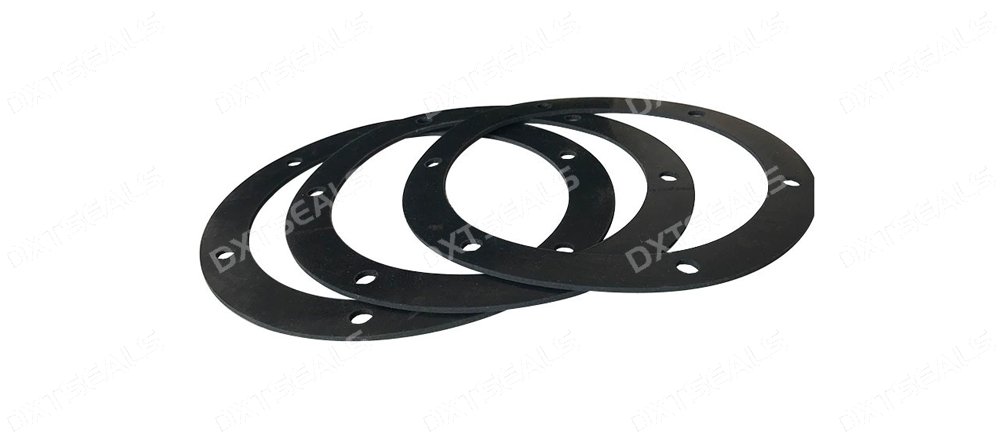
EPDM flange gaskets are widely used in industrial piping, water systems, HVAC equipment, pumps, valves, tanks, and process equipment. EPDM rubber is particularly suitable for applications involving water, hot water, weather exposure, ozone, and many water-based chemicals.
However, selecting an EPDM flange gasket requires more than choosing the correct rubber material. The gasket must also match the flange standard, nominal size, pressure class, flange facing, dimensions, and operating conditions.
American flange systems and European flange systems use different dimensional conventions and standards. ASME and ANSI terminology is commonly encountered in North American and international projects, while EN standards are widely used in Europe.
Understanding these differences helps prevent incorrect gasket selection and improves compatibility during installation and replacement.
What Is an EPDM Flange Gasket?
An EPDM flange gasket is a rubber sealing component installed between two mating flanges.
Its primary function is to create a reliable sealing interface and prevent leakage of the fluid flowing through a pipe, valve, pump, tank, or other equipment.
EPDM flange gaskets are commonly used in:
- Water pipelines
- Cooling-water systems
- HVAC systems
- Heating-water systems
- Water treatment equipment
- Pumps and valves
- Industrial tanks
- Outdoor piping
- General process equipment
The gasket design can vary according to the flange standard and application.
Why EPDM Is Used for Flange Gaskets
EPDM, or ethylene propylene diene monomer rubber, is a widely used elastomer for water and outdoor sealing applications.
Water Resistance
EPDM has good resistance to water and is commonly selected for water distribution, cooling, heating, and industrial water systems.
Weather and Ozone Resistance
EPDM performs well in outdoor environments and has good resistance to ozone and weathering. This makes it useful for exposed piping and equipment.
Temperature Capability
EPDM can operate over a relatively broad temperature range, although the actual limit depends on the specific compound, formulation, gasket design, and application.
For high-temperature service, the supplier's technical data should be checked for the specific EPDM grade.
Chemical Resistance
EPDM generally provides good resistance to many dilute acids, alkalis, and water-based chemicals.
Chemical compatibility should always be confirmed based on the actual medium, concentration, temperature, and exposure conditions.
American Flange Standards: ASME and ANSI
The term "ANSI flange" remains common in the industrial market, although modern flange specifications are generally referenced through ASME standards.
One important standard is ASME B16.5, which covers pipe flanges and flanged fittings within its specified size and pressure-class range.
American flange specifications commonly use:
- NPS nominal pipe sizes
- Class pressure designations
- Inch-based dimensions
- Specific bolt-hole patterns
- Defined flange facing configurations
Common pressure classes include:
- Class 150
- Class 300
- Class 600
- Class 900
- Class 1500
- Class 2500
The correct gasket must correspond to the specific flange size, class, facing, and design.
European Flange Standards
European piping systems commonly use EN standards for flange dimensions and configurations.
A frequently encountered standard family is EN 1092, which covers various types of flanges.
European flange systems commonly use:
- DN nominal sizes
- PN pressure designations
- Metric dimensions
- Standardized bolt patterns
- European flange configurations
Examples of commonly encountered pressure designations include:
- PN6
- PN10
- PN16
- PN25
- PN40
The actual applicable specification should always be confirmed according to the flange and equipment design.
American vs European Flange Dimensions
One of the most important differences is that American and European flange systems do not necessarily use the same dimensions for a similar nominal pipe size.
For example, an EPDM gasket intended for an ASME Class 150 flange should not automatically be substituted with a gasket identified only by a similar DN or PN designation.
Important dimensional differences may include:
| Dimension | American Flange System | European Flange System |
|---|---|---|
| Nominal sizing | NPS commonly used | DN commonly used |
| Pressure designation | Class | PN |
| Dimensional system | Primarily inch-based | Primarily metric |
| Bolt-hole pattern | Standard-specific | Standard-specific |
| Outside diameter | Depends on size/class | Depends on size/PN |
| Bolt-hole diameter | Standard-specific | Standard-specific |
| Bolt-circle diameter | Standard-specific | Standard-specific |
| Gasket dimensions | Matched to flange standard | Matched to flange standard |
These are general distinctions. Exact dimensions must be taken from the applicable standard and flange size.
ASME Class 150 vs EN PN16
Class 150 and PN16 are frequently encountered flange designations, but they should not be treated as directly interchangeable specifications.
Even when they are used for similar piping applications, flange dimensions, drilling patterns, and design conventions can differ.
For EPDM gasket selection, confirm:
- Actual flange standard
- Nominal size
- Pressure designation
- Flange facing
- Outside diameter
- Inside diameter
- Bolt-hole arrangement
- Gasket thickness
The same nominal pipe size does not guarantee that two gaskets will have the same dimensions.
EPDM Gasket Dimensions
A flange gasket specification may include several critical dimensions.
| Parameter | Description |
|---|---|
| Material | EPDM rubber |
| Nominal size | DN or NPS |
| Pressure class | Class or PN designation |
| Outside diameter | Overall gasket diameter |
| Inside diameter | Opening diameter |
| Thickness | Gasket thickness |
| Bolt holes | Number, diameter, and location where applicable |
| Bolt-circle diameter | Required for bolted full-face designs |
| Flange facing | RF, FF, or other configuration |
| Hardness | Based on selected EPDM compound |
| Operating temperature | Application-specific |
| Process medium | Fluid being sealed |
Accurate dimensional information is particularly important for replacement gaskets.
Full-Face vs Raised-Face EPDM Gaskets
Flange gasket geometry should correspond to the flange facing.
Full-Face Gaskets
Full-face EPDM gaskets generally cover the flange face and may include bolt holes.
They are commonly associated with flat-face flange configurations where the gasket extends across the full flange surface.
Raised-Face Gaskets
Raised-face applications use a gasket designed around the sealing area of the raised face.
The gasket's inside and outside dimensions should be selected according to the applicable flange standard and sealing configuration.
Using the wrong gasket geometry can result in poor compression, leakage, or installation problems.
American EPDM Flange Gasket Applications
EPDM flange gaskets designed for American flange systems can be used in applications such as:
- Industrial water piping
- Municipal water systems
- HVAC equipment
- Cooling systems
- Pumps
- Valves
- Water treatment equipment
- Industrial tanks
- General process piping
The actual suitability depends on the EPDM compound and the operating conditions.
European EPDM Flange Gasket Applications
European-standard EPDM flange gaskets are commonly used in:
- Water treatment systems
- District heating and cooling systems
- HVAC installations
- Industrial piping
- Pumping stations
- Chemical process equipment
- Storage tanks
- European OEM machinery
For European projects, the gasket should be specified according to the applicable EN flange standard rather than relying solely on a nominal DN or PN designation.
EPDM Flange Gaskets for Water Systems
Water service is one of the most common applications for EPDM flange gaskets.
They may be used for:
- Cold water
- Hot water
- Cooling water
- Chilled water
- Industrial water
- Wastewater
- Water treatment systems
For potable-water applications, the specific EPDM compound should have the necessary approvals or certifications required by the applicable market.
EPDM Flange Gaskets for HVAC
EPDM is widely used in HVAC systems because of its water resistance and environmental durability.
Typical applications include:
- Chilled-water pipelines
- Heating-water pipelines
- Cooling towers
- Pumps
- Heat exchangers
- HVAC valves
- Flanged pipe connections
The gasket must still be selected according to the system temperature, pressure, fluid, flange standard, and installation conditions.
American vs European Gasket Selection
The following workflow can help when choosing between American and European flange gasket configurations:
Step 1: Identify the Flange Standard
Determine whether the flange follows an ASME, EN, or another standard.
Step 2: Confirm the Nominal Size
Identify the NPS or DN size.
Step 3: Confirm the Pressure Designation
For example, identify the applicable Class or PN designation.
Step 4: Check the Flange Facing
Determine whether the flange is flat face, raised face, or another configuration.
Step 5: Confirm Gasket Dimensions
Check the inside diameter, outside diameter, thickness, and bolt-hole arrangement where applicable.
Step 6: Confirm EPDM Compatibility
Check the actual process medium and operating temperature.
This process reduces the risk of selecting a gasket based only on a similar-looking size designation.
Common Mistakes When Comparing American and European Gaskets
Mistake 1: Assuming NPS and DN Are Interchangeable
NPS and DN are different nominal sizing systems. Similar nominal values do not necessarily mean identical gasket dimensions.
Mistake 2: Treating Class and PN as Equivalent
Class and PN are different pressure designation systems. They should not be used as simple one-to-one replacements without checking the applicable flange standard.
Mistake 3: Ignoring the Flange Facing
A gasket for a full-face flange may not be suitable for a raised-face configuration.
Mistake 4: Selecting by Nominal Size Alone
The gasket must match the actual flange dimensions and drilling configuration.
Mistake 5: Using EPDM for Incompatible Media
EPDM is not generally the preferred material for petroleum-based oils and fuels. NBR, FKM, or another elastomer may be more suitable depending on the application.
Custom EPDM Flange Gasket Solutions
Standard flange gaskets cover many common ASME, ANSI-related, and EN applications. However, industrial equipment can also use non-standard flange dimensions.
Custom EPDM gaskets can be manufactured according to:
- Engineering drawings
- Existing gasket samples
- Flange measurements
- Equipment specifications
- OEM requirements
- Special thickness requirements
- Non-standard bolt-hole patterns
- Custom outside or inside diameters
Custom manufacturing is especially useful for maintenance and replacement projects involving older or specialized equipment.
How to Order an American or European EPDM Flange Gasket
For an accurate quotation, customers should provide:
- Gasket material
- Flange standard
- Nominal size
- Pressure class or PN designation
- Flange facing
- Outside diameter
- Inside diameter
- Thickness
- Bolt-hole information
- Operating temperature
- Operating pressure
- Process medium
- Required quantity
A technical drawing or physical sample is particularly useful when the original standard is unknown.
Standard and Custom Manufacturing
A professional industrial gasket manufacturer can provide both standard and custom EPDM flange gaskets.
Standard products can be manufactured according to commonly used American and European flange specifications. Custom products can be produced according to drawings, samples, dimensions, or OEM requirements.
This allows the same supplier to support:
- Standard piping projects
- Equipment maintenance
- Flange gasket replacement
- OEM production
- Pump and valve servicing
- Custom industrial equipment
- Non-standard flange connections
Conclusion
EPDM flange gaskets are widely used in water, HVAC, industrial piping, and other applications where EPDM's resistance to water, ozone, weathering, and many chemicals is beneficial.
When comparing American and European flange gasket standards, the most important point is that similar nominal sizes or pressure designations do not automatically mean identical gasket dimensions.
American systems commonly use NPS and Class designations, while European systems commonly use DN and PN designations. Flange outside diameter, bolt-hole arrangement, sealing face, gasket dimensions, and pressure-temperature requirements must be checked according to the applicable standard.
For standard applications, EPDM flange gaskets can be supplied according to established ASME-related and EN configurations. For specialized equipment, custom EPDM flange gaskets can be manufactured according to drawings, samples, flange measurements, and OEM requirements, providing a flexible solution for both American and European industrial applications.