
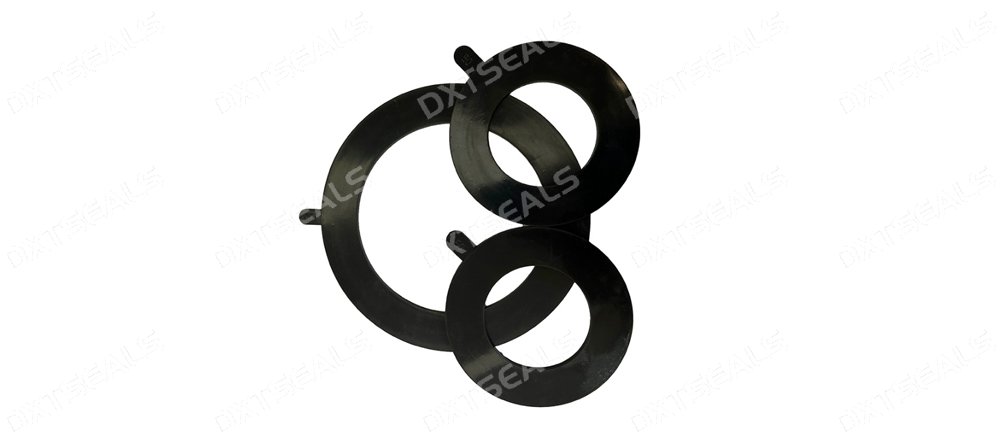
EPDM flange gaskets are widely used for sealing flanged connections in water systems, HVAC equipment, industrial pipelines, chemical processing systems, and many other applications. Their excellent resistance to water, weathering, ozone, and a wide range of chemicals makes EPDM a popular elastomer for flange sealing.
However, selecting the correct EPDM flange gasket is not simply a matter of choosing the right rubber material. The gasket must also match the flange design, pressure rating, temperature range, media, dimensions, and applicable standard.
This guide explains the key properties of EPDM flange gaskets, their common applications, flange configurations, and the most important factors to consider when selecting the right gasket.
What Is an EPDM Flange Gasket?
EPDM stands for Ethylene Propylene Diene Monomer, a synthetic rubber widely used in industrial sealing applications.
An EPDM flange gasket is a sealing component installed between two mating flanges. When the flange bolts are tightened, the gasket is compressed between the flange faces and creates a barrier against fluid or gas leakage.
EPDM flange gaskets can be manufactured in various shapes and dimensions according to the flange design.
Common configurations include:
-
Full Face (FF) flange gaskets
-
Raised Face (RF) flange gaskets
-
Ring-style flange gaskets
-
Custom-shaped EPDM gaskets
-
Flat EPDM flange gaskets
-
EPDM gaskets with reinforcing inserts
The correct gasket configuration depends on the flange type and sealing requirements.
Key Material Properties of EPDM
The popularity of EPDM flange gaskets comes from the material's combination of flexibility, weather resistance, water resistance, and chemical resistance.
Excellent Water Resistance
EPDM performs particularly well in water-based applications.
It is commonly used for:
-
Drinking water systems
-
Industrial water pipelines
-
Cooling water
-
HVAC systems
-
Wastewater systems
-
Water treatment equipment
-
Irrigation systems
Its resistance to water makes EPDM an excellent choice for many general-purpose water sealing applications.
Excellent Weather and Ozone Resistance
EPDM has excellent resistance to:
-
Ozone
-
UV exposure
-
Weathering
-
Aging
This makes it suitable for outdoor equipment and installations exposed to environmental conditions.
Unlike some elastomers that deteriorate relatively quickly under prolonged outdoor exposure, EPDM can maintain useful sealing properties for extended periods when properly selected and used.
Good Chemical Resistance
EPDM provides good resistance to many water-based chemicals, dilute acids, and alkaline solutions.
This makes it useful in various industrial environments.
However, chemical compatibility should always be evaluated against the actual chemical, concentration, temperature, and exposure conditions.
EPDM is generally not the preferred material for applications involving petroleum-based oils, mineral oils, or hydrocarbon fuels.
EPDM Temperature Resistance
EPDM can operate over a relatively broad temperature range, depending on the specific compound and application.
In many general industrial sealing applications, EPDM is suitable for moderate and elevated temperatures.
It is commonly used in:
-
Hot water systems
-
Cooling systems
-
HVAC equipment
-
Steam-related applications
-
Industrial water systems
However, the actual maximum operating temperature depends on the specific EPDM formulation, pressure, medium, and operating conditions.
For continuous high-temperature service, the gasket compound should be evaluated carefully rather than relying on a generic EPDM temperature rating.
EPDM vs. Other Common Rubber Materials
Material selection is one of the most important steps when choosing a flange gasket.
EPDM vs. NBR
NBR is commonly selected for oils and petroleum-based fluids, while EPDM generally provides better resistance to water, weathering, ozone, and many water-based chemicals.
For water and outdoor applications, EPDM is often the preferred choice.
For mineral oils and petroleum-based fluids, NBR may be more appropriate.
EPDM vs. FKM
FKM is known for its excellent resistance to many oils, fuels, and high-temperature environments.
EPDM, however, is generally more suitable for hot water, steam in appropriate conditions, weathering, and many water-based chemical applications.
The two materials should therefore not be considered interchangeable.
EPDM vs. PTFE
PTFE offers extremely broad chemical resistance and very low friction.
EPDM is an elastomer, while PTFE is a fluoropolymer, so they have significantly different mechanical properties and sealing behavior.
EPDM is often more economical for general-purpose water and utility flange sealing, while PTFE may be selected for aggressive chemical environments where its chemical resistance provides a significant advantage.
EPDM Flange Gasket Applications
EPDM flange gaskets are used in many industries because of their excellent resistance to water and environmental exposure.
1. Water Treatment
Water treatment equipment frequently uses EPDM flange gaskets for:
-
Water pipelines
-
Pumps
-
Valves
-
Filtration equipment
-
Treatment tanks
-
Pipe connections
EPDM is particularly suitable when the sealing medium is water and the operating conditions fall within the material's limits.
2. HVAC Systems
Heating, ventilation, and air-conditioning systems commonly contain extensive piping networks.
EPDM flange gaskets can be used in:
-
Chilled water systems
-
Cooling water systems
-
Heating water systems
-
HVAC pipelines
-
Pumps and valves
Their resistance to water and weathering makes them suitable for many HVAC applications.
3. Industrial Water Systems
Factories often use large quantities of process and cooling water.
EPDM flange gaskets can be installed in:
-
Cooling circuits
-
Circulation systems
-
Utility pipelines
-
Industrial pumps
-
Heat exchangers
-
Water storage systems
4. Chemical Processing
EPDM can be used for selected chemical applications involving compatible media.
It may be suitable for certain dilute acids, alkalis, and water-based chemicals.
However, chemical compatibility must always be checked before selecting the gasket.
5. Outdoor Piping Systems
EPDM's excellent resistance to ozone and weathering makes it suitable for outdoor applications.
It can be used in piping and equipment exposed to:
-
Sunlight
-
Rain
-
Ozone
-
Temperature fluctuations
-
Outdoor environmental conditions
FF and RF EPDM Flange Gaskets
Flange face configuration is an important factor when selecting an EPDM gasket.
Two common flange configurations are Full Face (FF) and Raised Face (RF).
Full Face EPDM Gaskets
A full-face gasket covers the entire flange face, including the bolt holes.
Full-face gaskets are commonly used with flat-face flanges.
They can provide a large sealing area and help distribute the compressive load across the flange surface.
Raised Face EPDM Gaskets
A raised-face gasket is designed for use with raised-face flanges.
The sealing area is concentrated around the raised portion of the flange rather than covering the entire flange face.
RF gaskets are widely used in industrial piping systems.
The gasket dimensions must match the applicable flange standard and pressure class.
American and European Flange Standards
EPDM flange gaskets are manufactured according to different international flange standards.
Common standards include:
-
ASME / ANSI flange standards
-
EN flange standards
-
DIN flange standards
-
JIS flange standards
-
Other regional or application-specific standards
American and European flange systems can have different dimensions, bolt patterns, pressure classifications, and gasket dimensions.
Therefore, a gasket designed for one flange standard should not automatically be assumed to fit another.
When ordering an EPDM flange gasket, the manufacturer should know the applicable flange standard, nominal size, pressure class, and flange face type.
EPDM Gasket Dimensions
Correct dimensions are essential for reliable flange sealing.
Important dimensions may include:
-
Inside diameter
-
Outside diameter
-
Overall gasket thickness
-
Bolt-hole diameter
-
Bolt-hole quantity
-
Bolt-hole pitch circle diameter
-
Sealing width
For standard flange applications, gasket dimensions can normally be determined from the relevant flange and gasket standard.
For non-standard equipment, custom dimensions may be required.
Standard vs. Custom EPDM Flange Gaskets
Standard EPDM flange gaskets are convenient when the flange dimensions match a recognized standard.
However, industrial equipment frequently contains non-standard or modified flange connections.
Custom EPDM gaskets may be required when:
-
The flange dimensions are non-standard
-
The equipment uses a special bolt pattern
-
The gasket has an unusual shape
-
The sealing surface is customized
-
A special thickness is required
-
The application requires a reinforced structure
Custom manufacturing allows the gasket geometry to be matched directly to the customer's drawing or existing equipment.
EPDM Gaskets with Reinforcing Inserts
Some applications require additional mechanical support.
An EPDM gasket can be manufactured with a reinforcing insert or metal frame depending on the design.
Reinforcement can help improve:
-
Mechanical stability
-
Handling strength
-
Dimensional stability
-
Resistance to extrusion
-
Installation convenience
A reinforced EPDM gasket may be particularly useful for larger gasket dimensions or applications where the gasket needs additional structural support.
The reinforcement material must be compatible with the operating environment.
How to Select the Right EPDM Flange Gasket
Selecting an EPDM flange gasket should begin with the operating conditions rather than simply the gasket size.
1. Identify the Sealing Medium
Determine exactly what the gasket will contact.
Examples include:
-
Water
-
Hot water
-
Air
-
Steam
-
Dilute chemicals
-
Alkaline solutions
-
Other industrial fluids
This is the first step in determining whether EPDM is chemically compatible.
2. Check Operating Temperature
Determine both the normal operating temperature and potential temperature peaks.
The EPDM compound should be selected according to the actual temperature conditions.
3. Check Operating Pressure
The gasket must be suitable for the system pressure and flange configuration.
Pressure, flange design, gasket thickness, and bolt load should be considered together.
4. Confirm Flange Type
Determine whether the application uses:
-
Flat Face (FF)
-
Raised Face (RF)
-
Another flange configuration
Using the wrong gasket geometry can lead to leakage or installation problems.
5. Confirm the Applicable Standard
Specify the relevant standard, such as:
-
ASME B16.5
-
ASME B16.47
-
EN standards
-
DIN standards
-
JIS standards
The exact standard depends on the piping system and equipment.
6. Confirm Dimensions
The gasket's ID, OD, thickness, bolt-hole pattern, and sealing area must match the flange.
7. Consider Reinforcement
For large or mechanically demanding gaskets, determine whether a reinforcing insert is necessary.
Common Mistakes When Selecting EPDM Flange Gaskets
Several mistakes can reduce gasket performance.
Choosing EPDM for Oil Applications
EPDM is generally not suitable for petroleum-based oils and hydrocarbon fuels.
A different elastomer such as NBR or FKM may be more appropriate depending on the conditions.
Ignoring the Flange Standard
A gasket with the correct nominal size may still have the wrong bolt-hole pattern or dimensions if the flange standard is different.
Using the Wrong Face Type
An FF gasket and an RF gasket are designed for different flange configurations.
Selecting Thickness Only by Preference
Gasket thickness affects compression and sealing performance. The recommended thickness should be based on the flange and application rather than simply choosing the thickest available gasket.
Ignoring Temperature and Pressure Together
A material may perform well at a particular temperature but not necessarily under the same temperature and pressure combination.
Why EPDM Remains a Popular Flange Gasket Material
EPDM remains widely used because it provides an attractive balance of performance and cost for many water and utility applications.
Its major advantages include:
-
Excellent water resistance
-
Excellent ozone resistance
-
Excellent weather resistance
-
Good chemical resistance
-
Good aging resistance
-
Flexible sealing performance
-
Wide range of available compounds
-
Cost-effective for many applications
These properties make EPDM a practical choice for a broad range of industrial flange sealing applications.
Conclusion
EPDM flange gaskets are versatile sealing components suitable for many industrial applications, particularly those involving water, hot water, HVAC systems, outdoor environments, and compatible water-based chemicals.
However, selecting the right EPDM gasket requires more than simply choosing an EPDM rubber sheet.
The flange face type, standard, nominal size, pressure rating, gasket dimensions, operating temperature, sealing medium, and reinforcement requirements should all be considered.
Full Face (FF) and Raised Face (RF) gaskets are designed for different flange configurations, while American and European flange standards may use different dimensions and bolt patterns.
For standard applications, standardized EPDM flange gaskets can provide a reliable and economical sealing solution. For non-standard equipment, custom EPDM gaskets can be manufactured according to specific drawings and dimensional requirements.
By matching the EPDM compound and gasket design to the actual operating conditions, manufacturers and end users can achieve reliable flange sealing performance and reduce the risk of leakage and premature gasket failure.