
Introduction
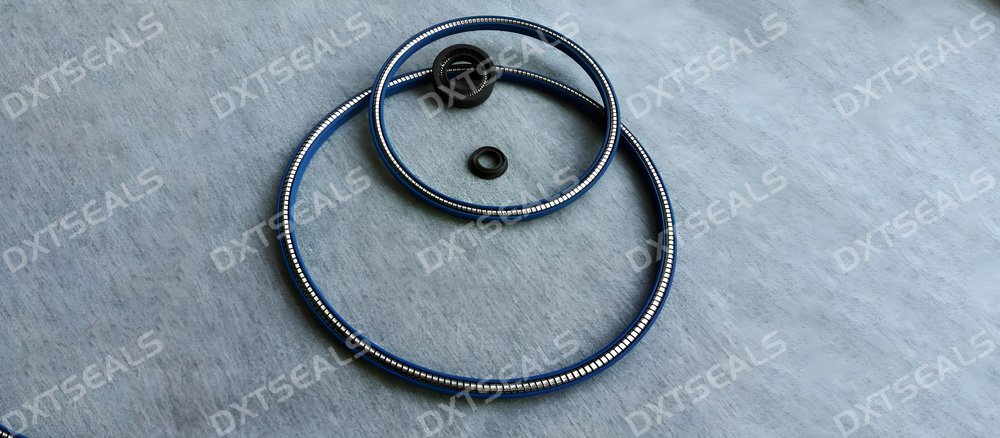
Spring energized seals are widely used in demanding industrial applications because of their excellent sealing performance, chemical resistance, and low friction characteristics. The sealing jacket material is typically based on PTFE (Polytetrafluoroethylene).
While virgin PTFE offers outstanding chemical stability and low friction, it also has limitations such as:
- Poor wear resistance
- High creep under load
- Limited mechanical strength
To overcome these issues, manufacturers use filled PTFE materials. Different fillers significantly improve the performance of PTFE for specific operating conditions.
This article explores the advantages and performance differences of filled PTFE materials in spring energized seals. At DXTSEALS, we provide customized material solutions optimized for various industrial environments.
1. Why Filled PTFE Is Used in Spring Energized Seals
Virgin PTFE is widely valued for:
- Excellent chemical resistance
- Broad temperature range
- Extremely low friction coefficient
However, under high pressure or dynamic conditions, virgin PTFE may experience:
- Excessive deformation
- Rapid wear
- Reduced sealing stability
Adding fillers improves:
- Mechanical strength
- Wear resistance
- Dimensional stability
- Thermal performance
This makes filled PTFE more suitable for demanding sealing applications.
2. Common Types of Filled PTFE Materials
Glass Fiber Filled PTFE
Glass-filled PTFE is one of the most commonly used materials.
Advantages
- Improved compressive strength
- Better dimensional stability
- Reduced creep deformation
- Enhanced wear resistance
Limitations
- Slightly higher friction than virgin PTFE
- May increase wear on mating surfaces in some conditions
Typical Applications
- Hydraulic systems
- General industrial equipment
- Medium-load sealing applications
Carbon Filled PTFE
Carbon-filled PTFE is widely used in dynamic and high-speed applications.
Advantages
- Excellent wear resistance
- Improved thermal conductivity
- Good resistance to deformation
- Lower friction under dynamic operation
Limitations
- Less suitable for strong oxidizing environments
Typical Applications
- Compressors
- Pumps
- Rotating equipment
Graphite Filled PTFE
Graphite-filled PTFE combines low friction with high-temperature capability.
Advantages
- Excellent self-lubricating properties
- Reduced friction and heat generation
- Good dry-running performance
- Stable at elevated temperatures
Limitations
- Lower mechanical strength than some other filled materials
Typical Applications
- High-temperature sealing
- Dynamic sealing systems
- Dry-running applications
Bronze Filled PTFE
Bronze-filled PTFE is designed for heavy-duty applications.
Advantages
- High mechanical strength
- Excellent wear resistance
- Strong resistance to deformation under load
Limitations
- Reduced chemical resistance in certain media
- Higher friction coefficient
Typical Applications
- Heavy-duty hydraulic systems
- High-pressure industrial equipment
Advanced Filled PTFE Materials
Specialized fillers such as:
- PEEK
- MoS₂ (Molybdenum Disulfide)
- Composite blends
are used for highly specialized applications requiring extreme performance.
3. Performance Comparison of Filled PTFE Materials
| Material Type | Wear Resistance | Friction Level | Chemical Resistance | Mechanical Strength | Temperature Performance |
|---|---|---|---|---|---|
| Virgin PTFE | Moderate | Very Low | Excellent | Low | Excellent |
| Glass Filled PTFE | Good | Medium | Very Good | Good | Good |
| Carbon Filled PTFE | Excellent | Low | Good | Good | Excellent |
| Graphite Filled PTFE | Very Good | Very Low | Excellent | Moderate | Excellent |
| Bronze Filled PTFE | Excellent | Medium–High | Moderate | Excellent | Good |
4. Selecting Filled PTFE Based on Working Conditions
High-Speed Dynamic Applications
Recommended:
- Carbon-filled PTFE
- Graphite-filled PTFE
Reason: low friction and excellent wear resistance.
High-Pressure Systems
Recommended:
- Bronze-filled PTFE
- Glass-filled PTFE
Reason: superior compressive strength and reduced creep.
Chemically Aggressive Environments
Recommended:
- Virgin PTFE
- Graphite-filled PTFE
Reason: excellent chemical compatibility.
High-Temperature Conditions
Recommended:
- Graphite-filled PTFE
- Carbon-filled PTFE
Reason: thermal stability and low friction at elevated temperatures.
At DXTSEALS, we evaluate operating conditions carefully to recommend the most suitable filled PTFE solution.
5. Importance of Matching Fillers with Spring Design
The performance of a spring energized seal depends on both:
- PTFE material characteristics
- Internal spring structure
For example:
- V-springs pair well with low-friction materials for dynamic sealing
- Helical springs are suitable for high-pressure systems requiring stronger sealing force
Optimizing both components ensures maximum sealing performance and service life.
6. Common Material Selection Mistakes
- Using virgin PTFE in high-load applications
- Selecting bronze-filled PTFE for highly corrosive environments
- Ignoring friction requirements in dynamic systems
- Failing to consider temperature effects
Proper engineering analysis helps avoid these issues.
Conclusion
Filled PTFE materials significantly improve the performance of spring energized seals by enhancing:
- Wear resistance
- Mechanical strength
- Thermal stability
- Dimensional control
Different fillers provide different advantages:
- Glass-filled PTFE for stability and strength
- Carbon-filled PTFE for dynamic wear resistance
- Graphite-filled PTFE for low friction and high temperature
- Bronze-filled PTFE for heavy-duty pressure applications
Selecting the right material combination is essential for reliable sealing and long service life.
At DXTSEALS, we provide customized filled PTFE sealing solutions tailored to your specific application requirements.
If you need assistance selecting the right PTFE material for your spring energized seals, contact DXTSEALS today for professional support and customized solutions.