
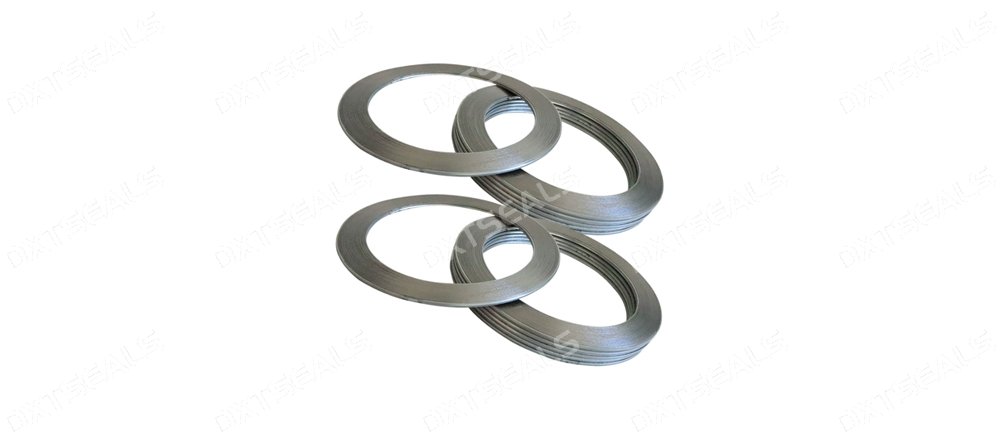
Flange gaskets are critical sealing components used in industrial piping, pumps, valves, heat exchangers, pressure vessels, and process equipment. Although a flange gasket may appear to be a simple flat sealing component, its dimensions and design must match the corresponding flange system precisely.
Selecting a gasket based only on nominal pipe size is often insufficient. Different flange standards can specify different flange dimensions, bolt-hole patterns, pressure classes, facing configurations, and gasket dimensions. A gasket that appears suitable by diameter may still be incompatible with the actual flange.
Common flange standards include ASME/ANSI, EN, DIN, and JIS, each serving different industrial and regional applications.
This article explains why flange gasket standards and dimensions matter, how FF and RF configurations affect gasket selection, and what information should be confirmed when purchasing or manufacturing standard and custom flange gaskets.
1. Why Flange Gasket Standards Matter
A flange gasket does not work independently. It forms part of a complete flange connection consisting of:
-
Flanges
-
Gasket
-
Bolts and nuts
-
Piping or equipment
-
Sealing surfaces
The gasket must fit the geometry of the flange and provide sufficient sealing pressure under operating conditions.
A flange standard establishes important dimensional requirements for the connection. Depending on the standard, these requirements may include:
-
Nominal pipe size
-
Flange outside diameter
-
Flange thickness
-
Bolt-circle diameter
-
Number of bolt holes
-
Bolt-hole diameter
-
Raised-face dimensions
-
Sealing-face dimensions
-
Pressure class or pressure rating
Because these dimensions can vary between standards, gasket compatibility must be evaluated against the actual flange standard.
2. Common Flange Standards
Several flange standards are widely used around the world.
ASME/ANSI Flange Standards
ASME flange standards are widely used in North America and in many international industrial projects.
Common examples include:
-
ASME B16.5
-
ASME B16.47
ASME B16.5 covers many standard pipe flanges and flanged fittings within its specified size and pressure ranges, while ASME B16.47 addresses larger-diameter flanges.
ASME systems commonly use pressure classes such as:
-
Class 150
-
Class 300
-
Class 600
-
Class 900
-
Class 1500
-
Class 2500
The applicable class must be identified when selecting a replacement gasket.
EN Flange Standards
EN flange systems are widely used in Europe and international equipment manufactured to European standards.
Common flange designations may include:
-
EN 1092-1
-
PN 6
-
PN 10
-
PN 16
-
PN 25
-
PN 40
-
Higher pressure ratings where applicable
The dimensions and designation system differ from ASME Class systems.
DIN Flange Standards
DIN standards have historically been widely used for industrial equipment and piping systems, particularly in Germany and other European markets.
Many modern applications use EN standards, but DIN-designated equipment and replacement parts remain common.
When replacing a gasket for older equipment, it is important to identify the actual flange specification rather than assuming that a DIN gasket and an EN gasket are automatically interchangeable.
JIS Flange Standards
JIS flange standards are widely used in Japan and in equipment manufactured for markets using Japanese industrial standards.
Common pressure designations include:
-
5K
-
10K
-
16K
-
Other applicable classes
JIS flange dimensions and bolt patterns can differ from ASME and EN/DIN systems.
Therefore, a JIS gasket should be selected according to the corresponding JIS flange dimensions.
3. Nominal Size Does Not Guarantee Compatibility
One of the most common mistakes in flange gasket selection is assuming that the same nominal pipe size means that all gaskets are interchangeable.
For example, a gasket for a nominal size such as 4 inches or DN100 may have different dimensions depending on:
-
Flange standard
-
Pressure class
-
Flange facing
-
Gasket type
-
Equipment design
The nominal pipe size is only one part of the specification.
A complete gasket identification should ideally include information such as:
Standard + nominal size + pressure class + flange face + gasket material + thickness
For example, simply requesting a "DN100 flange gasket" may not provide enough information for accurate manufacturing.
4. Flange Gasket Dimensions
The dimensions of a flange gasket may include:
-
Inside diameter (ID)
-
Outside diameter (OD)
-
Thickness
-
Bolt-hole diameter
-
Number of bolt holes
-
Bolt-circle diameter
-
Sealing-face width
-
Special internal or external profiles
The required dimensions depend on the gasket configuration.
Inside Diameter
The inside diameter must provide an appropriate opening for the pipe or equipment passage.
An excessively small ID can restrict flow or interfere with the pipe bore.
An excessively large ID may reduce the effective sealing area or create an unsuitable gasket configuration.
Outside Diameter
The outside diameter depends on the flange design and gasket type.
FF gaskets typically extend toward the outer flange edge, while RF gaskets are generally more concentrated around the raised sealing face.
Thickness
Gasket thickness affects compression, sealing behavior, bolt loading, and the ability to accommodate flange surface irregularities.
A thicker gasket is not automatically better.
The correct thickness should be selected according to the gasket material, flange design, operating conditions, and engineering requirements.
5. FF vs RF Gasket Dimensions
Flange facing is one of the most important factors affecting gasket dimensions.
FF — Full Face
A Full Face gasket generally covers the entire flange face and includes bolt-hole locations.
FF gaskets are normally associated with flat-face flange systems.
Typical FF gasket dimensions include:
-
Full outside diameter
-
Full inside diameter
-
Bolt-hole diameter
-
Bolt-hole quantity
-
Bolt-circle diameter
-
Gasket thickness
RF — Raised Face
An RF gasket is designed primarily for the raised sealing area of a raised-face flange.
Its outside diameter is generally smaller than that of a corresponding FF gasket.
RF gasket dimensions are therefore determined by:
-
Raised-face diameter
-
Flange standard
-
Nominal size
-
Pressure class
-
Gasket type
-
Material
-
Thickness
An FF gasket should not automatically be substituted for an RF gasket simply because the nominal pipe size is the same.
6. Pressure Class and Gasket Dimensions
Pressure class is another important part of flange gasket selection.
In ASME systems, common classes include:
-
150
-
300
-
600
-
900
-
1500
-
2500
In EN systems, pressure designations commonly include:
-
PN 6
-
PN 10
-
PN 16
-
PN 25
-
PN 40
-
Other applicable ratings
The pressure designation does not simply indicate the gasket's independent pressure capability. It identifies the design class of the flange system.
The gasket must therefore be compatible with the corresponding flange and service conditions.
Higher-pressure flange systems may require different:
-
Flange dimensions
-
Bolt configurations
-
Gasket dimensions
-
Gasket materials
-
Sealing designs
-
Installation procedures
7. Standard Compatibility and Bolt-Hole Patterns
Bolt-hole alignment is essential.
A gasket may have the correct inside and outside diameter but still be unsuitable if the bolt holes do not match the flange.
Important bolt-related dimensions include:
-
Number of bolt holes
-
Bolt-hole diameter
-
Bolt-circle diameter
-
Angular spacing
-
Hole position
For example, two flange systems may use similar nominal pipe sizes but have different bolt-hole patterns.
Installing a gasket with incorrect bolt holes can cause:
-
Installation difficulties
-
Misalignment
-
Uneven gasket compression
-
Reduced sealing area
-
Potential leakage
For this reason, bolt-hole dimensions should be verified when the flange standard is uncertain.
8. ASME vs EN/DIN vs JIS Flange Gaskets
Different standards should be treated as separate dimensional systems unless engineering documentation confirms compatibility.
| Standard System | Common Designations | Key Selection Factors |
|---|---|---|
| ASME | Class 150, 300, 600, etc. | NPS, pressure class, flange type, dimensions |
| EN | PN 6, 10, 16, 25, 40, etc. | DN, PN rating, flange type, dimensions |
| DIN | DIN-designated equipment/flanges | DN, pressure rating, flange dimensions |
| JIS | 5K, 10K, 16K, etc. | Nominal size, pressure designation, bolt pattern |
The terminology and dimensional systems are different.
Therefore, the safest approach is to identify the exact flange standard before selecting a replacement gasket.
9. Gasket Material and Dimensional Compatibility
Dimensions alone do not determine whether a gasket is suitable.
The gasket material must also match the operating environment.
Common flange gasket materials include:
EPDM
EPDM is commonly selected for:
-
Water
-
Cooling water
-
Chilled water
-
HVAC
-
Outdoor applications
-
Many polar chemicals
It provides excellent water, ozone, and weather resistance.
However, EPDM is generally unsuitable for many petroleum oils, mineral oils, and fuels.
NBR
NBR is commonly considered for applications involving:
-
Mineral oils
-
Petroleum-based fluids
-
Fuels
-
Hydraulic fluids
The exact NBR compound and temperature range must be evaluated.
FKM
FKM is often selected when resistance to certain oils, fuels, chemicals, and elevated temperatures is required.
Compatibility depends on the specific fluid and FKM compound.
PTFE
PTFE provides excellent chemical resistance and is widely used in chemical processing and corrosive-fluid applications.
Different PTFE grades and modified PTFE materials can provide different performance characteristics.
Non-Asbestos
Non-asbestos compressed gasket materials are widely used in industrial piping and equipment.
Different grades can provide different combinations of:
-
Temperature resistance
-
Chemical resistance
-
Compression behavior
-
Mechanical strength
Therefore, "non-asbestos" should not be treated as one universal gasket specification.
Graphite
Graphite gasket materials are often selected for high-temperature applications and can be used in various industrial sealing designs.
The appropriate graphite gasket construction depends on the application and flange system.
10. Why Material and Standard Must Be Considered Together
A gasket may have the correct dimensions but still fail because the material is unsuitable.
For example, an EPDM gasket may fit perfectly into an RF flange but still be unsuitable for a petroleum-based oil application.
Similarly, a chemically resistant PTFE gasket may have the correct material but incorrect dimensions for the flange.
Reliable gasket selection therefore requires both:
Dimensional compatibility
and
Material compatibility
These two factors should always be evaluated together.
11. Gasket Thickness and Flange Sealing
Thickness is an important but sometimes overlooked specification.
The gasket thickness influences:
-
Required bolt load
-
Compression
-
Gasket deformation
-
Flange separation
-
Surface conformity
-
Long-term sealing behavior
Different gasket materials behave differently under compression.
For example, elastomeric materials such as EPDM can deform significantly, while compressed fiber and metallic gasket materials have different compression characteristics.
When replacing an existing gasket, matching the original thickness may be important unless the application has been specifically redesigned.
12. Surface Finish and Gasket Selection
The flange sealing surface also affects gasket performance.
The flange should be inspected for:
-
Scratches
-
Corrosion
-
Pitting
-
Deformation
-
Contamination
-
Excessive surface roughness
-
Uneven flange faces
Different gasket materials may have different requirements for flange surface finish.
A gasket cannot compensate indefinitely for a severely damaged flange surface.
If the flange is warped, badly corroded, or mechanically damaged, replacing the gasket alone may not solve the leakage problem.
13. How to Identify the Correct Replacement Flange Gasket
When replacing an existing gasket, the following information should ideally be collected.
1. Flange Standard
Determine whether the flange follows:
-
ASME
-
EN
-
DIN
-
JIS
-
Other standards
2. Nominal Size
Record the nominal pipe size, such as:
-
NPS
-
DN
-
Other applicable size designations
3. Pressure Class
Record the applicable pressure class or PN designation.
4. Flange Facing
Identify:
-
FF
-
RF
-
RTJ
-
Other specialized facing
5. Gasket Material
Identify the original or required material.
6. Gasket Thickness
Measure or confirm the required thickness.
7. Bolt-Hole Pattern
Check:
-
Number of holes
-
Hole diameter
-
Bolt-circle diameter
-
Hole spacing
8. Operating Conditions
Record:
-
Medium
-
Temperature
-
Pressure
-
Chemical concentration where applicable
This information significantly improves replacement accuracy.
14. Custom Flange Gasket Manufacturing
Not every industrial flange uses a standard catalog gasket.
Custom flange gaskets are frequently required for:
-
Older equipment
-
Imported machinery
-
Special process equipment
-
Large-diameter piping
-
Non-standard flange designs
-
Modified equipment
-
Replacement parts with discontinued specifications
Custom gasket manufacturing can produce:
-
Custom FF gaskets
-
Custom RF gaskets
-
Large-diameter flange gaskets
-
Special bolt-hole patterns
-
Non-standard gasket thicknesses
-
Special-shaped gaskets
-
Custom EPDM gaskets
-
Custom non-asbestos gaskets
-
PTFE gaskets
-
Graphite gaskets
-
Other application-specific sealing products
Manufacturing can be based on:
-
Engineering drawings
-
CAD files
-
Existing gasket samples
-
Flange measurements
-
Equipment documentation
15. Why Accurate Measurements Matter for Custom Gaskets
A few millimeters of dimensional error can affect gasket installation and sealing performance.
Important measurements include:
Inside Diameter → Outside Diameter → Bolt-Circle Diameter → Bolt-Hole Diameter → Number of Holes → Thickness
For large or unusual flanges, measurements should ideally be verified using appropriate dimensional inspection equipment.
For critical applications, technical drawings are preferable to estimates based on photographs or nominal pipe size alone.
16. Common Flange Gasket Dimension Mistakes
Mistake 1: Ordering by Nominal Size Only
"DN100 gasket" or "4-inch gasket" may not contain enough information.
The flange standard and pressure class are also required.
Mistake 2: Confusing FF and RF
An FF gasket and an RF gasket can have significantly different dimensions even when used with the same nominal pipe size.
Mistake 3: Ignoring the Bolt Pattern
Correct ID and OD do not guarantee correct bolt-hole alignment.
Mistake 4: Mixing Standards
A gasket manufactured for one standard should not automatically be assumed to fit another.
Mistake 5: Ignoring Thickness
Changing gasket thickness can affect compression and bolt loading.
Mistake 6: Choosing Material Independently of the Medium
A dimensionally correct gasket can still fail if its material is incompatible with the process fluid.
17. A Practical Flange Gasket Specification
For industrial purchasing and manufacturing, a complete gasket specification might include:
Gasket Type: RF Flange Gasket
Standard: ASME B16.5
Size: NPS 4
Pressure Class: Class 300
Material: Non-Asbestos
Thickness: Application-specific
Medium: Industrial water
Operating Temperature: Application-specific
A more complex specification might additionally include:
-
Flange material
-
Surface finish
-
Bolt material
-
Special certification
-
Chemical concentration
-
Temperature cycling
-
Required gasket density
The more complete the specification, the lower the risk of receiving an incompatible replacement gasket.
18. Flange Gasket Standards and Dimensions: Quick Checklist
Before ordering or manufacturing a flange gasket, confirm:
-
Flange standard
-
Nominal size
-
Pressure class / PN rating
-
FF or RF configuration
-
Inside diameter
-
Outside diameter
-
Gasket thickness
-
Bolt-hole quantity
-
Bolt-hole diameter
-
Bolt-circle diameter
-
Gasket material
-
Operating medium
-
Operating temperature
-
Operating pressure
-
Required certifications, if applicable
This checklist is particularly useful for replacement and custom gasket applications.
19. Conclusion
Flange gasket selection is not simply a matter of choosing a gasket with the correct nominal diameter.
Standard compatibility and dimensional accuracy are fundamental to reliable flange sealing.
ASME, EN, DIN, and JIS flange systems use different dimensional and designation systems. Even when two flanges have similar nominal sizes, their bolt-hole patterns, pressure classes, facing dimensions, and gasket requirements may differ.
FF and RF configurations must also be distinguished. A Full Face gasket is generally designed for a flat-face flange, while a Raised Face gasket is designed around the raised sealing surface of an RF flange.
Material selection is equally important. EPDM, NBR, FKM, PTFE, non-asbestos, graphite, and other gasket materials provide different levels of resistance to temperature, pressure, chemicals, oils, water, and environmental exposure.
The most reliable selection process is therefore:
Identify the flange standard → confirm size and pressure class → identify FF/RF configuration → verify gasket dimensions → select the appropriate material → confirm operating conditions.
For standard and non-standard industrial applications, accurate drawings, measurements, and technical specifications allow manufacturers to produce replacement flange gaskets that match the actual equipment rather than relying on nominal size alone.