
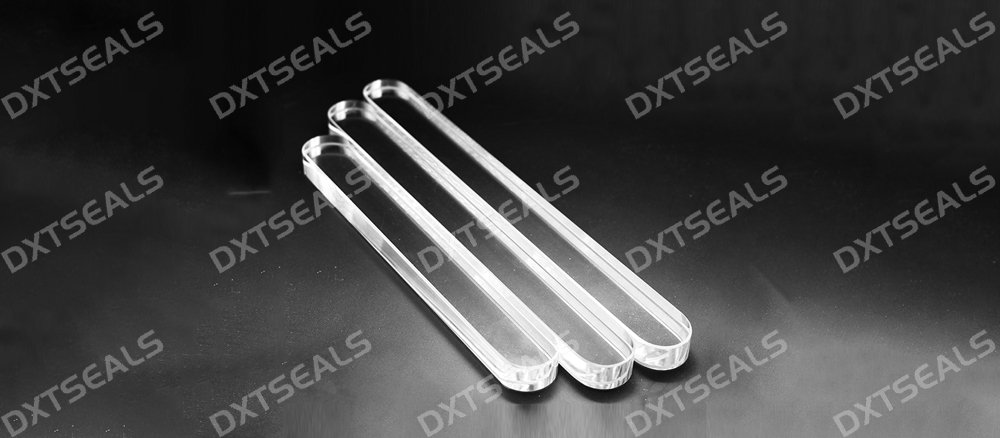
German standard borosilicate level gauge glass is widely used in industrial equipment for direct visual observation of liquid levels. Its combination of optical clarity, thermal stability, chemical resistance, and mechanical strength makes it suitable for demanding applications such as boilers, pressure vessels, tanks, and industrial liquid level indicators.
Compared with ordinary glass, borosilicate glass is designed to withstand greater temperature changes and harsh operating environments. When manufactured according to German-standard dimensions and specifications, the glass can be matched with corresponding level gauge bodies, gaskets, cushions, and other sealing components.
For industrial users, selecting the correct material, dimensions, surface quality, and sealing configuration is essential for reliable operation.
What Is German Standard Borosilicate Level Gauge Glass?
German standard borosilicate level gauge glass is a transparent glass component manufactured from borosilicate glass and produced according to applicable German-standard dimensions or equipment specifications.
It is commonly installed in reflex, transparent, or tubular level gauge assemblies to allow operators to visually monitor the liquid level inside industrial equipment.
Depending on the gauge design, the glass may be supplied with matching gaskets and other accessories to form a complete sealing and viewing assembly.
The exact dimensions, thickness, edge configuration, and operating limits should be selected according to the level gauge design and equipment requirements.
Material Properties of Borosilicate Gauge Glass
Low Thermal Expansion
One of the major advantages of borosilicate glass is its relatively low coefficient of thermal expansion. This allows the material to better withstand temperature changes than conventional glass.
This property is particularly important for boilers, hot-water systems, steam equipment, and other industrial applications where the gauge glass may experience repeated heating and cooling.
Good Thermal Shock Resistance
Industrial level gauge glass may be exposed to sudden temperature changes during equipment startup, shutdown, or process fluctuations.
Borosilicate glass provides good resistance to thermal shock when the appropriate glass grade, thickness, and installation method are used.
However, the allowable temperature difference depends on the specific glass design and operating conditions.
High Temperature Performance
Borosilicate glass is suitable for many high-temperature industrial applications. Its thermal stability makes it a common choice for liquid level indicators and sight glass systems used in heating and process equipment.
The actual maximum operating temperature should always be determined according to the glass grade, dimensions, mounting configuration, pressure, and manufacturer's specifications.
Chemical Resistance
Borosilicate glass has good resistance to many chemicals and industrial fluids. This makes it suitable for applications where the gauge glass may come into contact with water, steam, process liquids, and various chemical media.
For aggressive chemicals or specialized process fluids, material compatibility should be evaluated before selection.
Excellent Optical Clarity
Clear visual observation is one of the most important requirements for a level gauge glass.
High-quality borosilicate gauge glass provides good transparency, allowing operators to monitor the liquid level without opening the equipment or using electronic measuring instruments.
Good surface quality and dimensional accuracy also contribute to reliable visual inspection.
Typical Applications
German standard borosilicate level gauge glass can be used in a wide range of industrial equipment.
Boilers and Steam Equipment
Boiler level gauges are one of the most common applications. The glass allows operators to observe the water level directly and helps support safe equipment operation.
Because boiler systems involve high temperature and pressure, the gauge glass must be properly matched with the gauge body, sealing components, and operating conditions.
Pressure Vessels
Borosilicate gauge glass can also be used on pressure vessels where direct observation of liquid levels is required.
The glass dimensions and pressure capability must be selected according to the specific vessel and level gauge assembly.
Storage and Process Tanks
Industrial tanks may require visual liquid-level monitoring for water, oils, chemicals, solvents, and other process media.
Borosilicate gauge glass provides a simple and reliable method of visual inspection without requiring complex electronic equipment.
Industrial Level Indicators
Borosilicate glass is commonly used in transparent level gauges and other mechanical liquid-level indication systems.
It can be supplied in different dimensions and configurations to match standard industrial level gauge designs.
Chemical and Process Equipment
Because of its good chemical resistance and thermal stability, borosilicate glass is suitable for selected chemical processing and industrial process applications.
The specific chemical medium, concentration, temperature, and pressure should be considered when choosing the appropriate glass material.
Why Choose Borosilicate Glass for Level Gauges?
The main advantages of borosilicate level gauge glass include:
- Good thermal stability
- Low thermal expansion
- Good thermal shock resistance
- High optical clarity
- Good chemical resistance
- Suitable for high-temperature applications
- Reliable dimensional stability
- Suitable for industrial level gauge assemblies
- Available in standard and custom dimensions
These characteristics make borosilicate glass a practical material for industrial liquid-level observation.
Importance of Correct Dimensions
Level gauge glass is not a universal component. Even small differences in length, width, thickness, hole position, edge design, or mounting configuration can affect installation.
When replacing an existing gauge glass, it is important to confirm:
- Overall length and width
- Glass thickness
- Hole dimensions and positions, if applicable
- Edge configuration
- Gauge type
- Installation method
- Gasket dimensions
- Operating temperature
- Operating pressure
- Process medium
For equipment using German-standard level gauge components, matching the original dimensions and assembly configuration is especially important.
Gauge Glass and Gasket Matching
A level gauge glass normally works together with sealing components. The gasket provides sealing between the glass and the gauge body while helping maintain the required assembly configuration.
Depending on the application, different gasket materials may be selected, including graphite, PTFE, mica-based materials, or other suitable sealing materials.
The correct gasket material depends on the temperature, pressure, chemical medium, and equipment design.
Providing the gauge glass together with matching gaskets can simplify replacement and maintenance for industrial customers.
Standard and Custom Manufacturing
German-standard borosilicate level gauge glass is available in standard market dimensions for common industrial level gauge systems.
At the same time, many replacement projects require non-standard dimensions because equipment may have been modified, discontinued, or manufactured according to specific OEM requirements.
Custom manufacturing can be based on:
- Technical drawings
- Existing glass samples
- Detailed dimensions
- OEM specifications
- Equipment model information
- Required gasket configuration
Custom processing allows manufacturers to provide replacement gauge glass that matches the customer's existing equipment.
Replacement Borosilicate Level Gauge Glass
For maintenance and replacement applications, it is not always necessary to purchase a complete new level gauge assembly.
If the gauge body remains in good condition, replacing only the damaged or worn glass and sealing components can be a more practical solution.
Before ordering replacement glass, customers should confirm the original dimensions and operating conditions. A matching gasket should also be considered to ensure proper installation and sealing.
Quality Considerations
For industrial level gauge glass, quality control should cover both the glass material and finished dimensions.
Important inspection points may include:
- Glass dimensions
- Thickness
- Surface condition
- Edge quality
- Transparency
- Dimensional tolerances
- Hole position and size, where applicable
- Flatness
- Compatibility with the sealing assembly
Consistent manufacturing quality is particularly important for replacement parts used in boilers, pressure equipment, and industrial process systems.
Conclusion
German standard borosilicate level gauge glass provides a combination of thermal stability, chemical resistance, optical clarity, and mechanical reliability for industrial liquid-level observation.
It is widely applicable to boilers, pressure vessels, storage tanks, process equipment, and industrial level indicators. Correct material selection and accurate dimensions are essential for safe and reliable installation.
We can supply standard German-style borosilicate level gauge glass for common industrial applications and also provide non-standard customized products according to drawings, samples, dimensions, or OEM requirements. Matching gaskets and related sealing components can also be supplied for complete replacement solutions.