
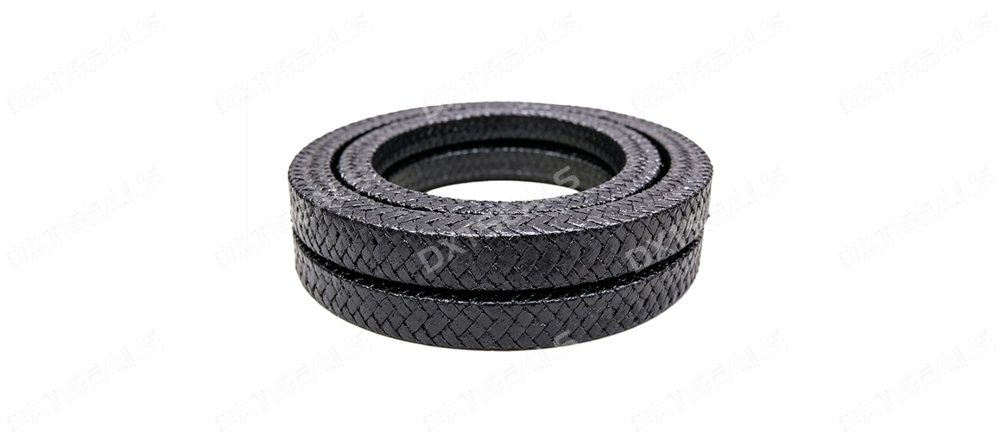
High-temperature industrial equipment requires sealing materials that can maintain reliable performance under elevated temperatures, pressure fluctuations, mechanical movement, and demanding process conditions. Graphite packing is widely used for these applications because graphite provides excellent thermal stability, low friction, and good resistance to many industrial environments.
Graphite packing is commonly installed around valve stems, pump shafts, and other moving or stationary components. It can be manufactured in different constructions, including braided graphite packing, flexible graphite packing, expanded graphite packing, and reinforced graphite packing.
The actual performance of graphite packing depends on its graphite grade, construction, reinforcement, operating temperature, pressure, process medium, equipment design, and installation conditions.
What Is Graphite Packing?
Graphite packing is a gland packing material made primarily from graphite-based materials. Depending on the product design, it may use flexible graphite foil, expanded graphite, graphite yarn, or combinations of graphite with reinforcing materials.
The packing is compressed inside a stuffing box to create a sealing barrier between a stationary housing and a moving shaft or valve stem.
Typical applications include:
- Industrial valves
- High-temperature pumps
- Steam systems
- Power-generation equipment
- Chemical processing equipment
- Thermal-fluid systems
- Process machinery
- High-temperature rotating equipment
Graphite packing can be supplied in various cross-sections and constructions to meet different equipment requirements.
Key Material Properties of Graphite Packing
High-Temperature Resistance
The most important characteristic of graphite packing is its suitability for high-temperature sealing.
Graphite can maintain useful sealing properties at temperatures where many conventional polymer-based packing materials become unsuitable. However, the actual service temperature depends on the graphite grade, packing construction, atmosphere, pressure, and manufacturer specifications.
Graphite packing should therefore be selected according to the specific product rating rather than relying on a general temperature value for graphite.
Excellent Thermal Stability
Graphite has excellent thermal stability and can withstand significant temperature variations when properly selected for the application.
This makes graphite packing suitable for equipment that experiences heating, cooling, startup, shutdown, and temperature cycling.
Low Friction
Graphite has favorable friction characteristics and can provide relatively low resistance between the packing and moving valve stems or shafts.
This can help reduce mechanical wear and heat generation during dynamic operation.
Good Chemical Resistance
Graphite provides good resistance to many industrial chemicals and process fluids. Its suitability depends on the actual chemical environment, temperature, concentration, and packing construction.
Special attention should be given to strongly oxidizing environments because graphite can oxidize under certain conditions.
Good Thermal Conductivity
Graphite has relatively high thermal conductivity compared with many conventional packing materials.
This can help distribute and dissipate frictional heat in suitable dynamic sealing applications.
Advantages of Graphite Packing for High-Temperature Sealing
1. Suitable for High-Temperature Applications
Graphite packing is widely considered for high-temperature valves, pumps, and process equipment.
It can be used in suitable applications involving steam, hot fluids, and other elevated-temperature media.
2. Good Thermal Stability
Graphite maintains its physical characteristics over a broad temperature range, making it suitable for demanding thermal environments.
3. Low-Friction Sealing
The low-friction characteristics of graphite can help reduce resistance during valve stem movement and shaft rotation.
This is particularly useful for equipment that requires repeated operation.
4. Good Sealing Conformability
Flexible graphite can conform to the surfaces of a stuffing box and shaft or valve stem when properly compressed.
This helps create an effective sealing interface.
5. Available in Reinforced Constructions
Graphite packing can be reinforced with suitable materials to improve mechanical strength, pressure resistance, dimensional stability, or resistance to extrusion.
The reinforcement structure can be selected according to the application.
Types of Graphite Packing
Braided Graphite Packing
Braided graphite packing is manufactured by braiding graphite yarn or flexible graphite-based materials into a packing structure.
It is commonly used for valves, pumps, and industrial equipment.
Flexible Graphite Packing
Flexible graphite packing uses flexible graphite as the primary sealing material. It can provide excellent conformability and thermal performance.
Expanded Graphite Packing
Expanded graphite is produced by expanding graphite material and forming it into suitable packing structures.
It can provide excellent temperature resistance and sealing performance in appropriate applications.
Reinforced Graphite Packing
Reinforced graphite packing incorporates materials such as carbon or other reinforcement fibers to improve mechanical properties.
Reinforcement can help the packing withstand mechanical loads and pressure conditions.
Graphite Packing for Valve Sealing
Valve stem sealing is one of the most common applications for graphite packing.
Industrial valves used in high-temperature systems require packing that can maintain a sealing interface while the valve stem moves during operation.
Graphite valve packing is commonly considered for:
- Steam valves
- High-temperature process valves
- Power-generation valves
- Thermal-fluid valves
- Chemical process valves
- Industrial control valves
Proper gland compression is essential. Excessive compression can increase stem friction, while insufficient compression can result in leakage.
Graphite Packing for Pump Sealing
Graphite packing can also be used in selected pump applications.
Pump packing operates under dynamic conditions because the shaft rotates continuously or intermittently. Therefore, factors such as shaft speed, shaft surface condition, packing pressure, lubrication, and cooling can strongly influence service life.
Graphite pump packing may be considered for applications involving:
- Hot water
- Steam-related equipment
- High-temperature process fluids
- Industrial process pumps
- Selected chemical process applications
The packing construction should be selected according to the pump speed, temperature, pressure, and process medium.
Applications in Steam Systems
Steam systems are among the typical applications where graphite packing is considered.
Steam valves and related equipment may operate at temperatures beyond the practical range of many conventional polymer-based packing materials.
Graphite packing can provide a suitable sealing solution when its temperature, pressure, and environmental limitations are compatible with the application.
The complete valve assembly should be evaluated, including the stem material, stuffing-box design, gland arrangement, and packing dimensions.
Applications in Power Generation
Power-generation equipment often contains valves and other components operating under elevated temperatures and pressures.
Graphite packing can be used in selected applications such as:
- Steam valves
- Boiler-related equipment
- Turbine auxiliary systems
- High-temperature process valves
- Thermal-fluid equipment
For critical pressure and temperature applications, packing should be selected according to the equipment manufacturer's requirements and applicable engineering specifications.
Applications in Chemical Processing
Graphite packing can be used in selected chemical processing applications where high temperature and chemical resistance are both required.
However, chemical compatibility must be evaluated carefully because graphite is not universally compatible with every chemical environment.
Applications may include:
- Chemical process valves
- High-temperature pumps
- Reactors and process equipment
- Heat-transfer systems
- Industrial fluid-handling equipment
The actual process medium, concentration, temperature, and pressure should be considered before selecting graphite packing.
Graphite Packing vs PTFE Packing
Graphite and PTFE are both widely used industrial packing materials, but they have different performance characteristics.
| Property | Graphite Packing | PTFE Packing |
|---|---|---|
| Main Advantage | High-temperature performance | Chemical resistance and low friction |
| Temperature Capability | Very high, depending on construction | High, but generally lower than graphite for extreme-temperature service |
| Chemical Resistance | Good to excellent for many applications | Excellent for many chemicals |
| Friction | Low | Very low |
| Thermal Stability | Excellent | Good |
| Water Resistance | Good | Excellent |
| High-Temperature Valve Service | Excellent for suitable applications | Suitable within specified limits |
| Chemical Valve Service | Good for compatible media | Excellent for many compatible media |
| Typical Applications | Steam, high-temperature valves, process equipment | Chemical processing, water, valves, pumps |
The comparison is general. Actual performance depends on the specific packing construction and operating conditions.
Factors Affecting Graphite Packing Performance
Operating Temperature
Temperature is one of the most important factors. Both continuous temperature and short-term temperature peaks should be considered.
Oxidizing Environment
Graphite can oxidize at elevated temperatures in the presence of oxygen. Therefore, the operating atmosphere is an important consideration when selecting graphite packing.
Operating Pressure
High pressure can increase the mechanical requirements placed on packing.
Packing density, reinforcement, cross-section, and gland design all influence pressure performance.
Shaft or Valve Stem Condition
A damaged or rough shaft or valve stem can accelerate packing wear and cause leakage.
Surface condition should be checked before installing new packing.
Packing Compression
Correct gland compression is essential.
Too little compression can result in leakage, while excessive compression can increase friction and wear.
Equipment Movement
Rotating shafts and reciprocating valve stems place different demands on packing. Shaft speed and operating frequency should therefore be considered during selection.
How to Select Graphite Packing
A practical selection process should include the following factors:
- Identify the equipment — valve, pump, mixer, or other machinery.
- Confirm the packing dimensions — cross-section, inner diameter, and outer diameter as applicable.
- Check operating temperature — including normal and peak temperatures.
- Check operating pressure — including pressure fluctuations.
- Identify the process medium — including chemical concentration.
- Check the operating atmosphere — especially for high-temperature applications.
- Determine shaft or stem speed — for dynamic sealing.
- Select the appropriate graphite construction — braided, flexible, expanded, or reinforced.
- Confirm installation requirements — stuffing-box dimensions and gland configuration.
Custom Graphite Packing Solutions
Not all industrial equipment uses standard packing sizes. OEM equipment and replacement applications may require special dimensions or specific packing constructions.
Custom graphite packing can be manufactured according to:
- Engineering drawings
- Existing packing samples
- Shaft dimensions
- Valve stem dimensions
- Stuffing-box dimensions
- Required cross-section
- Operating temperature
- Operating pressure
- Process medium
- Equipment model
- Specific sealing requirements
Custom manufacturing can be especially useful for obsolete equipment, non-standard stuffing boxes, special valve designs, and OEM applications.
Installation Considerations
Even high-quality graphite packing requires correct installation to achieve reliable performance.
Before installation, the stuffing box and shaft or valve stem should be inspected for damage, corrosion, or excessive wear.
Packing rings should be installed correctly, with joints arranged according to the recommended installation procedure. The gland should then be adjusted gradually to achieve the required sealing performance without excessive compression.
For rotating equipment, appropriate cooling and lubrication may also be required depending on the packing design and application.
Conclusion
Graphite packing is an important sealing solution for high-temperature industrial applications. Its combination of high-temperature capability, thermal stability, low friction, good conformability, and useful chemical resistance makes it suitable for many demanding sealing environments.
Typical applications include steam valves, high-temperature pumps, power-generation equipment, chemical processing systems, thermal-fluid equipment, and industrial process machinery.
However, graphite packing should not be selected based on temperature alone. Operating pressure, atmosphere, process medium, shaft or valve-stem condition, movement speed, packing construction, and gland design can all affect sealing performance.
Standard graphite packing and custom graphite packing solutions can be manufactured according to drawings, samples, dimensions, and specific operating requirements, providing flexible options for OEM, replacement, and industrial maintenance applications.