
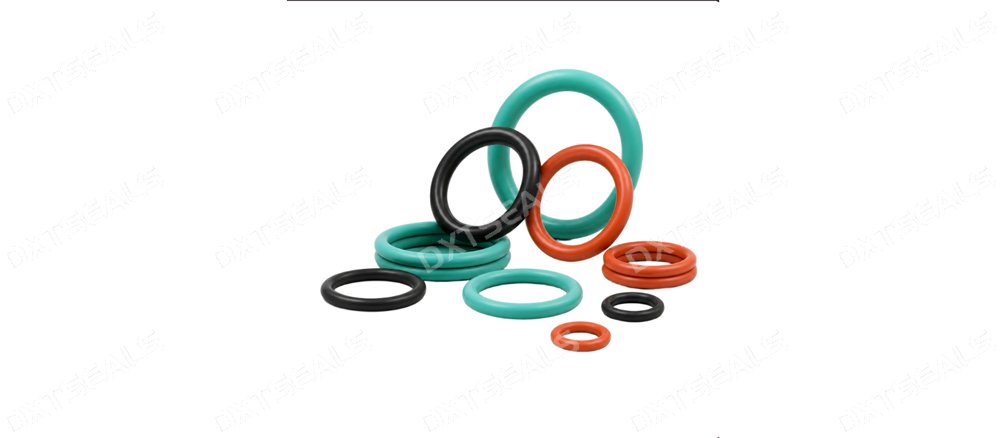
Choosing the right O-ring material is essential for achieving reliable sealing performance, minimizing leakage, and extending equipment service life. Although O-rings are simple in design, their performance depends on several operating conditions, including temperature, pressure, chemical exposure, and the type of media being sealed.
Different elastomers and polymer materials offer different advantages. NBR is widely used in oil and hydraulic applications, FKM is suitable for many high-temperature and chemical environments, EPDM performs well in water and weather-exposed applications, and silicone offers excellent flexibility across a broad temperature range. PTFE provides outstanding chemical resistance but behaves differently from conventional elastic materials.
This guide explains how to select the appropriate O-ring material by evaluating the most important operating conditions and comparing common materials for industrial applications.
1. Understand the Main O-Ring Material Types
Before selecting an O-ring, it is important to understand the characteristics and limitations of the available materials.
NBR O-Rings
Nitrile rubber (NBR) is a common choice for general industrial sealing. It offers good resistance to many petroleum-based oils and hydraulic fluids, along with good mechanical strength and abrasion resistance.
Typical applications include hydraulic cylinders, pneumatic equipment, pumps, gearboxes, and industrial machinery.
Best suited for: Oil-based media, hydraulic systems, and general-purpose industrial sealing.
Main limitation: NBR generally has lower resistance to ozone, outdoor weathering, and elevated temperatures than FKM.
FKM O-Rings
Fluoroelastomer (FKM) O-rings are widely used in applications requiring resistance to elevated temperatures, oils, fuels, and many industrial chemicals. They are often selected for demanding automotive, chemical processing, and industrial equipment applications.
Best suited for: Many oil and fuel systems, elevated-temperature applications, and chemically demanding environments.
Main limitation: FKM is typically more expensive than NBR, and its chemical compatibility varies by compound. Certain ketones, amines, and other chemicals can be unsuitable for particular FKM grades.
EPDM O-Rings
EPDM offers excellent resistance to water, steam under suitable conditions, ozone, and outdoor weathering. It is commonly used in water treatment, HVAC systems, plumbing equipment, and selected chemical applications.
Best suited for: Water systems, cooling systems, outdoor equipment, and compatible aqueous media.
Main limitation: EPDM is generally unsuitable for petroleum-based oils and fuels.
Silicone O-Rings
Silicone rubber provides excellent flexibility and can perform across a broad temperature range, depending on the compound. It is often used in food-processing equipment, medical devices, electrical equipment, and applications requiring flexibility at low temperatures.
Best suited for: Temperature-sensitive applications, static sealing, and equipment requiring flexible sealing materials.
Main limitation: Silicone generally has lower tear strength and abrasion resistance than many conventional industrial elastomers. Its compatibility with oils, fuels, and other chemicals must be checked carefully.
PTFE O-Rings
Polytetrafluoroethylene (PTFE) is known for its outstanding chemical resistance, low friction, and low moisture absorption. However, standard PTFE is not elastomeric and does not recover its shape like conventional rubber O-rings.
PTFE sealing rings may therefore require specially designed grooves, installation methods, or energized sealing structures to achieve reliable sealing performance.
Best suited for: Highly corrosive chemical environments, low-friction applications, and situations where conventional elastomers are unsuitable.
Main limitation: PTFE has limited elastic recovery and can be susceptible to creep or cold flow under sustained loading.
2. Consider the Operating Temperature
Temperature is one of the most important factors in O-ring material selection. Excessive heat can accelerate aging, cause hardening, reduce elasticity, or lead to chemical degradation. Low temperatures may make some materials stiff and reduce their ability to maintain contact with sealing surfaces.
When evaluating temperature resistance, consider both the normal operating temperature and short-term temperature peaks.
High-Temperature Applications
For elevated-temperature service, FKM is a common choice because many FKM compounds provide good heat resistance alongside oil and chemical compatibility. Silicone may also be suitable when flexibility and temperature performance are priorities, although its mechanical properties and media compatibility must be considered.
PTFE can tolerate many elevated-temperature environments, but its sealing behavior differs from that of elastic rubber.
Low-Temperature Applications
For low-temperature service, silicone and specially formulated low-temperature NBR or FKM compounds may be appropriate. The correct choice depends on the minimum operating temperature, the required sealing movement, and the properties of the specific compound.
Temperature Comparison
| Material | General Temperature Characteristics | Key Consideration |
|---|---|---|
| NBR | Suitable for many standard industrial temperature ranges | Grade and oil exposure affect service life |
| FKM | Commonly selected for elevated-temperature service | Chemical compatibility remains compound-dependent |
| EPDM | Available in grades for cold, warm, and hot-water service | Check compatibility with the actual fluid |
| Silicone | Broad temperature capability, including many low-temperature applications | Lower abrasion and tear resistance than many industrial elastomers |
| PTFE | Suitable for many demanding temperature environments | Limited elasticity and potential creep |
Temperature limits are formulation-dependent. Always verify the manufacturer's specifications for continuous operation, short-term exposure, and the actual sealing environment.
3. Evaluate Chemical Resistance
An O-ring may perform well mechanically but fail prematurely if its material reacts with the sealed fluid. Chemical exposure can cause swelling, shrinkage, softening, hardening, cracking, or loss of sealing force.
Material selection should account for the exact chemical composition, concentration, temperature, and exposure duration.
How Common Materials Compare
| Material | General Chemical Compatibility | Typical Considerations |
|---|---|---|
| NBR | Good resistance to many oils and hydraulic fluids | Limited compatibility with some solvents and aggressive chemicals |
| FKM | Good resistance to many oils, fuels, and chemicals | Not universally compatible with ketones, amines, and other specific substances |
| EPDM | Good resistance to water, weathering, and many aqueous chemicals | Generally unsuitable for petroleum oils and fuels |
| Silicone | Suitable for selected media and temperature-sensitive applications | Must be evaluated carefully for oils, fuels, and solvents |
| PTFE | Excellent resistance to a broad range of chemicals | Mechanical sealing behavior differs from elastomers |
Chemical resistance tables are useful for initial screening, but they should not replace compound-specific compatibility checks. Two compounds within the same material family may have different performance characteristics.
For critical applications, confirm compatibility using the manufacturer's data or representative testing under actual operating conditions.
4. Match the O-Ring Material to the Sealed Media
The type of media in contact with the O-ring is often the most direct starting point for material selection.
Hydraulic Oil and Lubricating Oil
NBR is commonly used for hydraulic oil, lubricating oil, and many petroleum-based fluids. FKM may be preferred when higher temperatures or more demanding fluid conditions justify its use.
The final selection depends on oil formulation, additives, temperature, and pressure.
Water and Cooling Fluids
EPDM is often a suitable choice for water supply, cooling water, and HVAC systems. For hot water or steam, select a compound specifically rated for the relevant temperature and exposure conditions.
FKM, NBR, and silicone should not automatically be substituted for EPDM without checking the fluid and operating conditions.
Fuels and Hydrocarbon Media
FKM is commonly considered for many fuel and hydrocarbon applications, while NBR may also be suitable for certain oils and fuels. Actual compatibility depends on fuel composition, additives, temperature, and the specific compound.
Acids, Alkalis, and Solvents
PTFE may be an appropriate option for highly aggressive chemicals because of its broad chemical resistance. However, pressure, deformation, installation, and sealing design still need to be evaluated.
For elastomers, the exact chemical, concentration, temperature, and duration of exposure must be checked before selecting a material.
5. Check the Operating Pressure
Pressure affects the mechanical demands placed on an O-ring. At higher pressures, the seal may deform or extrude into the clearance gap between mating components, particularly when the gap is large or the material is too soft.
Material selection should therefore consider pressure together with hardness, groove design, clearance, and the use of backup rings.
Low-Pressure Applications
Many standard elastomer O-rings can perform effectively in low-pressure static and dynamic applications when the groove dimensions and surface finishes are appropriate.
High-Pressure Applications
High-pressure systems may require a harder elastomer, a more tightly controlled extrusion gap, or an anti-extrusion backup ring. The best solution depends on pressure peaks, temperature, component movement, and the equipment design.
PTFE rings and specially designed energized seals may be considered for certain demanding applications, but they require appropriate sealing geometry.
Pressure-Related Selection Factors
-
Operating pressure: Include pressure fluctuations and transient peaks.
-
Material hardness: A harder elastomer may improve extrusion resistance but can increase installation difficulty.
-
Extrusion clearance: Larger gaps can increase the risk of seal damage.
-
Groove design: Correct groove width, depth, and fill are essential.
-
Dynamic movement: Reciprocating or rotating applications introduce friction and wear considerations.
-
Backup rings: These may be necessary in high-pressure conditions.
An O-ring material does not have one universal pressure rating. Allowable pressure depends on the complete sealing design and operating conditions.
6. Consider Static or Dynamic Sealing
The type of movement also affects material selection.
Static Sealing
Static O-rings are used where components remain stationary relative to one another. Examples include flange connections, covers, housings, and threaded assemblies.
Material compatibility, compression, groove dimensions, and temperature are key considerations.
Dynamic Sealing
Dynamic O-rings operate where components move relative to the seal, such as in hydraulic cylinders, pneumatic actuators, and selected rotating equipment.
Dynamic service introduces friction, wear, heat generation, and the possibility of twisting or rolling. Material hardness, lubrication, surface finish, and groove design become particularly important.
For demanding reciprocating or rotary applications, an alternative seal design may provide better performance than a conventional O-ring.
7. Compare O-Ring Materials for Different Applications
The following table provides a practical starting point for material selection.
| Application | Common Material Candidates | Main Selection Considerations |
|---|---|---|
| Hydraulic cylinders | NBR, FKM | Oil compatibility, pressure, wear, temperature |
| Pumps and gearboxes | NBR, FKM | Lubricant type, rotational or static conditions, heat |
| Water treatment systems | EPDM, PTFE | Water chemistry, temperature, pressure |
| HVAC and cooling systems | EPDM | Water or glycol compatibility, operating temperature |
| Fuel systems | FKM, selected NBR compounds | Fuel composition, temperature, swelling |
| Chemical processing equipment | PTFE, compatible FKM compounds, selected EPDM compounds | Exact chemical and concentration |
| Low-temperature equipment | Silicone, low-temperature elastomer grades | Flexibility, compression recovery, media |
| High-temperature equipment | FKM, suitable silicone or PTFE designs | Continuous temperature, pressure, chemical exposure |
These are general guidelines rather than universal recommendations. The actual compound and complete sealing design must be verified for the intended service.
8. Check Hardness, Size, and Groove Design
Selecting the correct material is only part of O-ring design. The dimensions and installation conditions also influence sealing performance.
O-Ring Hardness
Elastomer hardness is commonly specified using the Shore A scale. Softer materials can conform well to sealing surfaces, while harder compounds may offer improved resistance to extrusion under certain conditions.
The appropriate hardness depends on pressure, clearance, surface finish, and whether the seal is static or dynamic.
O-Ring Dimensions
The inside diameter and cross-sectional diameter must match the equipment design. Incorrect sizing can cause excessive stretching, inadequate compression, installation damage, or premature failure.
For replacement applications, verify the original dimensions rather than relying on appearance alone.
Groove Design and Compression
The groove must provide the correct squeeze without over-compressing the seal. Excessive compression may accelerate wear or damage, while insufficient compression can lead to leakage.
For high-pressure service, check extrusion clearance and whether backup rings are required.
9. Common O-Ring Material Selection Mistakes
Several common mistakes can reduce sealing reliability:
-
Selecting by temperature alone. A material may tolerate the temperature but be incompatible with the fluid.
-
Assuming all FKM compounds are equivalent. Different formulations can have different chemical resistance and temperature capabilities.
-
Using EPDM with petroleum-based oils without verification. EPDM is generally unsuitable for these media.
-
Ignoring pressure and extrusion clearance. A compatible material can still fail if the mechanical design is unsuitable.
-
Overlooking dynamic movement. Friction, wear, and lubrication can affect service life.
-
Replacing an O-ring without checking its dimensions. Incorrect cross-section or inside diameter can cause leakage or installation damage.
-
Assuming PTFE behaves like rubber. PTFE's low elasticity requires appropriate sealing geometry and design.
Avoiding these mistakes helps improve equipment reliability and reduce unplanned maintenance.
10. A Practical O-Ring Material Selection Checklist
Before ordering or manufacturing an O-ring, confirm the following information:
-
Media: What fluid, gas, oil, chemical, or mixture will contact the seal?
-
Temperature: What are the minimum, normal, and maximum temperatures?
-
Pressure: What are the normal operating pressure and peak pressure?
-
Movement: Is the application static, reciprocating, or rotary?
-
Dimensions: What are the required inside diameter and cross-sectional diameter?
-
Hardness: What hardness is appropriate for the pressure and groove design?
-
Chemical compatibility: Has the specific material compound been verified?
-
Installation conditions: Are there sharp edges, large clearances, or other potential sources of damage?
-
Service requirements: Are there requirements for food contact, cleanliness, outdoor exposure, or other special conditions?
Providing this information makes it easier to identify a suitable material and reduce the risk of premature seal failure.
11. Custom O-Ring Manufacturing and Material Selection
Standard O-rings are suitable for many industrial applications, but some equipment requires non-standard dimensions, special materials, or specific hardness grades.
Custom O-ring solutions may be needed when:
-
The required size is not available as a standard product.
-
The operating temperature or chemical environment requires a specialized compound.
-
The original equipment uses a non-standard groove or sealing configuration.
-
A replacement seal must match an existing sample or technical drawing.
-
The application requires a particular hardness, color, or material specification.
A reliable supplier should be able to evaluate the operating conditions, confirm the material requirements, and manufacture O-rings according to drawings, samples, or specified dimensions.
Conclusion
Choosing the right O-ring material requires more than comparing basic material properties. Temperature, chemical resistance, pressure, sealed media, movement, hardness, and groove design must all be considered together.
NBR is widely used for oil and hydraulic applications, FKM is suitable for many elevated-temperature and chemical environments, EPDM is commonly used for water and weather-exposed applications, silicone offers excellent flexibility, and PTFE provides broad chemical resistance with different mechanical sealing characteristics.
By confirming the operating conditions and selecting the appropriate material and design, equipment manufacturers and maintenance teams can improve sealing reliability, reduce leakage, and extend service life. Standard O-rings and custom-manufactured solutions can both be tailored to meet the requirements of industrial sealing applications.