
Introduction
Seal failure is one of the most common causes of equipment downtime, leakage, and reduced operational efficiency in industrial systems. In demanding applications involving:
- High pressure
- Extreme temperature
- Dynamic motion
- Aggressive chemicals
traditional sealing solutions may struggle to maintain stable performance over time.
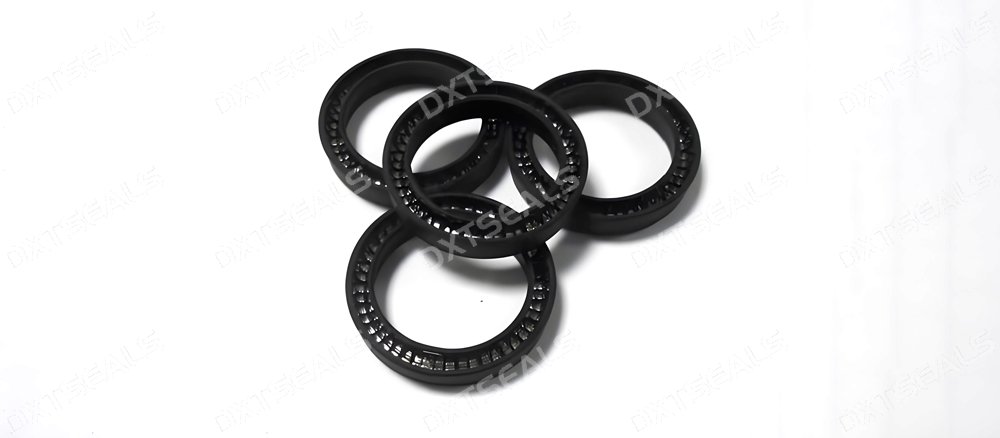
Spring energized seals (泛塞封) are widely used because of their excellent sealing reliability, low friction, and strong chemical resistance. However, achieving long service life depends heavily on two critical factors:
- Proper PTFE material selection
- Optimized spring structure design
This article explains how seal failures occur and how the correct combination of materials and spring design can significantly improve sealing performance and durability. At DXTSEALS, we specialize in customized spring energized sealing solutions engineered for demanding industrial environments.
1. Common Causes of Seal Failure
Before discussing prevention methods, it is important to understand the most common causes of seal failure.
Excessive Wear
Wear can occur because of:
- High friction
- Poor lubrication
- Improper material selection
- Excessive spring preload
Excessive wear gradually reduces sealing force and eventually leads to leakage.
Extrusion Damage
In high-pressure systems, insufficient support may cause the PTFE material to extrude into clearance gaps.
This often results in:
- Seal deformation
- Lip damage
- Sudden seal failure
Thermal Deformation
Extreme temperatures may cause:
- PTFE softening
- Dimensional changes
- Reduced spring effectiveness
Repeated thermal cycling may also accelerate material fatigue.
Chemical Attack
Improper material compatibility with aggressive media can cause:
- Material degradation
- Swelling
- Surface cracking
- Corrosion of metal spring components
Loss of Spring Compensation
Over time, poorly designed springs may lose elasticity, reducing:
- Contact pressure
- Wear compensation capability
- Low-pressure sealing performance
2. Why PTFE Material Selection Is Critical
The PTFE sealing jacket directly contacts the mating surface and operating media, making material selection one of the most important factors in preventing seal failure.
3. Advantages and Limitations of Virgin PTFE
Advantages
Virgin PTFE offers:
- Outstanding chemical resistance
- Extremely low friction
- Wide temperature capability
- Excellent purity
Limitations
However, virgin PTFE also has:
- Lower wear resistance
- Higher creep deformation under load
- Limited mechanical strength
For high-load or dynamic applications, filled PTFE materials are often preferred.
4. How Filled PTFE Materials Improve Seal Reliability
Glass-Filled PTFE
Provides:
- Better dimensional stability
- Improved compressive strength
- Reduced creep deformation
Suitable for:
- Hydraulic systems
- Medium-to-high pressure applications
Carbon-Filled PTFE
Offers:
- Excellent wear resistance
- Improved thermal conductivity
- Superior dynamic sealing performance
Ideal for:
- High-speed motion systems
- Rotary applications
- Heavy wear environments
Graphite-Filled PTFE
Provides:
- Excellent self-lubrication
- High-temperature stability
- Reduced friction and heat generation
Suitable for:
- Dry-running conditions
- High-temperature equipment
At DXTSEALS, PTFE fillers are selected according to actual operating pressure, speed, and media conditions.
5. The Critical Role of Spring Design in Preventing Seal Failure
The internal spring provides continuous preload force to maintain sealing contact even when:
- Pressure fluctuates
- PTFE wears over time
- Thermal expansion occurs
Proper spring design is essential for stable long-term sealing performance.
6. How Different Spring Structures Affect Seal Reliability
V-Spring Structures
Characteristics:
- Low preload force
- Fast elastic response
- Low friction
Advantages:
- Reduced wear in dynamic systems
- Excellent high-speed sealing performance
Typical applications:
- Pneumatic systems
- Precision motion equipment
- Aerospace applications
Helical Spring Structures
Characteristics:
- Strong radial sealing force
- Excellent compensation capability
Advantages:
- Reliable sealing under high pressure and vacuum
- Superior wear compensation
Typical applications:
- Oil & gas systems
- Hydraulic equipment
- Semiconductor vacuum systems
U-Spring Structures
Characteristics:
- Balanced preload force
- Stable sealing performance
Advantages:
- Versatile industrial application capability
- Moderate friction and wear characteristics
7. Matching Spring Load with PTFE Material
Improper combinations between spring force and PTFE material can accelerate failure.
Excessive Spring Force + Soft PTFE
May cause:
- Rapid wear
- Excessive friction
- Heat buildup
Insufficient Spring Force + High Dynamic Conditions
May lead to:
- Leakage
- Unstable sealing
- Poor wear compensation
At DXTSEALS, spring preload and PTFE material properties are optimized together to maximize performance and service life.
8. Importance of Groove Design and Surface Finish
Even the best seal materials and spring structures can fail if groove design is incorrect.
Key factors include:
- Proper compression ratio
- Controlled extrusion clearance
- Accurate dimensional tolerances
- Appropriate surface roughness
Poor groove design may result in:
- Uneven wear
- Leakage
- Seal instability
9. Selection Recommendations for Different Operating Conditions
High-Speed Dynamic Applications
Recommended:
- Carbon-filled PTFE
- V-spring structures
- Low preload design
Purpose: reduce friction and wear.
High-Pressure Systems
Recommended:
- Glass-filled PTFE
- Helical spring structures
- Strong anti-extrusion groove support
Purpose: maintain stable sealing under heavy load.
High-Temperature Environments
Recommended:
- Graphite-filled PTFE
- Heat-resistant alloy springs
Purpose: improve thermal stability and reduce material degradation.
Chemical and Corrosive Applications
Recommended:
- Virgin PTFE
- Hastelloy or corrosion-resistant springs
Purpose: maximize chemical compatibility and corrosion resistance.
10. Future Trends in Seal Failure Prevention
Modern sealing technologies are evolving toward:
- Advanced composite PTFE materials
- Precision spring preload optimization
- Simulation-based wear prediction
- Lower friction designs
- Improved thermal management
These innovations help extend seal lifespan and reduce maintenance costs.
At DXTSEALS, we continuously develop advanced sealing technologies to improve reliability in demanding industrial applications.
Conclusion
Preventing seal failure requires a comprehensive understanding of both PTFE material behavior and spring structure performance.
Proper material and spring selection can significantly improve:
- Wear resistance
- Leakage control
- Friction management
- Pressure compensation
- Overall seal lifespan
Key recommendations include:
- Use filled PTFE materials for demanding dynamic or high-pressure conditions
- Match spring preload to operating requirements
- Optimize groove dimensions and surface finish
- Consider temperature, pressure, and media compatibility together
At DXTSEALS, we provide customized spring energized sealing solutions designed to minimize seal failure and maximize long-term operational reliability.
If you need assistance selecting the right spring energized seal materials or spring structures for your application, contact DXTSEALS today for professional technical support and customized sealing solutions.