
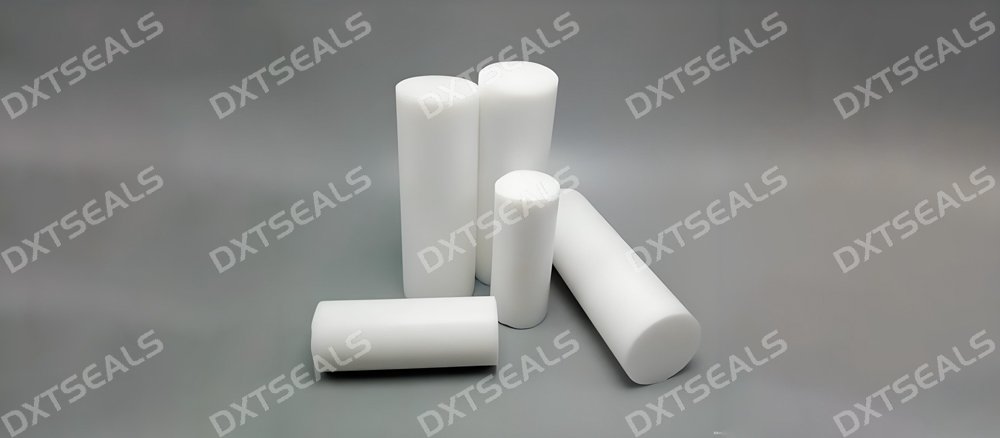
Different PTFE Materials in Spring Seals: Performance Differences & Application Analysis
PTFE (Polytetrafluoroethylene) is one of the most widely used sealing materials in hydraulic and pneumatic systems, especially in Spring Seals. Its outstanding chemical resistance, low friction, and wide temperature range make it a top choice for dynamic sealing applications.
However, not all PTFE materials are the same. To meet various working conditions, manufacturers use different PTFE compound formulations, each offering unique mechanical and tribological properties.
This article explains the differences between common PTFE materials used in Spring Seals and provides guidance on selecting the right formulation for your working conditions.
(Professional PTFE seals available from DXTSEALS.)
1️⃣ Why PTFE Is Widely Used in Spring Seals
Spring Seals rely on PTFE because it offers:
-
Extremely low friction coefficient
-
Excellent wear resistance
-
Wide temperature capability (-60°C to +260°C)
-
Chemical inertness
-
No stick-slip effect
-
Low deformation under dynamic pressure
However, pure PTFE has limitations:
-
Too soft
-
High creep tendency
-
Lower wear resistance under high load
Therefore, PTFE is often filled with reinforcing additives.
2️⃣ Common PTFE Materials Used in Spring Seals
Below is a comparison of the most commonly used PTFE compounds.
A. Pure PTFE (Virgin PTFE)
Properties:
-
Best chemical resistance
-
Ultra-low friction
-
Excellent temperature resistance
-
Soft and prone to cold flow
-
Lowest wear resistance among PTFE types
Best for:
-
Chemical processing equipment
-
Low-load pneumatic cylinders
-
Food-grade or medical systems
-
Ultra-clean environments
Avoid when:
-
High-pressure hydraulic systems
-
Heavy-load reciprocating movement
B. Bronze-Filled PTFE (40% Bronze PTFE)
Properties:
-
Very high wear resistance
-
Improved heat dissipation
-
High compressive strength
-
Good dimensional stability
-
Reduced chemical resistance (compared to pure PTFE)
Best for:
-
High-pressure hydraulic cylinders
-
Excavator cylinders
-
Injection molding machines
-
Heavy-duty linear actuators
-
High-speed reciprocating applications
This is the most popular material for Spring Seals because it balances strength and friction.
C. Carbon-Filled PTFE (10–35% Carbon PTFE)
Properties:
-
Excellent wear resistance
-
Low friction under dry or semi-dry conditions
-
High thermal stability
-
Good resistance to deformation
-
Electrically conductive (depending on formulation)
Best for:
-
Air compressors
-
High-temperature hydraulic systems
-
Dry-running or low-lubrication conditions
-
High PV (Pressure × Velocity) applications
Carbon-filled PTFE is ideal when lubrication is inconsistent or unavailable.
D. Glass-Filled PTFE (15–25% Glass Fiber PTFE)
Properties:
-
Higher hardness
-
Increased wear resistance
-
Better creep resistance
-
Not suitable for soft mating surfaces (can cause abrasion)
Best for:
-
High-load linear movement
-
Water-based hydraulic systems
-
Industrial valves
-
High-pressure sealing
Avoid when:
-
Mating parts are aluminum or soft alloys
(glass fiber may scratch the surface)
E. Graphite-Filled PTFE
Properties:
-
Very low friction
-
Suitable for high-speed applications
-
Good resistance to aggressive media
-
Stable at high temperatures
Best for:
-
High-speed cylinders
-
Chemical fluid handling
-
Pumps and compressors
-
Precision hydraulic actuators
Graphite-filled PTFE is chosen when friction reduction is a top priority.
3️⃣ Comparison of PTFE Materials Used in Spring Seals
| PTFE Type | Wear Resistance | Friction | Pressure Resistance | Chemical Resistance | Best Application |
|---|---|---|---|---|---|
| Virgin PTFE | ★★ | ★★★★★ | ★★ | ★★★★★ | Chemical / low load |
| Bronze PTFE | ★★★★★ | ★★★ | ★★★★★ | ★★ | Heavy-duty hydraulics |
| Carbon PTFE | ★★★★ | ★★★★ | ★★★★ | ★★★ | High temp / dry-running |
| Glass PTFE | ★★★★ | ★★★ | ★★★★★ | ★★★ | High pressure systems |
| Graphite PTFE | ★★★★ | ★★★★★ | ★★★ | ★★★★ | High-speed sealing |
4️⃣ How to Choose the Right PTFE for Your Glyd Ring Seal
✔ High Pressure → Bronze PTFE
For heavy-duty industrial cylinders.
✔ High Temperature → Carbon PTFE or Graphite PTFE
Better thermal stability and wear resistance.
✔ Fast Movement → Graphite PTFE
Lowest friction for high-speed operations.
✔ Low Lubrication → Carbon PTFE
Stable performance during dry-running.
✔ Chemical Environments → Virgin PTFE
Maximum chemical resistance.
✔ Water-Based Fluids → Glass PTFE
High stability and pressure resistance.
5️⃣ Why Choose DXTSEALS for PTFE Spring Seals
DXTSEALS provides:
-
Custom PTFE Spring Seals using bronze, carbon, graphite, glass, or pure PTFE
-
CNC machining with tight tolerances
-
Material reports and dimensional inspection
-
Fast sampling and stable bulk supply
-
Solutions for hydraulic, pneumatic, and chemical systems
Whether you need single prototypes or mass production, DXTSEALS offers high-performance sealing solutions tailored to your equipment.
✅ Conclusion
Different PTFE materials offer unique strengths when used in Spring Seals.
Choosing the right formulation is essential for achieving:
-
Lower friction
-
Longer service life
-
Better pressure resistance
-
Stable performance in demanding environments
Understanding your working conditions—pressure, speed, temperature, lubrication, and media—helps ensure optimal sealing results.
For custom-made Spring Seals, high-performance PTFE compounds, or engineering support, contact DXTSEALS anytime.