
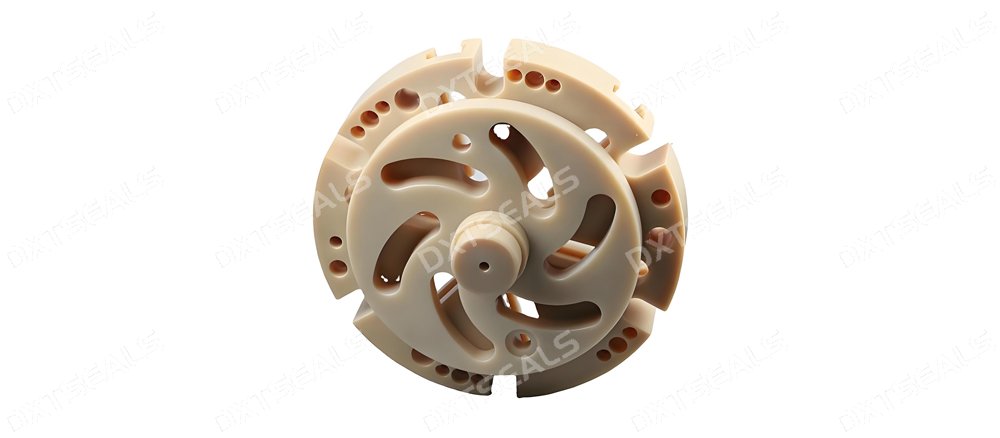
In today’s precision manufacturing industry, choosing the right plastic material is a key factor in ensuring product performance, durability, and cost efficiency. Among the most widely used engineering plastics are PEEK (Polyetheretherketone), POM (Polyoxymethylene, or Acetal), and PTFE (Polytetrafluoroethylene). Each offers distinct advantages, making them suitable for different industrial applications.
As a professional custom sealing and machining parts supplier, DXTSEALS shares this detailed comparison to help engineers and buyers make informed material selection decisions for their custom plastic parts.
1. PEEK – The High-Performance Engineering Plastic
PEEK is often regarded as one of the strongest and most versatile thermoplastics available.
Key Properties:
-
Exceptional mechanical strength and stiffness, even at high temperatures (up to 250°C).
-
Excellent chemical resistance against oils, fuels, and most solvents.
-
Low creep and wear rate, suitable for dynamic applications.
-
Outstanding dimensional stability and machinability.
Typical Applications:
PEEK is widely used in aerospace, automotive, and semiconductor industries for high-performance components such as bushings, seals, valve seats, and bearings that must withstand heat, pressure, and aggressive chemicals.
Advantages:
If your design requires high precision, durability, and resistance to extreme environments, PEEK is often the best choice despite its higher cost.
2. POM – The Economical and Strong General-Purpose Plastic
POM, also known as Acetal or Delrin, is a cost-effective engineering plastic with excellent mechanical strength and machinability.
Key Properties:
-
High stiffness and good impact resistance.
-
Excellent dimensional stability and low moisture absorption.
-
Easy to machine and ideal for tight-tolerance components.
-
Moderate resistance to fuels and oils.
Typical Applications:
POM is commonly used in gears, rollers, bushings, and precision mechanical parts where wear resistance and low friction are important but temperature exposure is moderate (below 120°C).
Advantages:
For applications that need balanced performance and cost-efficiency, POM is an ideal choice. It provides smooth movement and long service life in many mechanical assemblies.
3. PTFE – The King of Chemical and Friction Resistance
PTFE (Teflon) is well-known for its outstanding chemical inertness and lowest coefficient of friction among plastics.
Key Properties:
-
Excellent resistance to almost all chemicals and solvents.
-
Very low friction and non-stick surface properties.
-
Can operate in temperatures from -200°C to +260°C.
-
Excellent electrical insulation and weather resistance.
Typical Applications:
PTFE is often used in valve seals, gaskets, and sliding components in chemical, pharmaceutical, and food industries where chemical resistance and low friction are crucial.
Advantages:
When corrosion resistance and non-stick performance are your top priorities, PTFE outperforms most other plastics. However, it is softer and less wear-resistant compared to PEEK or POM, so it’s often used with fillers like glass or carbon to enhance strength.
4. Comparison Summary Table
| Property / Material | PEEK | POM (Acetal) | PTFE |
|---|---|---|---|
| Temperature Resistance | ★★★★★ | ★★★ | ★★★★★ |
| Mechanical Strength | ★★★★★ | ★★★★ | ★★ |
| Chemical Resistance | ★★★★ | ★★★ | ★★★★★ |
| Wear Resistance | ★★★★★ | ★★★★ | ★★ |
| Machinability | ★★★★ | ★★★★★ | ★★★ |
| Cost | High | Low | Medium |
| Common Applications | Aerospace, Valves, Seals | Gears, Bearings, Rollers | Chemical seals, Liners, Gaskets |
5. Choosing the Right Material for Your Custom Plastic Parts
When selecting materials for your custom plastic components, consider these key factors:
-
Operating Temperature – PEEK or PTFE for high heat; POM for moderate heat.
-
Chemical Exposure – PTFE for aggressive media; PEEK for mixed conditions.
-
Mechanical Load & Wear – PEEK or reinforced POM for load-bearing parts.
-
Cost & Availability – POM offers the most economical solution.
-
Precision Requirements – PEEK and POM offer excellent machinability for CNC processing.
At DXTSEALS, we provide custom CNC-machined plastic parts using PEEK, POM, PTFE, and other high-performance materials. Our engineers can assist you in material selection, machining optimization, and quality inspection to ensure your parts meet the toughest industrial requirements.
Conclusion
Each plastic—PEEK, POM, and PTFE—offers unique strengths for specific working environments.
-
Choose PEEK for high temperature and mechanical load.
-
Choose POM for general engineering and economical performance.
-
Choose PTFE for chemical resistance and smooth, low-friction applications.
Understanding their differences allows engineers and buyers to make smarter, more cost-effective material decisions.
For custom plastic components or precision sealing solutions, DXTSEALS provides reliable engineering support and advanced machining services.