
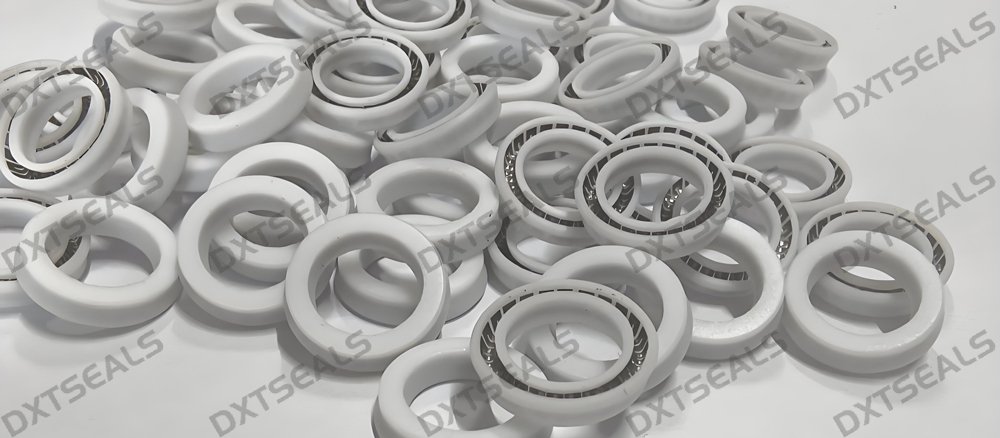
In the world of industrial sealing, selecting the right type of seal can make a major difference in equipment performance, durability, and safety. Two of the most common types are PTFE spring-energized seals (also known as Variseals) and conventional elastomer seals, such as O-rings or lip seals.
While both serve the purpose of preventing leaks and contamination, their structures, materials, and performance capabilities vary significantly. This article from DXTSEALS explores the differences between these two seal types and helps you determine which is best suited for your specific operating conditions.
1. What Is a PTFE Spring Seal?
PTFE (Polytetrafluoroethylene) spring seals are high-performance sealing components designed for extreme operating environments.
They consist of a PTFE sealing jacket and a metal spring energizer, which maintains constant pressure on the sealing lip.
Key Characteristics:
-
Extremely low friction coefficient.
-
Excellent chemical resistance.
-
Wide temperature range: from -200°C to +300°C.
-
Long service life even under dynamic motion.
Typical Applications:
-
Aerospace and defense systems.
-
Chemical processing and oil & gas equipment.
-
High-speed rotating shafts and hydraulic systems.
2. What Are Conventional Seals?
Conventional seals are typically made from elastomeric materials such as NBR, EPDM, FKM, or silicone. These include O-rings, lip seals, and gaskets, which rely on the elastic deformation of rubber to maintain sealing pressure.
Key Characteristics:
-
Excellent flexibility and resilience.
-
Easy to install and cost-effective.
-
Ideal for low to medium pressure systems.
-
Moderate temperature and chemical resistance.
Typical Applications:
-
Automotive engines and pumps.
-
General hydraulic and pneumatic systems.
-
Industrial machinery and equipment.
3. PTFE vs. Rubber: Performance Comparison
| Feature | PTFE Spring Seal | Conventional Rubber Seal |
|---|---|---|
| Material | PTFE + Metal Spring | NBR, EPDM, FKM, Silicone |
| Temperature Range | -200°C to +300°C | -40°C to +200°C |
| Chemical Resistance | Excellent (resists almost all chemicals) | Moderate |
| Pressure Capability | High to Ultra-High | Low to Medium |
| Friction & Wear | Very Low | Moderate |
| Elastic Recovery | Relies on spring energizer | Excellent elasticity |
| Dynamic Sealing | Excellent for rotary and reciprocating motion | Good for low-speed applications |
| Cost | Higher | Lower |
4. Suitable Working Conditions
-
Choose PTFE Spring Seals When:
-
The system operates under high pressure or high temperature.
-
The medium is corrosive, aggressive, or abrasive.
-
You need low friction and long service life.
-
The seal must perform reliably under dynamic motion.
-
-
Choose Conventional Seals When:
-
The system is low-cost or low-pressure.
-
The working temperature is within -40°C to +150°C.
-
Frequent replacement and maintenance are acceptable.
-
The sealing environment is clean and stable.
-
5. Why Choose PTFE Seals from DXTSEALS?
At DXTSEALS, we specialize in custom-engineered sealing solutions to meet the demands of complex industrial environments.
Our PTFE spring seals are designed and precision-machined to deliver superior chemical resistance, durability, and sealing stability in harsh applications.
We also manufacture a wide range of O-rings, gaskets, and rubber seals, ensuring that customers can find the ideal sealing solution — whether for standard equipment or high-end engineering systems.
Conclusion
In summary, PTFE spring seals stand out for their exceptional performance in extreme conditions, while conventional rubber seals remain a practical and economical choice for standard applications.
By understanding the differences in material, structure, and working range, engineers can select the best sealing solution to improve equipment reliability and extend service life.
For custom PTFE or rubber sealing solutions, contact DXTSEALS — your trusted partner in precision sealing technology.