
Introduction
EPDM flange gaskets are widely used in industrial piping systems because of their flexibility, water resistance, and resistance to ozone and weathering. However, some applications require additional structural support to improve dimensional stability, handling strength, or resistance to deformation during installation and service.
Reinforced EPDM flange gaskets with metal inserts combine the sealing properties of EPDM rubber with the mechanical support of a metal reinforcement. Depending on the design, the metal insert may be embedded within the rubber body or incorporated into a specific section of the gasket to provide additional rigidity and support.
These reinforced gaskets can be suitable for selected water systems, industrial pipelines, HVAC equipment, and other applications where the working medium is compatible with EPDM and the gasket design meets the operating requirements.
Understanding their construction, advantages, limitations, and application conditions helps engineers and purchasing teams select the right gasket for reliable flange sealing.
1. What Are Reinforced EPDM Flange Gaskets with Metal Inserts?
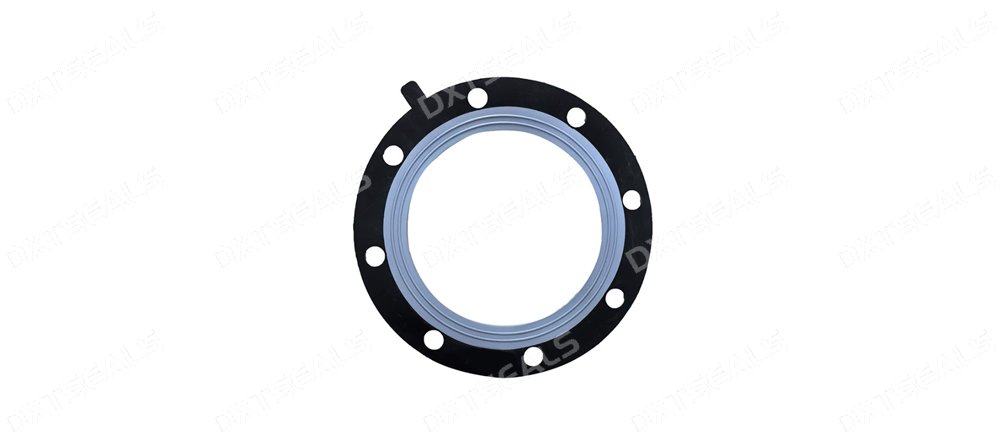
A reinforced EPDM flange gasket is a sealing component made primarily from EPDM rubber with an integrated metal insert or reinforcement. The EPDM provides the sealing interface, while the metal component supports the gasket structure.
Unlike a conventional solid EPDM gasket, a reinforced design can offer improved handling and dimensional stability when properly engineered. The exact performance depends on the metal insert's shape, position, thickness, and material, as well as the EPDM compound and overall gasket geometry.
Metal-reinforced EPDM gaskets are not a single standardized construction. Their design should be matched to the flange configuration, bolt arrangement, compression requirements, and service conditions.
2. Structure and Materials
The structure of a reinforced EPDM flange gasket typically consists of two main components: the EPDM sealing material and the metal reinforcement.
EPDM Rubber Sealing Layer
EPDM, or ethylene propylene diene monomer, is a synthetic elastomer valued for its flexibility and resistance to weathering, ozone, and many water-based environments.
Its primary functions include:
-
Forming a sealing interface between mating flange surfaces
-
Accommodating minor surface irregularities under suitable compression
-
Helping prevent leakage of compatible fluids
-
Maintaining flexibility under specified operating conditions
-
Providing resistance to environmental exposure in suitable applications
EPDM is commonly considered for water supply, wastewater, cooling water, and HVAC systems. However, compatibility with the actual fluid and temperature must be verified. EPDM is generally unsuitable for petroleum-based oils and fuels.
Metal Insert or Reinforcement
The metal insert provides structural support within the gasket assembly. Depending on the application, the insert may be manufactured from carbon steel, stainless steel, or another suitable metal.
Potential functions of the insert include:
-
Improving dimensional stability
-
Supporting the gasket during handling and installation
-
Helping maintain the intended gasket shape
-
Providing localized structural reinforcement
-
Reducing unwanted deformation where the design and loading conditions permit
Material selection is important. Carbon steel may require corrosion protection, while stainless steel can be considered for environments where corrosion resistance is important. The correct metal grade depends on the surrounding environment, fluid exposure, temperature, and compatibility with adjacent components.
Integrated Gasket Construction
The metal reinforcement may be fully embedded within the EPDM body or arranged in another application-specific configuration. The design should preserve the required sealing surfaces and avoid creating leakage paths.
The position of the insert is especially important. If it interferes with the sealing contact area or prevents adequate rubber compression, the gasket may not seal correctly. The reinforcement must therefore be designed together with the rubber thickness, flange geometry, and bolt loading.
3. Key Benefits of Metal-Reinforced EPDM Flange Gaskets
Improved Dimensional Stability
The metal insert can help the gasket retain its intended shape during handling, positioning, and installation. This can be useful for larger gaskets or designs that require additional structural support.
Dimensional stability depends on the insert geometry and the mechanical loads involved. Reinforcement does not automatically prevent all deformation under compression or temperature changes.
Easier Handling and Installation
Large or relatively thin rubber gaskets may be difficult to handle without distortion. An appropriately designed metal insert can make the gasket more rigid and easier to position during assembly.
This may help reduce installation difficulties, particularly when the gasket has a large diameter or a non-standard shape.
Additional Mechanical Support
The metal component can provide support in areas where a rubber-only gasket may lack sufficient rigidity. This can be useful in selected equipment connections and specialized flange assemblies.
However, the insert is not a substitute for correct flange alignment, adequate bolt loading, or proper gasket installation.
EPDM Sealing Properties
The EPDM portion retains the material's characteristic flexibility, water resistance, and weathering resistance when the selected compound is suitable for the service conditions.
This combination allows the gasket to provide an elastomeric sealing interface while benefiting from the structural support of the metal insert.
Potential for Application-Specific Design
Metal-reinforced EPDM gaskets can be customized according to equipment requirements. Insert shape, metal grade, rubber hardness, gasket thickness, and overall dimensions may be adjusted to suit a particular flange connection.
Custom engineering is particularly valuable when standard rubber gaskets do not provide the required combination of geometry, handling strength, and sealing performance.
4. Reinforced EPDM Gaskets vs. Standard EPDM Flange Gaskets
Both reinforced and standard EPDM flange gaskets rely on EPDM for sealing, but their mechanical construction differs.
| Feature | Standard EPDM Flange Gasket | Metal-Reinforced EPDM Flange Gasket |
|---|---|---|
| Main construction | EPDM rubber | EPDM rubber with metal reinforcement |
| Flexibility | Generally higher | Depends on insert design and placement |
| Dimensional stability | Depends on rubber hardness and geometry | May be improved by the metal insert |
| Handling of large gaskets | May require careful support | Reinforcement may simplify handling |
| Structural support | Provided by rubber alone | Additional support from the insert |
| Design complexity | Relatively simple | More complex construction |
| Manufacturing cost | Often lower | Usually higher, depending on design |
| Customization | Available | Often tailored to specific requirements |
| Suitable applications | General compatible flange connections | Applications requiring additional structural support |
A reinforced design is not necessarily superior in every application. A standard EPDM gasket may be more economical and entirely adequate when the flange geometry, sealing load, and operating conditions are straightforward.
The decision should be based on the actual mechanical and sealing requirements rather than reinforcement alone.
5. Typical Applications
Reinforced EPDM flange gaskets may be used in applications where EPDM compatibility and additional structural support are both required.
Water Supply and Distribution Systems
In compatible water piping systems, EPDM provides the sealing material while the insert can support the gasket's shape during assembly. The gasket must still meet the system's pressure, temperature, and applicable regulatory requirements.
Wastewater Treatment Equipment
Wastewater systems may involve irregular operating conditions and varying fluid compositions. Reinforced EPDM gaskets can be considered for compatible services where improved handling or dimensional stability is useful.
The composition of the wastewater should be reviewed because some chemicals and contaminants may affect EPDM performance.
HVAC and Cooling Water Systems
Heating, ventilation, and air-conditioning equipment often includes water circulation lines, cooling systems, and flange connections. EPDM is frequently considered for these applications because of its suitability for many water-based services.
A metal insert may be useful where a specific gasket shape requires additional support during installation.
Industrial Equipment and Piping
Certain industrial machines, tanks, pipe connections, and fluid-handling systems require gaskets with application-specific dimensions or construction.
Metal-reinforced EPDM gaskets can be designed for these connections when the medium is compatible with EPDM and the reinforcement meets the relevant mechanical requirements.
Large-Diameter or Special-Shape Connections
Large gaskets and non-standard geometries may be more difficult to position accurately than conventional small gaskets. A properly designed metal insert can provide additional support during transportation and installation.
For these applications, the insert must be designed carefully to avoid interfering with compression or the sealing contact area.
6. Important Material and Design Considerations
Selecting a reinforced EPDM flange gasket requires more than choosing rubber and metal materials. The complete assembly must be evaluated.
Fluid Compatibility
Confirm that EPDM is suitable for the working medium, including any additives, cleaning chemicals, or process contaminants. EPDM is commonly suitable for many water-based applications but generally does not perform well with petroleum-based oils and fuels.
If the application involves aggressive chemicals, alternative elastomers or fluoropolymer gasket materials may be more appropriate.
Operating Temperature and Pressure
The allowable operating conditions depend on the EPDM compound, metal insert design, gasket dimensions, flange configuration, and installation quality.
Pressure ratings should not be assigned based solely on the presence of a metal insert. The complete flange assembly must provide the required sealing load and structural integrity.
Metal Corrosion Resistance
The metal insert should be selected according to the surrounding environment and any potential contact with the working fluid. Carbon steel, stainless steel, and other metals have different corrosion characteristics.
Where corrosion could weaken the reinforcement or affect the surrounding rubber, material selection and protective measures should be evaluated.
Rubber Hardness and Thickness
EPDM hardness affects conformability and resistance to deformation. Gasket thickness influences compression, dimensional stability, and the ability to accommodate flange surface irregularities.
The appropriate combination depends on flange surface condition, bolt load, and the required sealing performance.
Insert Geometry and Position
The insert must provide support without preventing the EPDM from forming a continuous sealing interface. Sharp edges, unsuitable insert dimensions, or incorrect positioning may damage the rubber or interfere with compression.
For custom designs, drawings and dimensional specifications should be reviewed before production.
7. Manufacturing and Quality Control
Manufacturing reinforced EPDM flange gaskets requires control of both the rubber component and the metal reinforcement.
Typical production considerations include:
-
Metal insert fabrication: Cutting, punching, machining, or forming the reinforcement to the required geometry.
-
Rubber preparation: Selecting an appropriate EPDM compound and preparing it for the intended manufacturing process.
-
Insert integration: Positioning and securing the metal component within the gasket structure according to the design.
-
Dimensional inspection: Verifying inside diameter, outside diameter, thickness, bolt-hole pattern, and other specified dimensions.
-
Visual inspection: Checking for visible cracks, voids, incomplete coverage, or other manufacturing defects.
-
Application-specific testing: Conducting relevant material, dimensional, or sealing tests according to the product specification and quality requirements.
The exact manufacturing process depends on the gasket construction. Bonding methods, molding conditions, and insert preparation should be selected to provide reliable integration without compromising the sealing layer.
Quality requirements should be agreed upon before production, particularly for custom gaskets used in critical equipment.
8. How to Specify a Custom Reinforced EPDM Flange Gasket
Providing complete technical information helps a manufacturer develop a gasket that matches the intended application.
When requesting a quotation or custom design, consider supplying the following details:
| Specification | Information to Provide |
|---|---|
| Gasket material | EPDM compound or required material specification |
| Metal insert | Material grade, thickness, and corrosion requirements |
| Dimensions | Inside diameter, outside diameter, and overall thickness |
| Geometry | Shape, bolt-hole pattern, and insert configuration |
| Flange standard | Applicable standard, nominal size, and pressure class |
| Working medium | Fluid type, concentration, and relevant additives |
| Operating conditions | Temperature, pressure, and operating cycles |
| Sealing requirements | Required performance and applicable test criteria |
| Quantity | Prototype, sample, or production quantity |
| Technical documents | Drawings, samples, or equipment specifications |
If the gasket is intended to replace an existing part, a dimensioned drawing or physical sample can help clarify the original design. Any changes to the metal insert, rubber compound, or dimensions should be evaluated for compatibility with the flange assembly.
Conclusion
Reinforced EPDM flange gaskets with metal inserts combine the flexibility and environmental resistance of EPDM rubber with additional structural support from a metal component. Depending on their design, they can offer improved dimensional stability, easier handling, and application-specific reinforcement for selected industrial flange connections.
They are particularly worth considering for compatible water systems, HVAC equipment, wastewater treatment, industrial piping, and large or non-standard gasket configurations that benefit from additional support.
Successful gasket selection requires careful evaluation of fluid compatibility, temperature, pressure, flange geometry, metal corrosion resistance, and installation conditions. The metal insert should complement the EPDM sealing layer rather than interfere with its compression or contact surface.
For applications with special dimensions or mechanical requirements, custom-manufactured reinforced EPDM flange gaskets can provide a practical solution when designed and validated for the intended operating conditions.