
Introduction
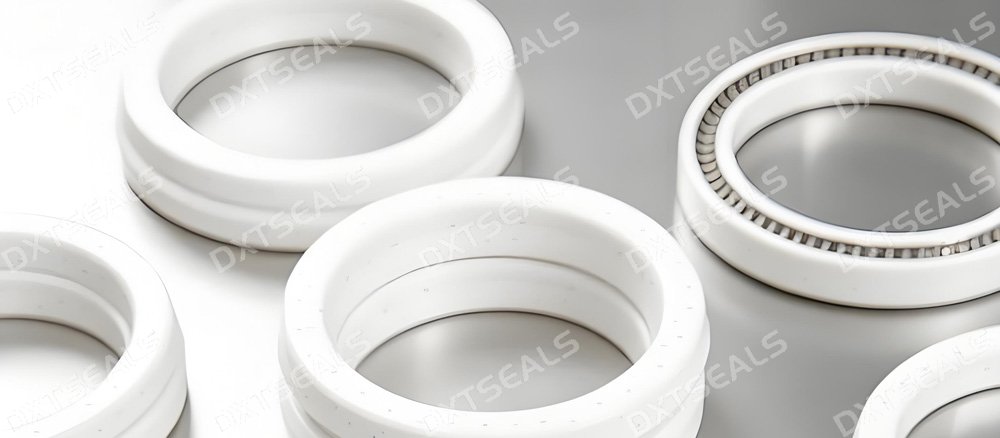
Spring energized seals are widely used in hydraulic systems, pneumatic equipment, semiconductor machinery, and high-end industrial applications due to their excellent sealing reliability and low friction performance.
Depending on the installation position, spring energized seals are generally divided into:
- Rod seals
- Piston seals
Although both use similar PTFE jacket materials and internal spring structures, their design concepts, sealing behavior, and application requirements are significantly different.
Understanding these differences is essential for achieving optimal sealing performance and service life. At DXTSEALS, we provide customized spring energized sealing solutions for both rod and piston applications.
1. What Is a Rod Seal?
A rod seal is installed on the inner diameter (ID) of a housing and seals against the moving shaft or rod surface.
Main Function
- Prevent fluid leakage along the shaft
- Protect systems from contamination
- Maintain pressure inside the system
Typical Motion
- Reciprocating shaft movement
- Rotary or oscillating shaft motion
Common Applications
- Hydraulic cylinders
- Pneumatic actuators
- Valve stems
- Aerospace actuators
2. What Is a Piston Seal?
A piston seal is installed on the outer diameter (OD) of a piston and seals against the bore surface.
Main Function
- Separate pressure chambers
- Maintain pressure efficiency inside cylinders
Typical Motion
- Reciprocating piston movement within a bore
Common Applications
- Hydraulic pistons
- Pneumatic cylinders
- Industrial pumps
- High-pressure equipment
3. Key Design Differences Between Rod and Piston Seals
Sealing Direction and Pressure Orientation
Rod Seals
- Pressure acts from the outside toward the shaft
- Seal lip is designed to maintain inward contact force
Piston Seals
- Pressure acts from inside the piston outward toward the bore
- Seal lip expands outward to maintain sealing contact
This difference directly affects seal geometry and spring loading direction.
Groove Design Differences
Rod Seal Groove Design
Key considerations include:
- Shaft surface finish
- Dynamic friction control
- Prevention of contamination ingress
The groove must minimize friction while maintaining reliable sealing.
Piston Seal Groove Design
Key considerations include:
- Bore tolerance control
- Pressure balancing
- Seal stability under reciprocating motion
Piston grooves typically require stronger anti-extrusion support under high pressure.
At DXTSEALS, groove dimensions are optimized based on the application type and operating conditions.
Lip Geometry Differences
Rod seals often feature:
- Sharper sealing lips
- Lower friction design
- Better contamination exclusion capability
Piston seals generally feature:
- More balanced sealing geometry
- Enhanced pressure distribution
- Improved stability under bidirectional pressure conditions
4. Differences in Friction and Wear Characteristics
Rod Seals
Rod applications usually emphasize:
- Low friction
- Smooth dynamic movement
- Reduced wear on the shaft surface
This is especially important in high-speed or precision motion systems.
Piston Seals
Piston seals focus more on:
- Pressure retention efficiency
- Resistance to extrusion
- Stable sealing under heavy load
Because piston seals often experience larger contact areas and pressure loads, wear resistance is especially important.
5. Material and Spring Selection Differences
Rod Seal Recommendations
Commonly preferred:
- Low-friction PTFE materials
- Carbon-filled or graphite-filled PTFE
- V-spring structures for fast response and reduced friction
Piston Seal Recommendations
Commonly preferred:
- High-strength filled PTFE materials
- Glass-filled or bronze-filled PTFE
- Helical or U-spring structures for stronger sealing force
The correct combination depends on pressure, speed, and media conditions.
6. Application Scenario Analysis
Rod Seal Applications
Rod-type spring energized seals are ideal for:
- High-speed reciprocating shafts
- Precision equipment
- Semiconductor machinery
- Aerospace systems requiring low friction
Key advantages:
- Excellent dynamic sealing
- Reduced friction and wear
- Better contamination protection
Piston Seal Applications
Piston-type spring energized seals are widely used in:
- Hydraulic cylinders
- High-pressure pumps
- Industrial automation equipment
- Heavy-duty hydraulic systems
Key advantages:
- High pressure resistance
- Stable sealing under heavy load
- Excellent chamber separation performance
7. Common Selection Mistakes
Using Rod Seals in Piston Applications
May cause:
- Insufficient pressure resistance
- Seal instability
- Reduced lifespan
Using Piston Seals in High-Speed Rod Applications
May result in:
- Excessive friction
- Increased heat generation
- Accelerated wear
Ignoring Groove and Surface Finish Requirements
Improper machining can significantly reduce sealing performance and service life.
At DXTSEALS, we help customers avoid these issues through professional engineering support and customized design solutions.
Conclusion
Although rod seals and piston seals are both spring energized sealing solutions, they differ significantly in:
- Pressure direction
- Groove design
- Lip geometry
- Friction characteristics
- Material and spring selection
Understanding these design differences is essential for selecting the right seal for specific applications.
- Rod seals prioritize low friction and dynamic sealing performance
- Piston seals focus on pressure resistance and sealing stability
At DXTSEALS, we provide customized spring energized seals engineered for both rod and piston applications, ensuring reliable sealing performance and extended service life.
If you need assistance selecting the right rod or piston spring energized seal, contact DXTSEALS today for expert guidance and customized sealing solutions.