
Introduction
Rod-type spring-energized seals, also known as shaft spring-energized seals, are widely used in dynamic sealing applications where conventional elastomer seals face limitations. With their unique structure and material advantages, these seals provide reliable sealing under high pressure, wide temperature ranges, and demanding motion conditions.
This article introduces the design features of rod-type spring-energized seals and outlines key considerations for proper seal selection.
What Is a Rod-Type Spring-Energized Seal?
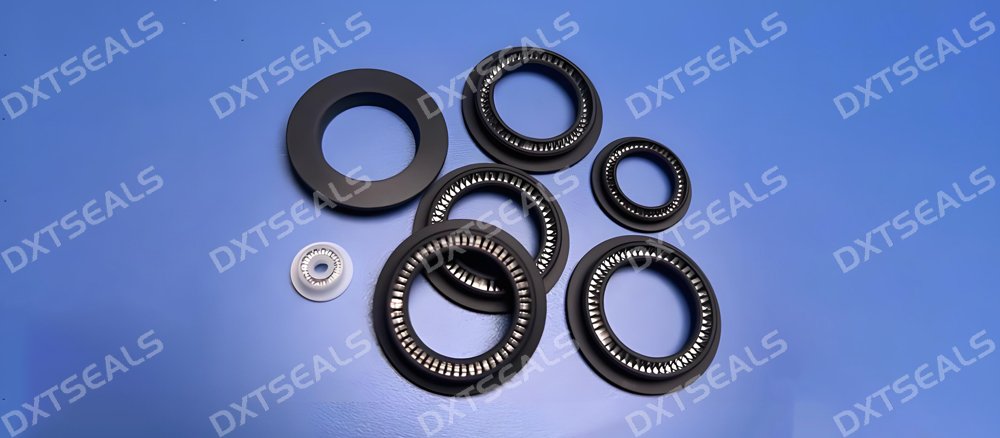
A rod-type spring-energized seal is installed on a shaft or piston rod and seals against the inner surface of a housing. The seal consists of:
-
A PTFE or filled PTFE sealing jacket
-
An internal energizing spring that applies continuous outward force
This design ensures consistent contact pressure between the seal lip and the bore surface, even under dynamic conditions.
Key Design Features of Rod-Type Spring-Energized Seals
Continuous Sealing Force
The energizing spring provides constant sealing force, allowing effective sealing at low pressure, zero pressure, or during pressure fluctuations.
Low Friction and Smooth Motion
PTFE-based sealing jackets offer low friction coefficients, reducing wear and minimizing stick-slip behavior during reciprocating or slow-speed motion.
Excellent Wear and Chemical Resistance
Filled PTFE materials enhance wear resistance while maintaining chemical compatibility with a wide range of fluids and gases.
Tolerance and Misalignment Compensation
The flexible sealing structure and spring energization help accommodate shaft runout, minor misalignment, and dimensional tolerances.
Selection Considerations for Rod-Type Spring-Energized Seals
Operating Pressure and Temperature
Different spring types and PTFE compounds are selected based on pressure levels and temperature ranges to ensure optimal sealing performance.
Motion Type and Speed
Reciprocating speed, stroke length, and frequency should be evaluated to prevent excessive wear and heat generation.
Surface Finish and Hardware Design
Proper shaft surface finish and groove dimensions are critical for minimizing friction and extending seal life.
Media Compatibility
Chemical compatibility between the seal material and the working media must be carefully verified to avoid material degradation.
Typical Applications
-
Hydraulic and pneumatic cylinders
-
Industrial actuators and linear motion systems
-
Valves and control equipment
-
Aerospace and precision machinery
At DXTSEALS, we provide rod-type spring-energized seals engineered for demanding dynamic sealing applications, offering reliable performance and extended service life.
Conclusion
Rod-type spring-energized seals combine advanced PTFE materials with precision spring design to deliver stable, low-friction sealing in dynamic environments. By understanding their design features and carefully considering application parameters during selection, manufacturers can achieve improved reliability and reduced maintenance costs.
Proper seal selection is essential to maximizing system performance and longevity.