
Introduction
Spring-energized seals are widely used in applications requiring reliable sealing under extreme temperatures, pressures, and dynamic conditions. Beyond material selection, the cross-sectional profile of a spring-energized seal plays a critical role in its sealing behavior, friction level, and wear resistance.
This article introduces the most common spring-energized seal cross-section types—U-shaped, C-shaped, and rectangular designs—and explains how their structures influence performance in different applications.
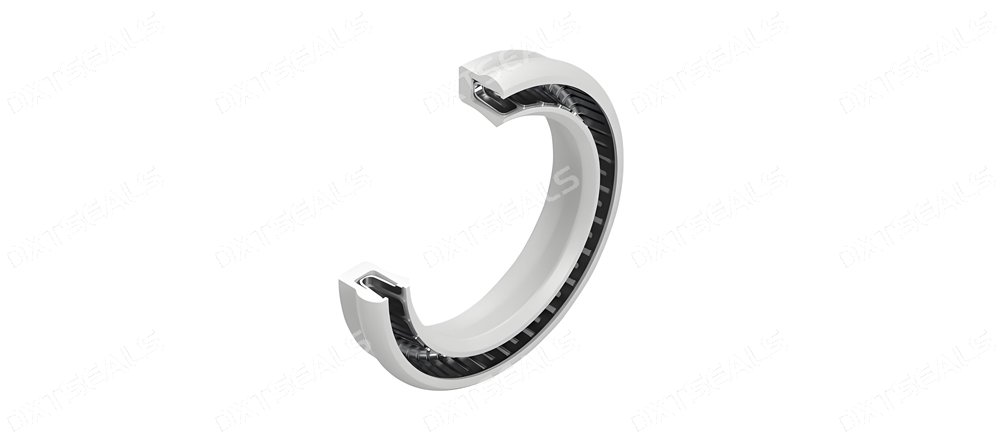
Overview of Spring-Energized Seal Structure
A typical spring-energized seal consists of two main components:
-
A PTFE or filled PTFE jacket that contacts the mating surface
-
A metal energizing spring that provides consistent sealing force
The cross-sectional shape determines how the seal deforms, how pressure is distributed, and how effectively the spring force is transmitted to the sealing lip.
U-Shaped Spring-Energized Seals
Structural Characteristics
U-shaped seals feature two flexible sealing lips with an internal cavity housing the energizing spring. This design allows the lips to adapt easily to surface irregularities.
Performance Advantages
-
Excellent sealing at low and high pressure
-
Good compensation for wear and thermal expansion
-
Suitable for both static and dynamic applications
Typical Applications
-
Hydraulic and pneumatic systems
-
Reciprocating and rotary sealing
-
General industrial equipment
At DXTSEALS, U-shaped spring-energized seals are commonly used where versatility and reliable sealing are required.
C-Shaped Spring-Energized Seals
Structural Characteristics
C-shaped seals have a more compact profile with a single primary sealing lip. The spring energizes the lip directly, offering controlled contact pressure.
Performance Advantages
-
Lower friction compared to U-shaped designs
-
Better performance in high-speed rotary applications
-
Reduced wear on mating surfaces
Typical Applications
-
High-speed rotating shafts
-
Precision machinery
-
Applications requiring low torque
Rectangular Spring-Energized Seals
Structural Characteristics
Rectangular spring-energized seals feature a simple, solid cross-section with the spring embedded inside. The sealing surface is flat and stable.
Performance Advantages
-
High extrusion resistance
-
Excellent stability under high pressure
-
Ideal for confined installation spaces
Typical Applications
-
Static sealing
-
High-pressure valves and flanges
-
Limited groove depth designs
Choosing the Right Cross-Section Profile
Selecting the appropriate seal profile depends on several factors:
-
Static or dynamic operation
-
Pressure level and direction
-
Speed and friction requirements
-
Installation space and groove design
Each cross-section offers distinct advantages, and proper selection ensures optimal sealing performance and extended service life.
Conclusion
U-shaped, C-shaped, and rectangular spring-energized seals each serve specific performance needs. Understanding their structural differences helps engineers make informed decisions when designing sealing systems for demanding applications.
With the right profile and material combination, spring-energized seals deliver reliable performance even under extreme operating conditions.