
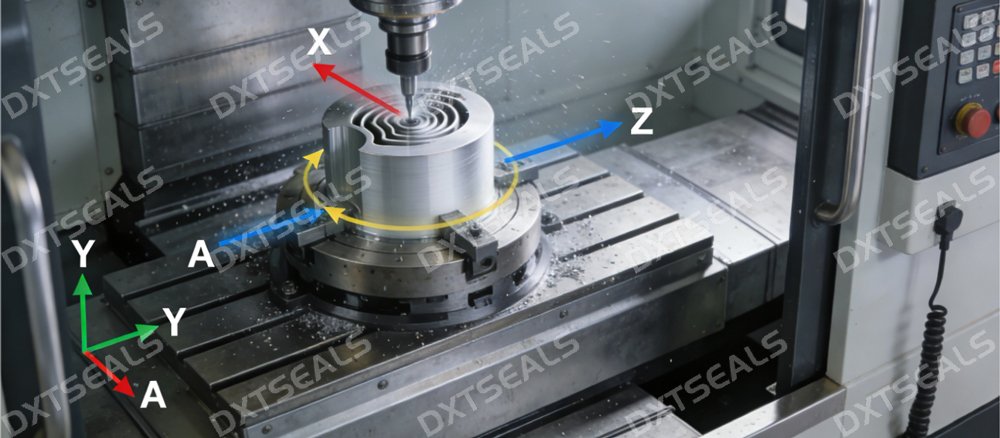
CNC machining technology has developed from conventional three-axis machining to advanced four-axis and five-axis systems capable of producing increasingly complex components. While all three machining configurations use computer-controlled cutting tools, the number and coordination of controlled axes significantly affect how a component can be positioned and machined.
The differences between 3-axis, 4-axis, and 5-axis CNC machining are not simply about the number of axes. They also involve workpiece positioning, tool orientation, setup requirements, machining flexibility, programming complexity, equipment investment, and the types of components that can be manufactured efficiently.
Understanding these differences helps manufacturers select the most appropriate CNC machining process for precision metal, plastic, graphite, and other industrial components.
What Do CNC Machining Axes Mean?
A CNC machining axis represents a controlled direction of movement between the cutting tool and workpiece.
A conventional 3-axis CNC machine typically controls three linear axes:
-
X-axis: Left-to-right movement
-
Y-axis: Front-to-back movement
-
Z-axis: Up-and-down movement
Additional CNC axes are usually rotary axes.
Depending on the machine configuration, rotary axes may be designated as:
-
A-axis: Rotation around the X-axis
-
B-axis: Rotation around the Y-axis
-
C-axis: Rotation around the Z-axis
The exact axis configuration varies between different machine designs.
Therefore, a 4-axis machine generally adds one controlled rotary axis to the three linear axes, while a 5-axis machine adds two rotary axes.
What Is 3-Axis CNC Machining?
3-axis CNC machining is one of the most widely used CNC milling configurations.
The cutting tool moves along the X, Y, and Z axes while the workpiece generally remains fixed in the fixture during the machining operation.
Typical 3-Axis CNC Operations
A 3-axis CNC milling machine can perform operations such as:
-
Face milling
-
End milling
-
Pocket machining
-
Slot machining
-
Drilling
-
Tapping
-
Contouring
-
Chamfering
-
Surface machining
Typical 3-Axis CNC Parts
3-axis machining is suitable for many components with relatively straightforward geometries, including:
-
Plates
-
Brackets
-
Blocks
-
Machine covers
-
Flange plates
-
Fixtures
-
Housings
-
Simple mechanical components
It can also produce complex 3D surfaces, although highly complex geometries may require additional setups or specialized fixtures.
Advantages of 3-Axis CNC Machining
The main advantages include:
-
Relatively simple programming
-
Lower equipment investment
-
Wide availability
-
Straightforward operation
-
Efficient production of standard geometries
-
Suitable for many prototypes and production parts
For simple and moderately complex components, a 3-axis CNC machine can often provide an efficient and economical manufacturing solution.
What Is 4-Axis CNC Machining?
A 4-axis CNC machine adds one rotary axis to the standard X, Y, and Z linear axes.
The additional rotary axis allows the workpiece or cutting tool to rotate around one direction.
This provides access to additional surfaces without necessarily requiring the operator to manually reposition the workpiece.
How 4-Axis CNC Machining Works
A typical 4-axis setup may use a rotary table.
The workpiece can be rotated to a specific angle, allowing machining operations to be performed around multiple sides.
Depending on the machine and application, the fourth axis can be used for:
-
Indexing
-
Cylindrical machining
-
Multiple-side machining
-
Radial drilling
-
Angular features
-
Contour machining
Typical 4-Axis CNC Applications
4-axis machining is useful for components that require machining around a central axis or multiple sides.
Examples include:
-
Cylindrical components with milled features
-
Components with radial holes
-
Parts requiring multiple indexed faces
-
Certain gears and shafts
-
Custom brackets
-
Complex mechanical components
Advantages of 4-Axis CNC Machining
Compared with conventional 3-axis machining, 4-axis equipment can provide:
-
Greater machining flexibility
-
Reduced manual repositioning
-
Better access to multiple surfaces
-
More efficient machining of radial features
-
Potentially fewer setups
However, a 4-axis machine does not provide the same tool-orientation flexibility as a full 5-axis system.
What Is 5-Axis CNC Machining?
5-axis CNC machining adds two rotary axes to the three linear axes.
This allows the cutting tool and/or workpiece to be positioned from multiple directions.
The additional rotary movement provides greater flexibility for machining:
-
Complex curved surfaces
-
Angled surfaces
-
Compound geometries
-
Multiple intersecting faces
-
Deep or difficult-to-access features
3+2 vs Simultaneous 5-Axis Machining
There are two important approaches to 5-axis machining.
3+2 machining uses the rotary axes to position the workpiece or tool at a selected orientation, followed by machining with the three linear axes.
Simultaneous 5-axis machining allows several axes to move continuously during cutting. This makes it possible to maintain a changing tool orientation while machining complex surfaces.
Simultaneous 5-axis machining is particularly useful for advanced 3D surfaces, although it generally requires more sophisticated CAM programming and process planning.
3-Axis vs 4-Axis vs 5-Axis CNC Machining
The main differences can be summarized as follows:
| Feature | 3-Axis CNC | 4-Axis CNC | 5-Axis CNC |
|---|---|---|---|
| Linear axes | X, Y, Z | X, Y, Z | X, Y, Z |
| Rotary axes | None | 1 | 2 |
| Basic tool movement | 3 directions | 3 linear + 1 rotary | 3 linear + 2 rotary |
| Workpiece positioning | Fixed during setup | Additional rotary positioning | Multiple orientations |
| Multiple surfaces | More setups may be required | Improved access | Highly flexible |
| Complex angled surfaces | Limited | Better | Excellent |
| Complex 3D surfaces | Capable | More flexible | Highly capable |
| Programming complexity | Lower | Moderate | Higher |
| Equipment investment | Lower | Moderate | Higher |
| Fixture requirements | Conventional | Rotary/indexing fixtures may be used | Advanced fixtures may be used |
| Ideal applications | Standard components | Multi-side/radial features | Complex precision components |
Key Difference 1: Number of Controlled Axes
The most obvious difference is the number of controlled axes.
A 3-axis machine uses three linear axes.
A 4-axis machine adds one rotary axis.
A 5-axis machine adds two rotary axes.
However, the additional axes are valuable because they change how the cutting tool can approach the workpiece.
The practical advantage is therefore not simply "more axes," but greater machining access and positioning flexibility.
Key Difference 2: Workpiece Setup
Setup requirements can be a major factor in CNC machining efficiency.
With 3-axis machining, a complex component may need to be removed and repositioned several times to machine different surfaces.
A 4-axis machine can rotate the component to access additional surfaces.
A 5-axis machine can often reach multiple surfaces in a single setup.
Reducing setups can help minimize:
-
Setup time
-
Workpiece handling
-
Alignment operations
-
Fixture changes
-
Potential positioning errors
However, the actual number of required setups depends on the component geometry and machining strategy.
Key Difference 3: Tool Orientation
Tool orientation is one of the most important differences between these machining configurations.
In conventional 3-axis machining, the cutting tool orientation is relatively limited.
A 4-axis system provides additional rotational positioning.
A 5-axis system provides even greater freedom to orient the tool relative to the workpiece.
This can be especially useful when machining:
-
Curved surfaces
-
Angled walls
-
Compound contours
-
Deep cavities
-
Complex 3D geometries
Key Difference 4: Complex Geometry
3-axis machining can manufacture many complex components, but certain geometries may require multiple setups or special fixtures.
4-axis machining extends the capabilities of 3-axis systems by providing additional rotational access.
5-axis machining is particularly advantageous when a component has multiple surfaces that must be machined from different directions.
This makes 5-axis machining well suited for:
-
Turbine components
-
Impellers
-
Complex molds
-
Aerospace components
-
Medical components
-
Advanced mechanical parts
Key Difference 5: Programming Complexity
More machining axes generally mean more complex programming requirements.
3-axis CNC programs are comparatively straightforward for conventional milling operations.
4-axis programming introduces rotary-axis movement and requires additional consideration of workpiece orientation.
5-axis programming can be significantly more sophisticated, especially for simultaneous machining.
CAM software must calculate appropriate tool paths and tool orientations while considering:
-
Tool length
-
Tool collisions
-
Machine kinematics
-
Workpiece geometry
-
Fixture geometry
-
Cutting conditions
Therefore, a 5-axis machine requires not only advanced hardware but also appropriate programming and process-planning capabilities.
Key Difference 6: Equipment and Production Cost
Generally, 3-axis CNC machines require less initial investment than 4-axis and 5-axis equipment.
As the number of controlled axes increases, equipment, programming, tooling, and process-planning costs may also increase.
However, the total manufacturing cost should not be judged only by machine purchase price.
A 5-axis machine may reduce the need for:
-
Multiple fixtures
-
Repeated setups
-
Manual repositioning
-
Intermediate handling
-
Separate machining operations
For complex parts, these savings can offset the higher equipment and programming costs.
For simple parts, however, using a 5-axis machine may provide little economic advantage.
3-Axis CNC: When Is It the Best Choice?
3-axis CNC machining is often the most practical option when:
-
The component has relatively simple geometry.
-
Most surfaces can be reached from one or a few orientations.
-
Flat surfaces and pockets dominate the design.
-
The part does not require continuous tool reorientation.
-
Production cost is a major consideration.
-
Large production volumes justify efficient conventional machining.
Examples include:
-
Flat plates
-
Simple housings
-
Brackets
-
Standard machine components
-
Fixtures
-
Basic flange components
4-Axis CNC: When Is It the Best Choice?
4-axis machining can be appropriate when:
-
The component requires rotary positioning.
-
Multiple sides need machining.
-
Radial holes or features are required.
-
Cylindrical parts contain milling features.
-
A rotary table can reduce setup requirements.
It can provide a useful middle ground between conventional 3-axis machining and more advanced 5-axis machining.
5-Axis CNC: When Is It the Best Choice?
5-axis machining is generally most valuable when:
-
The component has complex 3D geometry.
-
Multiple angled surfaces must be machined.
-
Tool orientation needs to change during machining.
-
Several setups would otherwise be required.
-
Feature-to-feature positional relationships are critical.
-
Complex curved surfaces require advanced tool paths.
It is particularly useful for high-value or geometrically complex components where machining flexibility is more important than minimizing machine investment.
Applications of 3-Axis, 4-Axis, and 5-Axis CNC Machining
Different industries can use all three machining configurations depending on the component.
Industrial Machinery
Industrial equipment commonly uses CNC-machined:
-
Brackets
-
Housings
-
Shafts
-
Flanges
-
Fixtures
-
Valve components
-
Custom machine parts
3-axis machining is often sufficient for standard geometries, while 4-axis or 5-axis machining can be used for more complex components.
Aerospace
Aerospace components often contain complex surfaces and strict dimensional requirements.
5-axis machining is frequently useful for:
-
Structural components
-
Turbine-related components
-
Complex housings
-
Engine components
-
Lightweight machined parts
Automotive
Automotive manufacturing can use different CNC configurations for:
-
Prototype components
-
Engine parts
-
Transmission components
-
Molds
-
Fixtures
-
Specialized mechanical parts
Medical Manufacturing
Medical components may require small and complex geometries.
Depending on the component, 3-axis, 4-axis, or 5-axis machining can be used for:
-
Surgical instruments
-
Precision fixtures
-
Medical equipment components
-
Complex machined parts
Mold and Tool Manufacturing
Mold components often benefit from multi-axis machining when complex curved surfaces are required.
5-axis machining can reduce the number of setups and provide more flexible tool orientation.
CNC Machining for Industrial Sealing Components
CNC machining is also widely used to manufacture custom sealing components.
Examples include:
-
Mechanical seal components
-
PTFE seal rings
-
Graphite rings
-
Seal housings
-
Bushings
-
Wear rings
-
Valve sealing components
-
Custom sealing parts
For simple rotational sealing components, CNC turning may be more appropriate than 3-axis, 4-axis, or 5-axis milling.
However, components containing holes, slots, pockets, angled surfaces, or complex profiles may require CNC milling.
The machining configuration should therefore be selected based on the actual geometry rather than simply choosing the most advanced machine available.
CNC Machining of PTFE and Graphite Components
Material characteristics also affect the appropriate machining process.
PTFE is relatively soft and can deform under excessive cutting or clamping forces. Machining strategies should therefore consider:
-
Workholding pressure
-
Cutting forces
-
Tool geometry
-
Heat generation
-
Dimensional stability
Graphite is relatively brittle and abrasive, requiring appropriate cutting tools, process parameters, and dust management.
For complex PTFE or graphite components, multi-axis machining may provide useful tool access, but material-specific machining practices remain essential.
How to Choose Between 3-Axis, 4-Axis, and 5-Axis CNC Machining
The best CNC process should be selected according to the component rather than the machine's axis count alone.
Consider the following factors:
Part Geometry
Simple geometries may only require 3-axis machining.
Components with rotary or multi-sided features may benefit from 4-axis machining.
Highly complex surfaces may justify 5-axis machining.
Number of Setups
If a component requires many repositioning operations, 4-axis or 5-axis machining may reduce production time and setup variation.
Tolerance Requirements
Components with multiple critical features may benefit from machining several features in fewer setups.
Surface Finish
Complex curved surfaces may benefit from improved tool orientation available with 5-axis machining.
Production Volume
For high-volume simple parts, conventional machining may be more economical.
For low-volume complex parts, reducing setups can make advanced multi-axis machining attractive.
Material
Hard, abrasive, brittle, or deformation-sensitive materials may require specialized tooling and machining strategies.
Overall Manufacturing Cost
The correct decision should consider total manufacturing cost, including:
-
Machine time
-
Setup time
-
Programming
-
Tooling
-
Fixtures
-
Inspection
-
Material handling
-
Secondary operations
Can a 5-Axis Machine Replace a 3-Axis or 4-Axis Machine?
Not necessarily.
A 5-axis machine can perform many operations that are possible on 3-axis and 4-axis machines, but that does not mean it is always the most efficient option.
For a simple plate with several holes, a 3-axis CNC mill may be faster and more economical.
For a cylindrical component requiring radial machining, a 4-axis machine may provide an efficient solution.
For a complex freeform component requiring continuously changing tool orientation, a 5-axis machine may be the better choice.
The goal is to match the machining technology to the component requirements.
Conclusion
The key differences between 3-axis, 4-axis, and 5-axis CNC machining are related to axis configuration, workpiece positioning, tool orientation, setup requirements, programming complexity, and the ability to manufacture complex geometries.
3-axis CNC machining is an efficient choice for many standard and moderately complex components.
4-axis CNC machining adds rotary positioning and can improve access to multiple surfaces and radial features.
5-axis CNC machining provides the highest level of machining flexibility among the three, making it particularly useful for complex multi-surface and three-dimensional components.
The most advanced machine is not automatically the best machine for every job. A professional CNC machining process should consider the part geometry, material, tolerance, surface finish, production volume, setup requirements, and total manufacturing cost before selecting the appropriate machining configuration.