
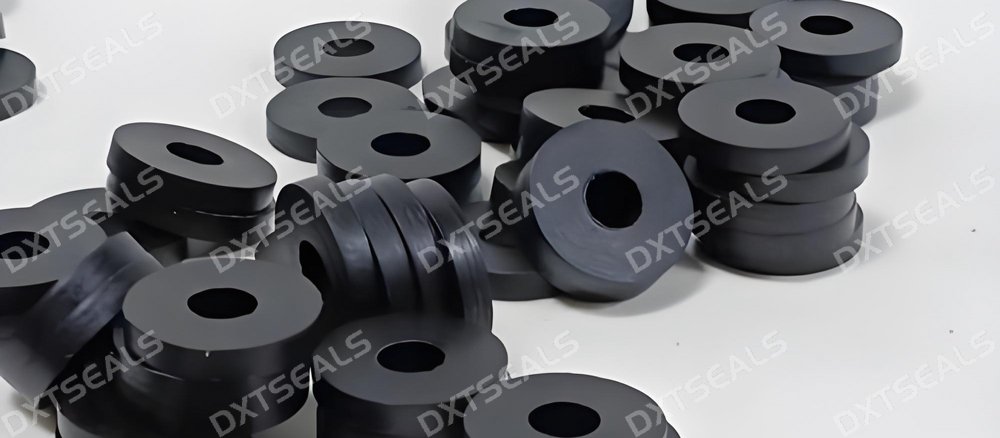
In industrial systems, rubber flat gaskets play a vital role in ensuring leak-free connections and vibration reduction across pipelines, pumps, and mechanical assemblies. Although often simple in appearance, these components are critical for maintaining long-term reliability and safety in machinery.
As an experienced sealing solutions provider, DXTSEALS shares insights into the applications, material options, and key selection factors for rubber flat gaskets in demanding engineering environments.
1. The Role of Rubber Flat Gaskets in Leakage Prevention
Leakage in fluid systems can cause equipment failure, product loss, and safety risks. Rubber flat gaskets serve as a compressible barrier between two surfaces, filling micro-irregularities to create an effective seal.
Key sealing functions include:
-
Fluid and gas sealing: Preventing oil, air, or water leakage between flanges or joints.
-
Compensation for surface roughness: Rubber’s elasticity helps achieve tight contact even under uneven pressure.
-
Pressure and temperature adaptation: Properly selected materials can withstand specific working conditions to ensure seal longevity.
Common sealing applications include pumps, compressors, pipe flanges, valves, and storage tanks.
2. Rubber Flat Gaskets as Vibration and Shock Absorbers
Beyond sealing, rubber gaskets also serve as vibration dampers. In rotating or dynamic equipment, mechanical vibration can cause loosening, noise, or fatigue damage. Rubber’s inherent elasticity and damping ability make it ideal for absorbing these vibrations.
Typical anti-vibration uses include:
-
Mounting pads for motors, compressors, and pumps
-
Buffer layers in automotive assemblies and electronic devices
-
Cushioning parts in industrial machinery
The right rubber gasket helps reduce operational noise, protect components, and extend equipment lifespan.
3. Common Rubber Materials for Flat Gaskets
Choosing the right rubber material depends on temperature range, chemical exposure, and mechanical requirements. Below are the most commonly used materials:
| Material | Features | Typical Applications |
|---|---|---|
| NBR (Nitrile Rubber) | Excellent oil and fuel resistance; good mechanical strength | Oil seals, hydraulic systems |
| EPDM (Ethylene Propylene Rubber) | Great weather, ozone, and water resistance; poor oil resistance | Water pipelines, outdoor equipment |
| FKM (Viton®) | Outstanding chemical and heat resistance | Chemical plants, high-temperature sealing |
| Silicone Rubber | Excellent flexibility in extreme temperatures (-60°C to +200°C) | Food, medical, and electronics industries |
| Neoprene Rubber | Balanced properties for oil, ozone, and weather resistance | HVAC systems, marine sealing |
At DXTSEALS, we provide custom-cut or molded flat gaskets in all these materials according to customer drawings and application needs.
4. Key Factors to Consider When Selecting Rubber Flat Gaskets
When selecting a gasket, engineers should evaluate the following aspects to ensure performance and reliability:
-
Operating Conditions:
Determine working pressure, temperature, and media type (oil, gas, water, chemical, etc.). -
Compression Set Resistance:
Select rubber with low compression set for long-term sealing under load. -
Chemical Compatibility:
Ensure the rubber resists degradation by the working medium. -
Hardness (Shore A):
Softer rubbers seal better but may deform under pressure; harder ones resist extrusion. -
Installation Surface Finish:
A smoother flange surface improves gasket sealing efficiency. -
Environmental Factors:
Consider UV exposure, ozone, and humidity for outdoor or marine applications.
5. Custom Rubber Flat Gasket Solutions from DXTSEALS
DXTSEALS specializes in custom sealing components for industrial applications. Our rubber flat gaskets are available in a wide range of materials, thicknesses, and hardness levels.
We support:
-
Custom dimensions and drawings
-
Material certification (FDA, RoHS, REACH)
-
Prototyping and bulk production
-
Precision cutting and molding services
Whether for anti-leakage, anti-vibration, or insulation, our engineering team helps clients select the most suitable material and design for optimal sealing performance.
6. Conclusion
Rubber flat gaskets may seem like small components, but they are essential for ensuring safety, stability, and reliability in mechanical and fluid systems.
By understanding each material’s strengths and application suitability, engineers can optimize gasket performance and reduce maintenance costs.
For high-quality, customized rubber flat gaskets, trust DXTSEALS — your reliable partner for precision sealing solutions across industrial, automotive, and mechanical sectors.