
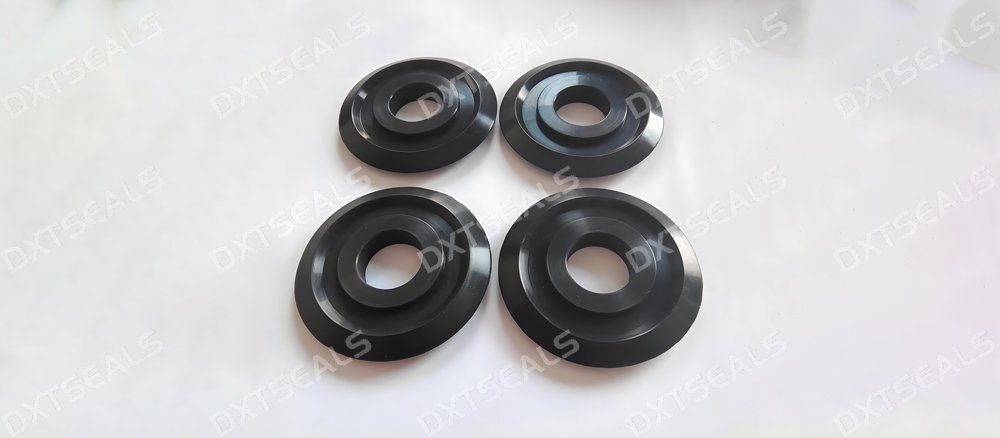
In modern industries, custom rubber parts are widely used in sealing, vibration damping, and protective applications. Their performance under oil exposure, friction, and high temperature determines the stability and longevity of the entire system.
This article by DXTSEALS provides an in-depth comparison of oil resistance, wear resistance, and heat resistance among common rubber materials such as NBR, FKM, EPDM, and silicone, helping you make informed material selections for your projects.
1. Oil Resistance: NBR and FKM Lead the Way
Oil resistance is a key factor for rubber components used in hydraulic systems, automotive engines, and fuel environments.
-
NBR (Nitrile Rubber):
Known for its excellent oil and fuel resistance, NBR is the most commonly used material for oil seals, gaskets, and O-rings.
It performs well in contact with mineral oils and petroleum-based fluids, making it ideal for automotive and machinery applications.
However, its temperature limit (up to 100°C) is relatively low compared to FKM. -
FKM (Fluoroelastomer):
Exhibits superior oil and chemical resistance, including tolerance to aggressive fuels and synthetic lubricants.
FKM remains stable under continuous temperatures up to 200°C, making it suitable for aerospace, chemical, and high-end automotive systems.
Its higher cost is balanced by its long-term performance in harsh conditions. -
EPDM & Silicone:
These materials are not recommended for oil contact environments, as they tend to swell or degrade when exposed to hydrocarbons.
✅ DXTSEALS Recommendation:
For oil-based systems, NBR is the economical choice, while FKM offers the best long-term resistance under severe chemical or thermal conditions.
2. Wear Resistance: The Key to Durability
Wear resistance directly affects the service life of rubber seals and gaskets, especially in dynamic or friction-intensive applications.
-
NBR:
Offers good abrasion resistance, commonly used in hydraulic seals and piston components.
It balances flexibility and strength, suitable for medium-pressure environments. -
EPDM:
Has moderate wear resistance, more suitable for static sealing applications such as weatherproofing and insulation. -
FKM:
Provides excellent wear resistance along with thermal and chemical stability, ideal for rotary shaft seals and mechanical sealing systems.
It performs well in continuous motion applications involving oil or heat. -
Silicone:
Although flexible, silicone has poor abrasion resistance, making it less ideal for dynamic or high-friction use.
✅ DXTSEALS Recommendation:
Choose FKM for high-friction, oil-lubricated conditions; NBR remains the best choice for cost-effective, wear-resistant seals in general applications.
3. Heat Resistance: EPDM and FKM Excel
Temperature resistance determines how well rubber materials perform in engines, compressors, or industrial furnaces.
-
EPDM (Ethylene Propylene Diene Rubber):
Exhibits excellent heat and ozone resistance, stable up to 150°C, and performs well in steam or hot-water environments.
Commonly used in HVAC systems, brake seals, and outdoor applications. -
FKM:
Outperforms most other rubbers with continuous working temperatures up to 200–250°C.
It retains elasticity and mechanical strength even after long-term thermal exposure. -
Silicone:
Excels in extreme temperature ranges (-60°C to +200°C), maintaining flexibility where other rubbers harden.
However, it is more suitable for static or light-load applications due to lower mechanical strength. -
NBR:
Has limited heat resistance (typically up to 100°C), so it’s not ideal for high-temperature systems.
✅ DXTSEALS Recommendation:
For high-temperature applications, FKM is the premium option.
For steam and outdoor environments, EPDM offers a cost-effective alternative.
4. Comprehensive Material Comparison Table
| Property | NBR | FKM | EPDM | Silicone |
|---|---|---|---|---|
| Oil Resistance | ★★★★☆ | ★★★★★ | ★☆☆☆☆ | ★☆☆☆☆ |
| Wear Resistance | ★★★★☆ | ★★★★★ | ★★★☆☆ | ★★☆☆☆ |
| Heat Resistance | ★★★☆☆ | ★★★★★ | ★★★★☆ | ★★★★★ |
| Cost Efficiency | ★★★★★ | ★★☆☆☆ | ★★★★☆ | ★★★☆☆ |
| Recommended Application | General oil seals, hydraulic parts | High-temp chemical seals | Outdoor & water systems | Food, medical, and electronics |
5. DXTSEALS Expertise in Custom Rubber Parts
At DXTSEALS, we specialize in custom rubber components engineered for extreme oil, heat, and wear conditions.
Our professional team assists clients in selecting the most suitable compound through:
-
Material formulation & customization
-
Precision molding and CNC trimming
-
Testing for oil, temperature, and abrasion resistance
-
OEM/ODM support for international projects
Whether you need NBR oil seals, FKM high-temperature gaskets, or EPDM outdoor components, DXTSEALS provides reliable sealing solutions tailored to your operating environment.
Conclusion
Choosing the right rubber material requires understanding the balance between oil resistance, wear resistance, and heat tolerance.
While NBR offers excellent performance for general oil applications, FKM stands out for extreme environments.
EPDM and silicone are preferred for heat or weather exposure, respectively.
By partnering with DXTSEALS, you gain access to expert guidance, high-quality materials, and precision manufacturing — ensuring your custom rubber components deliver superior performance and longevity.
DXTSEALS — Your Trusted Partner for Custom Rubber Solutions.
Visit www.dxtseals.com to explore material options and request technical support.