
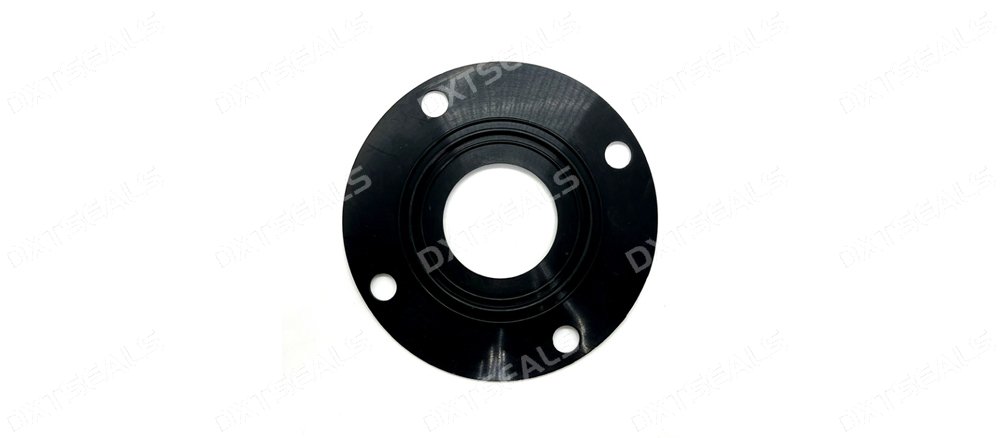
EPDM flange gaskets are widely used for sealing flanged connections in water systems, piping, HVAC equipment, industrial equipment, and other applications where resistance to water, weathering, ozone, and many chemicals is required.
However, selecting an EPDM flange gasket is not simply a matter of choosing the correct rubber material. The gasket must also match the flange standard, nominal size, pressure class, dimensions, bolt-hole arrangement, and operating conditions.
ASME and ANSI-related flange systems are commonly used in North America, while EN and other European standards are widely used in Europe. Although some flange sizes may appear similar, their dimensions and drilling patterns are not necessarily interchangeable.
This article explains the main considerations when selecting EPDM flange gaskets for ASME, ANSI, and European-standard flange systems.
What Is an EPDM Flange Gasket?
An EPDM flange gasket is a sealing component manufactured from ethylene propylene diene monomer rubber.
It is installed between two mating flanges to create a sealing interface and prevent leakage of the fluid passing through the piping or equipment.
EPDM is particularly well suited to applications involving:
- Water
- Hot water
- Cooling water
- HVAC systems
- Outdoor piping
- Certain dilute chemicals
- Wastewater systems
- General industrial fluid handling
EPDM is generally not recommended for applications involving petroleum-based oils and fuels because material compatibility must be considered carefully.
Key Properties of EPDM
EPDM is widely used for industrial rubber gaskets because of its favorable environmental resistance.
Excellent Water Resistance
EPDM provides good resistance to water and is commonly used in water piping, pumps, valves, heat-transfer systems, and related equipment.
Weather and Ozone Resistance
EPDM has strong resistance to weathering and ozone. This makes it useful for outdoor installations and equipment exposed to environmental conditions.
Temperature Resistance
EPDM can be used over a relatively broad temperature range, but the actual temperature limit depends on the specific compound, formulation, gasket design, and application.
For high-temperature applications, the manufacturer's material data should always be checked rather than relying on a generic EPDM temperature rating.
Chemical Resistance
EPDM generally provides good resistance to many water-based chemicals, acids, and alkalis.
However, chemical compatibility depends on the specific medium, concentration, temperature, and exposure time.
Why Flange Standards Matter
A flange gasket must fit the flange correctly.
Even when two flanges have the same nominal pipe size, their:
- Outside diameter
- Inside diameter
- Thickness
- Bolt-hole number
- Bolt-hole diameter
- Bolt-circle diameter
- Sealing-face dimensions
may differ according to the applicable standard and pressure class.
Therefore, specifying only "EPDM gasket" or "4-inch flange gasket" may not provide enough information for accurate product selection.
The flange standard should be confirmed before manufacturing or ordering.
ASME Flange Gaskets
ASME standards are widely used for pressure piping and flange systems in North America and many international industrial projects.
For example, ASME B16.5 covers pipe flanges and flanged fittings within its specified size and pressure-class range.
When selecting an EPDM gasket for an ASME flange, the following information should be confirmed:
- Nominal pipe size
- Pressure class
- Flange type
- Facing type
- Gasket dimensions
- Bolt-hole arrangement
- Operating temperature
- Process medium
The gasket dimensions should correspond to the actual flange and sealing-face configuration.
ANSI Flange Gaskets
The term "ANSI flange" is still commonly used in industry, although modern flange specifications are generally referenced through ASME standards.
For this reason, customers may use terms such as:
- ANSI 150 gasket
- ANSI 300 gasket
- ANSI flange gasket
- ASME Class 150 gasket
- ASME Class 300 gasket
When receiving an inquiry, it is useful to confirm the actual flange standard and pressure class rather than relying solely on the term "ANSI."
European Standard Flange Gaskets
European piping systems commonly use EN standards for flange dimensions and configurations.
EN flange systems may differ from ASME flange systems in:
- Dimensions
- Pressure designation
- Bolt-hole arrangement
- Outside diameter
- Sealing-face configuration
A gasket designed for an EN flange should therefore be manufactured according to the correct European specification rather than simply matched by nominal pipe size.
ASME / ANSI vs European Flange Gaskets
The main differences can be summarized as follows:
| Feature | ASME / ANSI System | European EN System |
|---|---|---|
| Common terminology | ASME / ANSI | EN |
| Pressure designation | Class, such as Class 150 or Class 300 | PN designation commonly used |
| Flange dimensions | Based on applicable ASME specifications | Based on applicable EN specifications |
| Bolt pattern | Standard-specific | Standard-specific |
| Nominal size | NPS commonly used | DN commonly used |
| Interchangeability | Must be verified | Must be verified |
The table is a general comparison. Exact gasket dimensions must be determined from the applicable flange standard and size.
ASME Class 150 EPDM Gaskets
Class 150 is one of the commonly encountered pressure classes in ASME flange systems.
When supplying an EPDM gasket for a Class 150 flange, the gasket should be matched to:
- Pipe nominal size
- Flange type
- Facing
- Flange dimensions
- Required gasket dimensions
- Service conditions
It is important to remember that a flange pressure class is not simply a universal operating-pressure rating for every temperature and material combination. The allowable conditions depend on the applicable standard and system design.
ASME Class 300 EPDM Gaskets
Class 300 flange systems generally use different dimensions from Class 150 systems.
Therefore, a Class 150 gasket should not automatically be substituted for a Class 300 gasket even when the nominal pipe size is identical.
For Class 300 applications, confirm:
- Nominal size
- Flange standard
- Pressure class
- Facing type
- Gasket dimensions
- Temperature
- Medium
This is particularly important when replacing an existing gasket.
EPDM Flange Gasket Dimensions
Typical gasket specifications may include:
| Parameter | Description |
|---|---|
| Material | EPDM rubber |
| Nominal size | DN or NPS |
| Pressure class | Class 150, Class 300, PN10, PN16, etc. |
| Outside diameter | Matched to flange |
| Inside diameter | Matched to pipe or sealing area |
| Thickness | According to application and flange design |
| Bolt-hole pattern | According to flange standard |
| Facing | RF, FF, or other applicable configuration |
| Hardness | According to selected EPDM compound |
| Temperature | Based on material and application |
| Medium | Water, chemicals, air, etc. |
The final dimensions should be confirmed against the relevant standard or customer drawing.
EPDM Flange Gaskets for Water Systems
Water applications are one of the most common uses for EPDM flange gaskets.
They can be considered for:
- Drinking-water-related systems where the specific compound has the required approvals
- Industrial water
- Cooling water
- Chilled water
- Hot water
- HVAC piping
- Water treatment equipment
For potable water applications, the EPDM compound should have the appropriate regulatory or sanitary approvals required in the target market.
EPDM Gaskets for HVAC Systems
EPDM is widely considered for heating, ventilation, and air-conditioning systems.
Typical applications include:
- Chilled-water pipelines
- Cooling-water systems
- Heating-water systems
- Pumps
- Valves
- Heat exchangers
- HVAC equipment
Its resistance to water, ozone, and weathering can make EPDM suitable for both indoor and outdoor HVAC installations.
EPDM vs Other Rubber Materials
Material selection should be based on the process medium and operating environment.
| Material | Typical Advantages | Common Applications |
|---|---|---|
| EPDM | Water, weather, ozone, and many chemical environments | Water, HVAC, outdoor systems |
| NBR | Good resistance to oils and fuels | Hydraulic systems, oil service |
| FKM | High-temperature and chemical resistance in many applications | Chemical and demanding industrial service |
| Silicone | Wide temperature capability and flexibility | Food, medical, and specialized applications |
These are general material characteristics. The exact compound and operating conditions should be verified before final selection.
EPDM Flange Gaskets With Different Flange Facings
The gasket geometry may depend on the flange facing.
Common configurations include:
- Full-face gasket
- Raised-face gasket
- Flat-face gasket
- Custom sealing profile
A full-face gasket may cover the entire flange face and include bolt holes, while a raised-face gasket is designed around the sealing area of a raised-face flange.
Selecting the correct configuration helps ensure proper installation and compression.
Custom EPDM Flange Gaskets
Standard flange gaskets cover many common sizes and standards, but industrial applications often require customized sealing components.
Custom EPDM gaskets can be manufactured according to:
- Engineering drawings
- Flange dimensions
- Samples
- Equipment specifications
- OEM requirements
- Non-standard dimensions
- Special thicknesses
- Custom bolt-hole patterns
Custom manufacturing is particularly useful for older equipment, special machinery, and applications where standard catalog dimensions do not provide the required fit.
How to Order the Correct EPDM Flange Gasket
For an accurate quotation and product confirmation, provide as much technical information as possible.
Recommended information includes:
- Gasket material
- Nominal size
- Flange standard
- Pressure class
- Flange facing
- Gasket outside diameter
- Gasket inside diameter
- Thickness
- Bolt-hole information
- Operating temperature
- Operating pressure
- Process medium
- Required quantity
If the standard is unknown, a drawing, existing gasket, flange dimensions, or physical sample can help identify the required configuration.
Common Mistakes When Selecting EPDM Flange Gaskets
Selecting Only by Pipe Size
The same nominal pipe size can have different flange dimensions under different standards.
Confusing ASME and EN Dimensions
ASME and EN flange systems should not be assumed to be interchangeable.
Ignoring Pressure Class
Class 150, Class 300, PN10, and PN16 represent different flange systems and should be specified correctly.
Choosing Rubber Based Only on Temperature
Temperature is only one factor. The process medium and chemical compatibility are equally important.
Using EPDM for Oil Service
EPDM generally has poor compatibility with petroleum-based oils and fuels. Another elastomer may be more appropriate for these applications.
Ignoring Gasket Thickness
Changing gasket thickness can affect compression, flange separation, and sealing performance.
Standard and Non-Standard EPDM Gasket Manufacturing
A professional gasket supplier can support both standard and customized EPDM flange gaskets.
Standard products can be supplied according to commonly used ASME, ANSI-related, EN, and other flange specifications. For special applications, non-standard EPDM gaskets can be manufactured according to drawings, samples, dimensions, or OEM requirements.
This flexibility is useful for:
- Industrial maintenance
- Equipment replacement
- OEM production
- Pipeline projects
- Valve and pump maintenance
- Custom machinery
- Special flange connections
Conclusion
EPDM flange gaskets are widely used in water, HVAC, industrial piping, and other applications where resistance to water, weathering, ozone, and many chemicals is required.
When selecting an EPDM flange gasket, the material is only one part of the specification. The flange standard, nominal size, pressure class, facing type, gasket dimensions, temperature, pressure, and process medium should all be considered.
ASME and ANSI-related flange terminology is common in North American and international markets, while EN standards are widely used in European applications. Because flange dimensions are not necessarily interchangeable, the correct standard and dimensional configuration should always be confirmed.
Standard EPDM flange gaskets can meet common requirements, while custom EPDM flange gasket manufacturing provides a solution for non-standard dimensions, OEM applications, replacement parts, and special industrial equipment.