
Introduction
Choosing the right flange gasket material is essential for achieving reliable sealing, preventing fluid leakage, and maintaining the safety of industrial piping systems. EPDM and PTFE are two widely used materials for flange gaskets, but they have different physical properties, chemical compatibility, and operating characteristics.
EPDM is a synthetic rubber known for its flexibility, weather resistance, and excellent performance in many water-based applications. PTFE, commonly known as polytetrafluoroethylene, offers broad chemical resistance, low friction, and good performance in many aggressive chemical environments.
Neither material is suitable for every application. The right choice depends on the working medium, operating temperature, pressure, flange design, installation conditions, and required service life.
This guide explains the differences between EPDM and PTFE flange gaskets and provides practical guidance for selecting the most appropriate material for your industrial sealing requirements.
1. What Are EPDM Flange Gaskets?
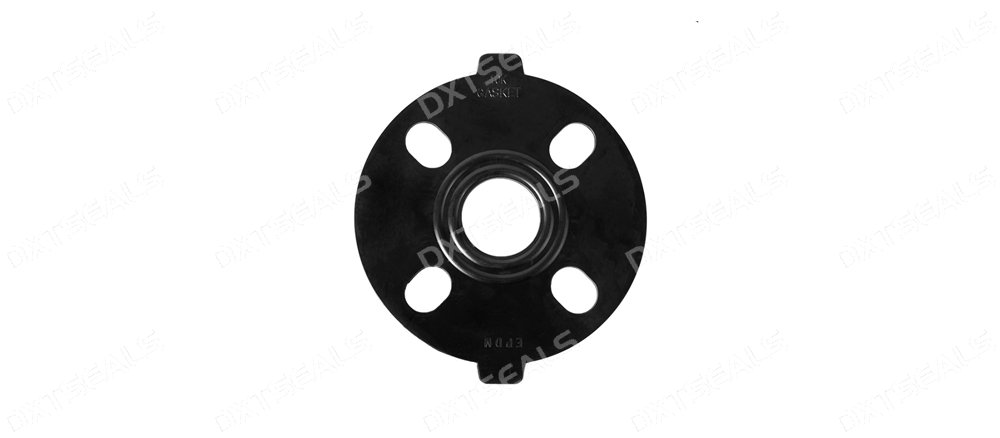
EPDM stands for ethylene propylene diene monomer, a synthetic elastomer widely used in industrial sealing applications. EPDM flange gaskets are typically manufactured from rubber sheets and cut or molded into the required shapes and dimensions.
Key Properties of EPDM Gaskets
-
Excellent water resistance: Suitable for many water, wastewater, and water-based fluid applications.
-
Good weather and ozone resistance: Performs well in outdoor installations and environments exposed to atmospheric aging.
-
Flexible sealing performance: Rubber elasticity helps the gasket conform to flange surfaces under suitable compression.
-
Good resistance to many dilute acids and alkalis: Compatibility depends on chemical concentration, temperature, and the specific EPDM compound.
-
Electrical insulation: EPDM can provide electrical insulation in applications where the complete gasket assembly is appropriately designed.
Typical Applications
EPDM flange gaskets are commonly used in:
-
Water supply and wastewater treatment systems
-
HVAC and cooling water pipelines
-
Industrial water circulation systems
-
Plumbing and building services
-
Selected chemical and water-based fluid systems
-
Outdoor piping installations
However, EPDM is generally not recommended for petroleum-based oils, fuels, and many hydrocarbon fluids. Compatibility with hot water, steam, and particular chemicals must also be confirmed for the selected compound and operating conditions.
2. What Are PTFE Flange Gaskets?
PTFE, or polytetrafluoroethylene, is a fluoropolymer valued for its broad chemical resistance and low-friction surface. PTFE flange gaskets are available in different formulations and constructions to meet various industrial requirements.
Common Types of PTFE Gaskets
Virgin PTFE Gaskets
Manufactured from unfilled PTFE, these gaskets offer broad chemical resistance and are suitable for many general-purpose chemical sealing applications.
Modified PTFE Gaskets
Modified PTFE formulations are designed to improve certain properties, such as creep resistance and sealing performance, while retaining broad chemical compatibility. Performance varies by formulation.
Expanded PTFE Gaskets
Expanded PTFE has a more compressible structure that can help it conform to uneven or irregular flange surfaces. It is often used where flange surface conditions or low bolt loads present challenges.
Filled PTFE Gaskets
Filled PTFE incorporates selected fillers to improve properties such as dimensional stability, wear resistance, or resistance to deformation under load. Chemical compatibility must be checked because fillers can affect the suitability of the material for particular media.
Key Properties of PTFE Gaskets
-
Broad chemical resistance: Suitable for many acids, alkalis, solvents, and other industrial chemicals, subject to grade-specific compatibility.
-
Low friction: PTFE has a naturally low coefficient of friction.
-
Good thermal stability: Can be used across a wide temperature range, depending on gasket design and service conditions.
-
Low moisture absorption: Helps maintain material stability in many wet environments.
-
Non-rusting material: PTFE does not corrode like metallic materials.
PTFE also has limitations. Conventional PTFE can creep or cold-flow under sustained compressive loads and may have limited elastic recovery compared with rubber. Proper material selection, flange design, bolt loading, and installation are important for maintaining sealing performance.
3. EPDM vs PTFE Flange Gaskets: Key Differences
Although both materials are widely used for flange sealing, their performance characteristics differ significantly.
| Comparison Factor | EPDM Flange Gaskets | PTFE Flange Gaskets |
|---|---|---|
| Material type | Synthetic rubber elastomer | Fluoropolymer |
| Flexibility | High elasticity | Generally less elastic than rubber |
| Chemical resistance | Good for many water-based media and selected chemicals | Broad resistance to many aggressive chemicals |
| Water resistance | Excellent for many applications | Excellent |
| Oil and fuel resistance | Generally poor for petroleum-based oils and fuels | Generally good with many oils and hydrocarbons; verify conditions |
| Temperature performance | Depends on compound and service conditions | Depends on formulation, gasket design, and operating conditions |
| Compression behavior | Elastic deformation and recovery | Conventional PTFE can creep under sustained compression |
| Weather and ozone resistance | Generally excellent | Generally excellent |
| Conformability | Rubber flexibility helps accommodate flange irregularities | Depends on PTFE type; expanded PTFE is especially conformable |
| Typical applications | Water systems, HVAC, wastewater, outdoor piping | Chemical processing, aggressive fluids, industrial pipelines |
| Relative material cost | Often economical | Often higher, depending on type and design |
The table provides general guidance rather than universal performance ratings. Actual suitability depends on the exact material grade and the conditions of the complete flange assembly.
4. Chemical Resistance: Which Material Is Better?
Chemical compatibility is often the most important factor when selecting a flange gasket.
When EPDM Is a Good Choice
EPDM is a strong candidate for water-based applications, including many water supply, wastewater, and cooling water systems. It also resists ozone and weathering well, making it suitable for many outdoor installations.
EPDM can perform well with selected dilute acids, alkalis, and other compatible chemicals. However, it is generally unsuitable for petroleum oils, fuels, and many hydrocarbon-based fluids.
For applications involving chemical mixtures, elevated temperatures, or concentrated solutions, compatibility should be verified using data for the exact EPDM compound.
When PTFE Is a Good Choice
PTFE is often preferred when the gasket must withstand aggressive chemicals or a wide variety of process media. It offers broad resistance to many acids, alkalis, solvents, and industrial fluids.
Nevertheless, PTFE should not be treated as universally compatible with every chemical under every condition. Temperature, concentration, exposure duration, pressure, and the presence of fillers or other gasket components may affect suitability.
Selection tip: If the piping system handles aggressive chemicals or frequently changes process media, PTFE may offer greater material versatility. For ordinary water systems where rubber elasticity is valuable, EPDM may be the more economical option.
5. Temperature and Pressure Performance
Operating temperature and pressure must be evaluated together rather than considered separately.
EPDM Temperature and Pressure Considerations
EPDM maintains useful flexibility in many applications, but its permissible temperature range depends on the rubber formulation and the working medium. Hot water, steam, chemicals, and continuous exposure can affect service life differently.
The gasket must also be compressed sufficiently to seal without being excessively crushed. Excessive compression, inadequate bolt load, or flange misalignment can lead to leakage or premature failure.
PTFE Temperature and Pressure Considerations
PTFE can be used in many applications involving elevated temperatures, but its resistance to sustained loading is an important design consideration. Conventional PTFE may deform gradually under compression, potentially reducing gasket stress over time.
Modified PTFE, expanded PTFE, and filled PTFE products can provide different performance characteristics. The appropriate choice depends on flange condition, bolt load, pressure cycling, temperature changes, and the manufacturer's technical data.
For both materials, the allowable operating conditions depend on more than the raw material's temperature rating. Flange dimensions, surface finish, gasket thickness, bolt configuration, and installation procedures also affect sealing reliability.
6. Sealing Performance and Flange Surface Conditions
The ability of a gasket to accommodate flange surface irregularities is another important selection factor.
EPDM is elastic and can conform to suitable flange surfaces when the correct compression is applied. This makes it useful for many conventional piping connections, particularly where rubber's flexibility is beneficial.
PTFE behaves differently. Virgin PTFE is less elastically resilient than EPDM, and sustained compression can cause deformation over time. Modified PTFE formulations may improve resistance to creep, while expanded PTFE can conform effectively to irregular or uneven flange surfaces.
When selecting either material, consider:
-
Flange face type and surface finish
-
Gasket thickness and dimensions
-
Required bolt load and available tightening force
-
Flange alignment and surface condition
-
Thermal cycling and pressure fluctuations
-
Expected maintenance and replacement intervals
The gasket must match the flange design. Full-face gaskets and ring-type gaskets are not interchangeable in every installation.
7. How to Choose Between EPDM and PTFE Flange Gaskets
A systematic selection process can reduce leakage risks and prevent unnecessary material costs.
Step 1: Identify the Working Medium
Determine whether the system handles water, wastewater, oils, fuels, acids, alkalis, solvents, or other process fluids.
For many water-based systems, EPDM is a suitable starting point. For aggressive chemical media, PTFE is often worth evaluating first.
Step 2: Confirm Chemical Compatibility
Check the compatibility of the exact material grade with the fluid, concentration, and operating temperature. Do not rely solely on broad material names such as EPDM or PTFE.
Step 3: Review Operating Temperature and Pressure
Consider normal operating conditions as well as startup, shutdown, pressure surges, and temperature cycling. Confirm that the selected gasket is suitable for the complete operating envelope.
Step 4: Check Flange Standards and Dimensions
Verify the applicable flange standard, nominal size, pressure class, bolt-hole pattern, flange face, and gasket dimensions.
Common systems include ASME flange standards in American piping applications and EN flange standards in many European applications. NPS/Class and DN/PN designations should be matched to the actual flange specification rather than treated as directly interchangeable.
Step 5: Evaluate Installation Conditions
Consider flange surface quality, available bolt load, alignment, gasket thickness, and installation procedures. Where flange surfaces are irregular, a suitable expanded PTFE gasket may be worth considering.
Step 6: Balance Cost and Service Life
EPDM is often an economical choice for compatible water and utility services. PTFE may justify a higher initial material cost when its chemical resistance better matches the application and helps reduce leakage risk or maintenance requirements.
The lowest-cost gasket is not necessarily the most economical choice over the full service life of the equipment.
8. Common Industrial Applications
| Application | Material to Evaluate First | Key Considerations |
|---|---|---|
| Water supply pipelines | EPDM | Water compatibility, pressure, temperature |
| HVAC and cooling water | EPDM | Water chemistry, operating temperature |
| Wastewater treatment | EPDM or PTFE | Waste composition and chemical exposure |
| Chemical processing pipelines | PTFE | Exact chemical compatibility and temperature |
| Acid and alkali handling | PTFE or compatible EPDM | Concentration, temperature, exposure duration |
| Oil and fuel systems | PTFE or another compatible material | EPDM is generally unsuitable for petroleum oils and fuels |
| Irregular flange surfaces | Expanded PTFE may be suitable | Surface condition, bolt load, gasket design |
| General outdoor piping | EPDM or PTFE | Media compatibility, weather exposure, mechanical conditions |
These recommendations are starting points, not final engineering approvals. Actual material selection should be based on the operating conditions and relevant technical data.
9. Custom EPDM and PTFE Flange Gasket Solutions
Standard flange gaskets may not meet every industrial requirement. Custom manufacturing can help address special dimensions, non-standard flange geometries, unusual thicknesses, and application-specific sealing needs.
When specifying a custom flange gasket, provide the following information whenever available:
-
Material requirement: EPDM, virgin PTFE, modified PTFE, expanded PTFE, or filled PTFE
-
Inside diameter, outside diameter, thickness, and overall geometry
-
Flange standard, nominal size, and pressure class
-
Working medium and chemical concentration
-
Operating temperature and pressure
-
Flange face type and surface condition
-
Required quantity and any relevant drawing or sample
A qualified gasket manufacturer can help evaluate the material, dimensions, and manufacturing method according to the intended application. Custom EPDM and PTFE flange gaskets can be produced for both standard equipment requirements and specialized industrial systems, subject to design and material availability.
Conclusion
EPDM and PTFE flange gaskets serve different purposes in industrial sealing. EPDM is often a practical, economical solution for compatible water-based systems and applications requiring rubber elasticity, weather resistance, and flexibility. PTFE is frequently preferred for aggressive chemical environments and applications that require broad chemical resistance.
To choose the right material, evaluate the working medium, temperature, pressure, flange design, surface condition, and installation requirements together. Confirm the compatibility and performance of the exact gasket grade rather than relying on general material properties alone.
Selecting the appropriate EPDM or PTFE flange gasket can improve sealing reliability, reduce maintenance risks, and support longer service life in industrial piping systems.