
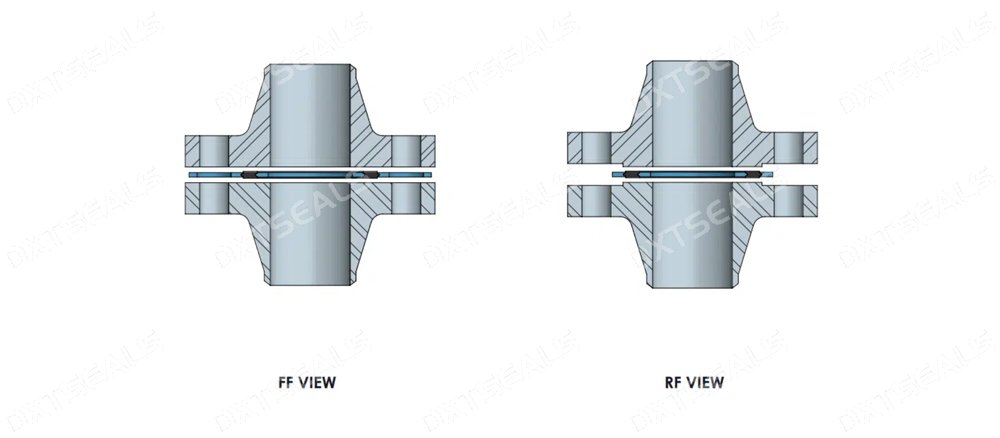
Flange gaskets are essential sealing components used to prevent leakage between connected flanges in piping systems, valves, pumps, heat exchangers, and industrial equipment. However, selecting the correct gasket involves more than choosing a suitable material. The flange facing and gasket configuration must also match the actual connection.
Two common flange gasket configurations are FF (Full Face) flange gaskets and RF (Raised Face) flange gaskets. Although both are designed to create a reliable sealing barrier between flange faces, their geometry, contact area, compression behavior, and typical applications are different.
Understanding the differences between FF and RF flange gaskets can help engineers, maintenance teams, and purchasing departments select the appropriate gasket for a specific flange connection.
1. What Is an FF Flange Gasket?
FF stands for Full Face.
A Full Face flange gasket covers substantially the entire flange face, including the area around the bolt holes. The gasket extends from the inside diameter of the pipe connection toward the outer edge of the flange.
The large gasket area corresponds to the geometry of a flat-face flange, where the entire flange face is generally located on the same plane.
FF gaskets are commonly manufactured from materials such as:
-
EPDM
-
NBR
-
FKM
-
PTFE
-
Non-asbestos compressed fiber
-
Rubber sheet
-
Graphite
-
Other application-specific gasket materials
The exact material should be selected according to the operating medium, temperature, pressure, and application requirements.
2. What Is an RF Flange Gasket?
RF stands for Raised Face.
A Raised Face flange has a raised sealing surface above the main flange face. The gasket is positioned primarily over the raised sealing area rather than covering the entire flange.
An RF flange gasket is therefore usually smaller in outside diameter than an equivalent FF gasket for the same nominal pipe size.
RF gaskets may be manufactured from:
-
Non-asbestos compressed fiber
-
PTFE
-
Graphite
-
Spiral wound gasket materials
-
Metallic materials
-
Rubber materials where appropriate
-
Other engineered sealing materials
The gasket design must match the specific flange standard, pressure class, facing, and dimensions.
3. FF vs RF Flange Gasket: Structural Difference
The most obvious difference is the gasket coverage area.
| Feature | FF Flange Gasket | RF Flange Gasket |
|---|---|---|
| Full name | Full Face | Raised Face |
| Flange facing | Flat Face | Raised Face |
| Gasket coverage | Covers most/all flange face | Covers mainly raised sealing area |
| Outside diameter | Generally larger | Generally smaller |
| Bolt-hole coverage | Usually includes bolt holes | Usually located inside bolt circle |
| Contact area | Large | More concentrated |
| Typical flange application | Flat-face flanges | Raised-face flanges |
| Common materials | EPDM, rubber, PTFE, non-asbestos | PTFE, graphite, spiral wound, non-asbestos |
| Typical use | Lower-pressure/general piping and equipment | Industrial process piping and higher-pressure applications |
| Compression characteristics | Distributed over larger area | Concentrated over smaller area |
The exact gasket dimensions depend on the applicable flange standard and pressure class.
4. Why Does Flange Facing Matter?
A flange gasket is not an independent component that can be selected without considering the flange.
The gasket works together with:
-
Flange geometry
-
Flange facing
-
Bolt loading
-
Gasket material
-
Gasket thickness
-
Surface finish
-
Operating temperature
-
Operating pressure
-
Process medium
The purpose of the gasket is to create sufficient contact pressure to prevent the process medium from passing through the flange interface.
If the gasket geometry does not match the flange design, the gasket may not be compressed correctly.
This can result in:
-
Leakage
-
Uneven compression
-
Gasket extrusion
-
Localized over-compression
-
Reduced sealing reliability
-
Premature gasket failure
Therefore, an FF gasket should generally be matched with the appropriate flat-face flange configuration, while an RF gasket should be matched with the corresponding raised-face configuration.
5. FF Flange Gaskets: Structural Characteristics
The large surface area of an FF gasket provides broad contact between the gasket and flange.
Because the gasket extends toward the outside edge of the flange, it can provide sealing coverage across the full flange face.
This configuration is commonly used where the flange design requires a full-face gasket.
Typical FF Gasket Geometry
An FF gasket normally includes:
-
Inner sealing diameter
-
Outer diameter extending toward the flange edge
-
Bolt holes
-
Defined gasket thickness
The bolt-hole pattern must correspond to the flange.
For large-diameter or custom flanges, the gasket may be manufactured according to an engineering drawing or measured flange dimensions.
6. RF Flange Gaskets: Structural Characteristics
RF gaskets are generally more compact.
Because the sealing area is concentrated around the raised face, the gasket does not normally extend across the entire flange surface.
This smaller gasket area can allow the available bolt load to generate higher gasket contact pressure over the sealing area.
RF flange systems are widely used in industrial piping and process equipment.
Depending on the service conditions, RF connections may use:
-
Compressed fiber gaskets
-
PTFE gaskets
-
Graphite gaskets
-
Spiral wound gaskets
-
Ring-type gasket designs
-
Other engineered gasket configurations
The appropriate design depends on the flange standard and application.
7. FF vs RF: Sealing Performance
Both FF and RF flange gaskets can provide reliable sealing when correctly selected and installed.
However, their sealing behavior is different because the gasket contact area and flange geometry are different.
FF Sealing Performance
FF gaskets distribute the sealing interface across a larger area.
This can be advantageous for flat-face flange systems where the flange design requires the gasket to cover the entire face.
However, because the gasket area is larger, the required bolt load and compression characteristics must be considered carefully.
RF Sealing Performance
RF gaskets concentrate the sealing interface over the raised face.
This can produce higher localized gasket stress for a given bolt load, which can be advantageous for many industrial flange applications.
However, higher localized compression also means that gasket material selection, flange surface condition, and bolt tightening are important.
The goal is not simply to maximize compression. Excessive compression can damage some gasket materials or cause gasket deformation.
8. FF vs RF Gaskets and Bolt Loading
Bolt load is one of the most important factors affecting flange gasket performance.
When bolts are tightened, they generate a compressive force between the flange faces.
For a gasket to seal effectively, the compression must be sufficient to:
-
Conform to flange surface irregularities
-
Establish gasket contact
-
Prevent leakage paths
-
Maintain sufficient sealing stress during operation
Because FF and RF gaskets have different effective sealing areas, the relationship between bolt load and gasket stress can differ significantly.
This is one reason why a gasket should not be selected only by nominal pipe size.
The complete flange assembly should be considered.
9. FF vs RF Gaskets: Pressure Applications
RF flange systems are widely associated with industrial piping and higher-pressure applications because the raised-face design provides a defined sealing area and can generate concentrated gasket compression.
FF flange gaskets are commonly used with flat-face flange systems, especially where the flange design and equipment require full-face contact.
However, it is not technically correct to say that all RF gaskets are high-pressure gaskets and all FF gaskets are low-pressure gaskets.
Pressure capability depends on the complete flange system, including:
-
Flange material
-
Flange pressure class
-
Gasket material
-
Gasket thickness
-
Bolt material
-
Bolt load
-
Temperature
-
Fluid
-
Flange surface finish
-
Piping design
The pressure rating of the flange standard and the gasket manufacturer's data should therefore be considered together.
10. FF vs RF Flange Gaskets for Rubber Materials
Rubber gasket materials such as EPDM, NBR, and FKM can be manufactured into different flange gasket configurations.
EPDM FF Gaskets
EPDM Full Face gaskets are commonly considered for:
-
Water piping
-
HVAC systems
-
Cooling water
-
Outdoor piping
-
Water treatment
-
General utility systems
EPDM provides excellent resistance to water, ozone, and weathering, but it is generally not suitable for many petroleum-based oils and fuels.
NBR FF Gaskets
NBR is commonly selected where oil and fuel resistance is more important.
Potential applications include:
-
Oil-containing systems
-
Fuel-related equipment
-
Hydraulic applications
-
Industrial machinery
The exact NBR compound and operating temperature must be considered.
FKM Gaskets
FKM is often selected when higher chemical and temperature resistance is required, particularly for certain oils, fuels, and hydrocarbon-related applications.
However, FKM is not universally compatible with every chemical, so application-specific compatibility should still be checked.
11. FF vs RF Gaskets for PTFE
PTFE is widely used for flange sealing because of its excellent chemical resistance.
PTFE flange gaskets may be used in:
-
Chemical processing
-
Corrosive fluid systems
-
Pharmaceutical equipment
-
Food-processing equipment
-
General process piping
PTFE can be manufactured into both FF and RF configurations where the flange design permits.
However, PTFE has relatively high thermal expansion and creep characteristics compared with some other gasket materials. Proper gasket thickness, flange loading, and installation are therefore important.
For demanding applications, expanded PTFE, filled PTFE, or other modified PTFE materials may be considered instead of standard virgin PTFE.
12. FF vs RF Gaskets for Non-Asbestos Materials
Non-asbestos compressed fiber gasket materials are widely used for industrial flange connections.
They can be manufactured into both FF and RF configurations.
Non-Asbestos FF Gaskets
These are often used for:
-
Water systems
-
General industrial piping
-
Pumps
-
Valves
-
Utility systems
-
General equipment connections
Non-Asbestos RF Gaskets
RF versions can be used in:
-
Industrial process piping
-
Pumps and valves
-
Utility systems
-
General process equipment
-
Flanged pipe connections
The specific grade should be selected based on temperature, pressure, chemical compatibility, and compression requirements.
13. FF vs RF Flange Gaskets and Flange Standards
Gasket dimensions must correspond to the flange standard.
Common flange standards include:
-
ASME B16.5
-
ASME B16.47
-
EN standards
-
DIN standards
-
JIS standards
-
Other regional or equipment-specific standards
A gasket for an ASME flange should not automatically be assumed to fit an EN or DIN flange with the same nominal pipe size.
Different standards may have different:
-
Outside diameters
-
Inside diameters
-
Bolt-hole patterns
-
Bolt-hole diameters
-
Pressure classes
-
Facing dimensions
-
Gasket dimensions
For this reason, the flange standard should always be confirmed before manufacturing or purchasing a replacement gasket.
14. FF vs RF: Common Application Scenarios
FF Gaskets
Typical applications include:
-
Flat-face pipe flanges
-
Cast iron flange systems
-
Water pipelines
-
HVAC systems
-
Water treatment equipment
-
Utility piping
-
General industrial equipment
-
Low-to-moderate pressure systems where the flange design requires a full-face gasket
RF Gaskets
Typical applications include:
-
Process piping
-
Industrial valves
-
Pumps
-
Chemical processing equipment
-
Oil and gas equipment
-
Heat exchangers
-
High-pressure piping systems
-
Industrial equipment using raised-face flanges
Again, the application should be determined by the complete flange system rather than the gasket shape alone.
15. Can an FF Gasket Be Used on an RF Flange?
This is an important question in gasket replacement.
In general, an FF gasket should not simply be substituted for an RF gasket without verifying the flange configuration and engineering requirements.
An FF gasket extends across a much larger portion of the flange face. Using it on an RF flange can create an unsuitable sealing configuration and may affect bolt loading and gasket compression.
Similarly, an RF gasket should not automatically be used on a flat-face flange.
The safest approach is to identify:
-
Flange type
-
Flange standard
-
Pressure class
-
Gasket dimensions
-
Gasket material
-
Operating conditions
before selecting a replacement.
16. How to Select the Correct FF or RF Gasket
A practical selection process should include the following steps.
Step 1: Identify the Flange Facing
Determine whether the flange is:
-
Flat Face (FF)
-
Raised Face (RF)
-
Ring Type Joint (RTJ)
-
Another specialized configuration
Step 2: Identify the Flange Standard
Confirm whether it follows:
-
ASME/ANSI
-
EN
-
DIN
-
JIS
-
Other standards
Step 3: Confirm Nominal Size and Pressure Class
The nominal pipe size alone is not enough.
The pressure class must also be identified.
Step 4: Select the Gasket Material
Consider:
-
Fluid
-
Temperature
-
Pressure
-
Chemical compatibility
-
Mechanical requirements
Step 5: Confirm Gasket Thickness
Different applications may require different gasket thicknesses.
Step 6: Check Flange Surface Condition
The flange sealing surface should be free from severe corrosion, scratches, deformation, and contamination.
Step 7: Follow Proper Bolt Tightening Procedures
Bolts should generally be tightened in a controlled and appropriate sequence to achieve relatively uniform gasket compression.
17. Custom FF and RF Flange Gasket Manufacturing
Industrial equipment frequently requires replacement gaskets that are not readily available as standard catalog products.
A custom gasket manufacturer can produce:
-
Custom FF gaskets
-
Custom RF gaskets
-
Large-diameter flange gaskets
-
Small-diameter gaskets
-
Non-standard bolt-hole patterns
-
Special gasket thicknesses
-
Custom material combinations
-
Replacement gaskets based on drawings
-
Replacement gaskets based on physical samples
For accurate production, useful information includes:
-
Flange standard
-
Nominal size
-
Pressure class
-
FF or RF configuration
-
Inside diameter
-
Outside diameter
-
Bolt-hole diameter
-
Number of bolt holes
-
Bolt-circle diameter
-
Gasket thickness
-
Material specification
-
Operating medium
-
Temperature
-
Pressure
For non-standard equipment, an engineering drawing or accurate flange measurements can significantly reduce the risk of incorrect gasket dimensions.
18. FF vs RF Flange Gaskets: Quick Comparison
| Selection Factor | FF Gasket | RF Gasket |
|---|---|---|
| Flange face | Flat Face | Raised Face |
| Gasket shape | Full face | Raised-face sealing area |
| Sealing area | Larger | More concentrated |
| Typical flange use | Flat-face systems | Raised-face systems |
| Common materials | EPDM, NBR, FKM, PTFE, non-asbestos | PTFE, graphite, non-asbestos, spiral wound |
| Bolt-hole coverage | Typically includes bolt holes | Typically inside bolt circle |
| Typical applications | Water, HVAC, utilities, general piping | Process piping, industrial equipment |
| Custom manufacturing | Available | Available |
| Main selection concern | Full-face compatibility | Raised-face compatibility |
19. Conclusion
FF and RF flange gaskets are both designed to prevent leakage, but they are intended for different flange configurations.
FF flange gaskets cover the full flange face and are primarily associated with flat-face flange systems. They are widely used in water piping, HVAC systems, utility systems, and general industrial applications.
RF flange gaskets are designed for raised-face flanges and concentrate the sealing interface around the raised sealing surface. They are widely used in industrial process piping, pumps, valves, heat exchangers, and other equipment.
The most important point is that gasket selection should begin with the flange configuration, not simply the gasket material or nominal pipe size.
Once the FF or RF configuration has been identified, the material should be selected according to the medium, temperature, pressure, chemical compatibility, and mechanical requirements. The final gasket dimensions must then match the applicable flange standard and pressure class.
For standard and non-standard industrial applications, correctly matching flange type + gasket configuration + material + dimensions + operating conditions is the foundation of reliable flange sealing.