
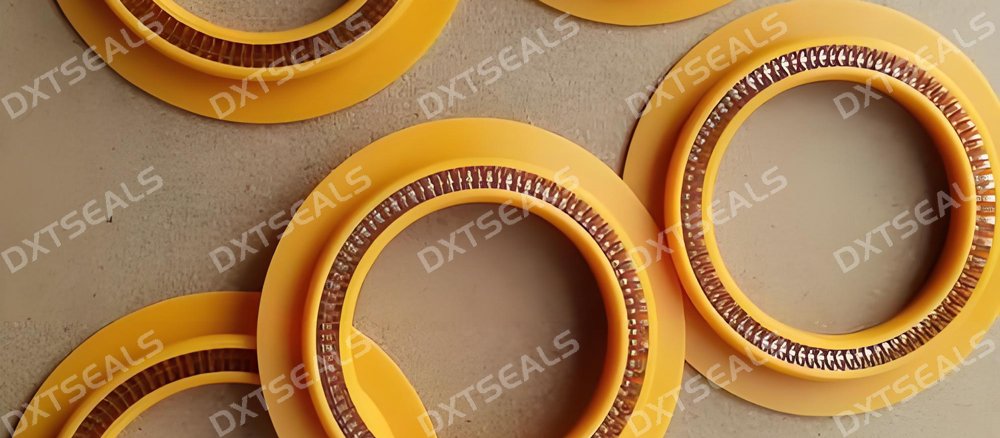
PTFE is one of the most widely used materials for Spring Seals due to its excellent friction, chemical resistance, and temperature stability. However, not all PTFE materials perform the same. For most industrial sealing applications, engineers must choose between virgin (pure) PTFE and filled PTFE—two materials with completely different mechanical behaviors.
This article compares the performance of filled PTFE and virgin PTFE in Spring Seals and provides a practical material selection guide for various working conditions.
(Custom PTFE sealing solutions available from DXTSEALS.)
1️⃣ Why PTFE Is Used in Spring Seals
PTFE is ideal for dynamic sealing thanks to its unique characteristics:
-
Ultra-low friction coefficient
-
No stick–slip behavior
-
Wide operating temperature range (−60°C to +260°C)
-
Broad chemical compatibility
-
Very low moisture absorption
-
Excellent performance in dry-running or low-lubrication conditions
However, pure PTFE is soft, so engineers often enhance its properties by adding fillers—this creates “filled PTFE.”
2️⃣ What Is Virgin PTFE?
Virgin PTFE refers to PTFE without any additives or reinforcements.
Key Properties
-
Highest chemical resistance
-
Extremely low friction
-
Excellent thermal stability
-
Non-contaminating and suitable for food, medical, or chemical industries
-
Lower mechanical strength
-
Higher cold flow and deformation under load
-
Poor wear resistance compared to filled PTFE
Typical Applications
-
Chemical processing and corrosion-sensitive environments
-
Low-pressure pneumatic cylinders
-
Clean-room equipment
-
Non-load-bearing sealing components
Virgin PTFE is ideal when purity and chemical resistance are more critical than mechanical durability.
3️⃣ What Is Filled PTFE?
Filled PTFE is PTFE modified with reinforcing materials to improve strength, wear resistance, and dimensional stability.
Common fillers include:
-
Bronze (40%) — high wear resistance & compressive strength
-
Carbon (10–35%) — excellent dry-running ability
-
Glass fiber (15–25%) — improved pressure resistance
-
Graphite — ultra-low friction at higher speeds
-
MoS₂ — enhanced lubrication
These fillers transform the mechanical performance of PTFE, making it much more suitable for demanding hydraulic sealing.
Key Properties
-
Significantly improved wear resistance
-
Reduced cold flow (creep)
-
Stronger under load
-
More stable under high pressure
-
Slightly higher friction compared to pure PTFE
-
Lower chemical resistance depending on filler type
Typical Applications
-
High-pressure hydraulic cylinders
-
Excavators, injection molding machines, presses
-
Heavy-load linear actuators
-
High-speed reciprocating systems
-
Equipment requiring long seal lifespan
Filled PTFE is the industry standard for Spring Seals in heavy-duty applications.
4️⃣ Performance Comparison: Filled PTFE vs. Virgin PTFE
| Performance Indicator | Virgin PTFE | Filled PTFE |
|---|---|---|
| Wear Resistance | ★★ | ★★★★★ |
| Compressive Strength | ★★ | ★★★★★ |
| Creep Resistance | ★★ | ★★★★ |
| Chemical Resistance | ★★★★★ | ★★★ |
| Friction Coefficient | ★★★★★ | ★★★★ |
| High-Pressure Suitability | Low | High |
| Ideal Applications | Chemical, low-load | Heavy-duty hydraulics |
Key Insight
👉 Filled PTFE offers 3–10 times the wear resistance of virgin PTFE, making it the preferred choice for Spring Seals in most hydraulic systems.
5️⃣ How Glyd Ring Performance Differs Between Virgin and Filled PTFE
✔ 1. Wear Resistance
-
Virgin PTFE wears faster under reciprocating load
-
Filled PTFE handles high-frequency, high-pressure motion with minimal wear
✔ 2. Deformation Under Load
-
Virgin PTFE exhibits significant cold flow
-
Filled PTFE maintains shape, preventing leakage
✔ 3. Seal Stability
-
Filled PTFE provides a tighter, more predictable sealing performance
-
Virgin PTFE is prone to extrusion in high-pressure applications
✔ 4. Suitable Fluids
-
Virgin PTFE → Strong acids, solvents
-
Filled PTFE → Oils, hydraulic fluids, water-glycol systems
6️⃣ Material Selection Guide for Spring Seals
Choose Virgin PTFE if:
✔ Chemical resistance is the top priority
✔ The system runs at low pressure
✔ The motion is light-duty
✔ Purity or non-contamination is required (food, medical, semiconductor)
Choose Filled PTFE if:
✔ High pressure or heavy load
✔ Reciprocating motion with high frequency
✔ Long service life is required
✔ Wear resistance is a key concern
✔ Operating temperature is high
✔ Equipment runs in harsh industrial conditions
Industry Examples
-
Virgin PTFE: Chemical dosing pumps, laboratory valves
-
Bronze-Filled PTFE: Hydraulic cylinders on excavators
-
Carbon-Filled PTFE: High-speed compressors and actuators
-
Glass-Filled PTFE: Water-based hydraulic equipment
7️⃣ Why Choose PTFE Spring Seals from DXTSEALS
DXTSEALS offers:
-
Complete range of virgin, modified, and filled PTFE materials
-
Custom Glyd ring production for hydraulic and pneumatic systems
-
Precision machining with tight tolerances
-
Engineering support for material selection
-
Stable quality with batch traceability
Whether you require food-grade seals or heavy-duty hydraulic PTFE components, DXTSEALS provides optimized sealing solutions for every industry.
✅ Conclusion
Both virgin PTFE and filled PTFE have their unique strengths.
-
Virgin PTFE excels in chemical resistance and cleanliness
-
Filled PTFE delivers superior mechanical performance and durability
For most Glyd ring applications—especially in hydraulics—filled PTFE is the better choice, offering longer lifespan and more reliable sealing.