
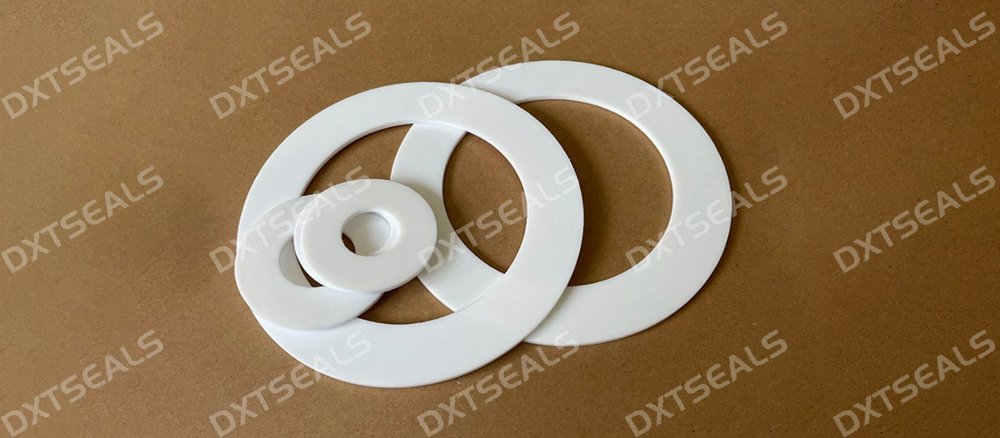
Flange gaskets and packing materials are essential components in industrial sealing systems. They help prevent leakage, maintain pressure, protect equipment, and improve the reliability of piping systems, pumps, valves, and process equipment.
Different sealing locations require different material characteristics. EPDM flange gaskets are widely used for water and weather-resistant applications, while PTFE packing is valued for chemical resistance and low friction. Graphite packing is commonly selected for high-temperature sealing applications where thermal stability is important.
Although all three materials are used for industrial sealing, they are not interchangeable. Their performance depends on the sealing configuration, operating temperature, pressure, process medium, equipment movement, and installation conditions.
This article compares EPDM, PTFE, and graphite as industrial sealing materials and explains how to select the appropriate option for different applications.
What Are Flange Gaskets and Packing Materials?
Flange gaskets and packing perform different sealing functions.
A flange gasket is installed between two mating flange surfaces to create a static seal. The gasket fills surface irregularities and helps prevent fluid leakage through the flange connection.
Packing materials, such as PTFE packing and graphite packing, are commonly compressed inside a stuffing box around a valve stem, pump shaft, or other component to control leakage.
Typical industrial sealing applications include:
- Pipe flange connections
- Industrial valves
- Pumps
- Mixers
- Heat exchangers
- Water treatment equipment
- Chemical processing systems
- Steam systems
- Industrial fluid handling equipment
The sealing material must be selected according to the actual service conditions rather than simply based on general material characteristics.
EPDM Flange Gaskets
EPDM stands for ethylene propylene diene monomer rubber. It is a synthetic rubber widely used for flange gaskets and other static sealing components.
EPDM is particularly suitable for water-based applications and environments where resistance to ozone, weathering, moisture, and aging is important.
Key Properties of EPDM
| Property | EPDM Gasket Performance |
|---|---|
| Water resistance | Excellent |
| Weather resistance | Excellent |
| Ozone resistance | Excellent |
| Elasticity | Good |
| Aging resistance | Good to excellent |
| Chemical resistance | Good for many compatible media |
| Low-temperature flexibility | Good, depending on compound |
| Petroleum oil resistance | Generally poor |
| Typical use | Static flange sealing |
EPDM can maintain flexibility over a wide range of industrial operating conditions, although the actual temperature range depends on the compound formulation and application.
Typical EPDM Flange Gasket Applications
EPDM flange gaskets are commonly used in:
- Water supply systems
- Cooling water systems
- HVAC systems
- Chilled water piping
- Water treatment
- Industrial water systems
- Outdoor piping
- General utility piping
EPDM is especially attractive when the gasket is exposed to water, humidity, ozone, or outdoor weather conditions.
EPDM Compatibility Considerations
EPDM is not a universal gasket material.
It is generally not the preferred choice for many petroleum-based oils, fuels, and hydrocarbon fluids. When such media are present, another elastomer or sealing material may be more appropriate.
The actual compatibility should be confirmed based on the specific medium, concentration, temperature, pressure, and EPDM compound.
PTFE Packing
PTFE packing is a gland packing material manufactured from polytetrafluoroethylene (PTFE).
It is commonly used around valve stems, pump shafts, and other components where chemical resistance and low friction are important.
Key Properties of PTFE Packing
| Property | PTFE Packing Performance |
|---|---|
| Chemical resistance | Excellent |
| Friction | Very low |
| Moisture resistance | Excellent |
| Water absorption | Very low |
| Corrosion resistance | Excellent |
| Non-stick characteristics | Excellent |
| Temperature capability | Good, depending on grade and design |
| Typical use | Valves, pumps, mixers |
One of the major advantages of PTFE is its broad chemical resistance. This makes PTFE packing useful in many chemical processing and fluid-handling applications.
Types of PTFE Packing
Depending on the application, PTFE packing may be supplied in several constructions:
- Pure PTFE packing
- Braided PTFE packing
- Expanded PTFE packing
- Lubricated PTFE packing
- Reinforced PTFE packing
Reinforcement can improve mechanical strength, dimensional stability, wear resistance, and pressure-handling capability.
Typical PTFE Packing Applications
PTFE packing is commonly used for:
- Industrial valves
- Pumps
- Mixers
- Chemical processing equipment
- Water treatment systems
- Corrosive fluid handling
- Solvent handling
- General industrial fluid equipment
Its low-friction characteristics can also help reduce operating resistance around moving valve stems and other dynamic components.
Graphite Packing
Graphite packing is commonly used in demanding industrial sealing applications where high-temperature performance and thermal stability are required.
Graphite packing may be manufactured using flexible graphite, expanded graphite, braided graphite, or reinforced graphite constructions.
Key Properties of Graphite Packing
| Property | Graphite Packing Performance |
|---|---|
| High-temperature performance | Excellent, depending on grade and environment |
| Thermal stability | Excellent |
| Thermal conductivity | High |
| Friction | Low |
| Conformability | Good |
| Chemical resistance | Good to excellent, depending on medium |
| High-temperature sealing | Excellent |
| Typical use | Valves, pumps, steam systems |
Graphite can maintain useful sealing performance under temperatures where many conventional elastomeric packing materials are unsuitable.
Typical Graphite Packing Applications
Graphite packing is commonly used in:
- Steam valves
- High-temperature valves
- Industrial pumps
- Power generation equipment
- Chemical processing equipment
- Heat transfer systems
- High-temperature process equipment
- Industrial fluid systems
It is particularly useful for high-temperature valve packing and other applications where thermal stability is a primary consideration.
EPDM vs PTFE vs Graphite: Material Comparison
The three materials have different characteristics and are generally selected for different sealing functions.
| Feature | EPDM | PTFE | Graphite |
|---|---|---|---|
| Material type | Elastomer | Fluoropolymer | Carbon-based material |
| Common product | Flange gasket | Packing | Packing |
| Main advantage | Water and weather resistance | Chemical resistance and low friction | High-temperature performance |
| Water resistance | Excellent | Excellent | Good |
| Chemical resistance | Good for selected media | Excellent | Good to excellent |
| Low friction | Moderate | Excellent | Good |
| High-temperature performance | Limited by elastomer grade | Good | Excellent |
| Ozone resistance | Excellent | Excellent | Not a primary feature |
| Elasticity | Good | Low compared with elastomers | Limited |
| Petroleum fluid suitability | Generally limited | Good for many applications | Application dependent |
| Typical sealing type | Static | Static/dynamic packing | Static/dynamic packing |
This comparison shows why material selection should be based on application requirements rather than simply choosing the material with the broadest general specifications.
Flange Gaskets vs Packing: Why the Application Matters
EPDM flange gaskets and PTFE or graphite packing are not normally direct substitutes for one another.
Flange Gaskets
Flange gaskets are designed primarily for static sealing between mating flange surfaces.
The gasket must match:
- Flange standard
- Nominal size
- Pressure designation
- Flange facing
- Gasket dimensions
- Operating medium
- Temperature
- Pressure
For example, EPDM flange gaskets are commonly used in water and HVAC piping systems.
Packing Materials
Packing is normally installed in a stuffing box and compressed by a gland.
Packing selection depends on:
- Shaft or stem size
- Packing cross-section
- Stuffing box dimensions
- Shaft or stem surface condition
- Equipment movement
- Temperature
- Pressure
- Process medium
- Required leakage control
PTFE and graphite packing therefore address a different sealing configuration from a typical flange gasket.
Temperature Comparison
Temperature is one of the most important factors when selecting industrial sealing materials.
EPDM is widely used in water and HVAC applications but has a lower temperature capability than graphite. PTFE can provide useful performance at elevated temperatures, while graphite is commonly considered for more demanding high-temperature applications.
However, material temperature limits should not be treated as a single universal value. The actual service limit depends on:
- Material grade
- Compound or construction
- Pressure
- Process medium
- Oxidizing environment
- Equipment design
- Duration of exposure
For graphite packing, high-temperature exposure in oxygen-containing environments requires particular attention because graphite can oxidize at elevated temperatures.
Chemical Resistance Comparison
Chemical compatibility is another major selection factor.
EPDM
EPDM provides good resistance to water and many water-based fluids and selected chemicals. However, it is generally not suitable for many petroleum-based oils and fuels.
PTFE
PTFE has excellent resistance to a broad range of chemicals and is frequently selected for aggressive chemical service.
Graphite
Graphite provides good chemical resistance in many industrial environments, but compatibility depends on the process medium and operating conditions. Strongly oxidizing environments require special consideration.
For chemical service, the exact chemical concentration and operating temperature should be evaluated rather than relying only on a general material category.
How to Choose the Right Sealing Material
A practical selection process should consider the following factors.
1. Identify the Sealing Position
Determine whether the product is required for:
- A flange connection
- A valve stem
- A pump shaft
- A mixer
- A static joint
- A moving sealing interface
This immediately helps determine whether a gasket or packing construction is appropriate.
2. Identify the Process Medium
Determine whether the sealing material will contact:
- Water
- Steam
- Oil
- Fuel
- Chemicals
- Solvents
- Acids
- Alkalis
- Gas
- Process fluids
Material compatibility should then be checked for the specific medium.
3. Determine Operating Temperature
Temperature affects elasticity, chemical resistance, mechanical strength, and long-term sealing performance.
The material grade and construction should be selected based on the actual operating temperature rather than a general material description.
4. Determine Operating Pressure
Pressure affects gasket compression, packing extrusion resistance, and the mechanical requirements of the sealing system.
For flange gaskets, flange design and bolt load are also important. For packing, stuffing box geometry and gland compression directly affect sealing performance.
5. Consider Movement
Static flange sealing and dynamic packing applications have different requirements.
Valve stems and pump shafts may move continuously or intermittently, making friction, wear, lubrication, and surface condition important considerations.
Flange Gasket Standards and Dimensions
When selecting an EPDM flange gasket, material selection is only one part of the process.
The gasket must also match the flange system.
Common considerations include:
- ASME-based flange dimensions
- ANSI terminology used in industry
- EN flange dimensions
- NPS size
- DN size
- Class pressure designation
- PN pressure designation
- Raised-face configuration
- Full-face configuration
- Gasket thickness
- Bolt-hole arrangement
American piping systems commonly use NPS and Class designations, while European systems commonly use DN and PN designations.
Class and PN should not automatically be treated as direct one-to-one equivalents. The complete flange and gasket specifications should be verified before production or installation.
Custom Flange Gaskets and Packing Materials
Many industrial applications require sealing products that are not available in standard dimensions.
Custom manufacturing can be based on:
- Engineering drawings
- Samples
- Customer dimensions
- OEM specifications
- Existing equipment
- Flange standards
- Special material requirements
Custom EPDM flange gaskets can be manufactured in different shapes, thicknesses, and dimensions. PTFE and graphite packing can also be supplied in different cross-sections and constructions.
For replacement applications, manufacturers can also reproduce sealing components according to samples or technical drawings.
Common Sealing Material Selection Mistakes
Choosing the Material Only by Temperature
A material may tolerate a particular temperature but still be chemically incompatible with the process medium.
Ignoring the Flange Standard
An EPDM gasket with the wrong dimensions or bolt-hole arrangement may not seal correctly even if the material itself is suitable.
Treating PTFE and Graphite as Identical Packing Materials
Both are used for packing, but their temperature, chemical, friction, and environmental characteristics differ.
Ignoring Equipment Movement
Packing around a moving valve stem or shaft requires consideration of friction and wear, not just chemical resistance.
Using EPDM for Petroleum-Based Fluids
EPDM is excellent for many water-based applications but is generally not the preferred material for petroleum oils and fuels.
Standard and Custom Industrial Sealing Solutions
A complete industrial sealing supplier should be able to provide both standard products and customized sealing components.
Standard products can cover common flange gasket sizes, packing cross-sections, and industrial equipment requirements. Custom products can address special dimensions, unusual geometries, non-standard materials, and OEM replacement requirements.
By combining material selection with precision manufacturing, industrial sealing components can be designed for specific operating conditions and equipment configurations.
Conclusion
EPDM flange gaskets, PTFE packing, and graphite packing each have specific advantages in industrial sealing.
EPDM is widely used for water, HVAC, cooling, and outdoor flange applications because of its water, ozone, and weather resistance. PTFE packing is a strong choice for applications requiring excellent chemical resistance and low friction. Graphite packing is commonly used for high-temperature valves, pumps, steam systems, and industrial process equipment.
The correct sealing material should be selected according to the complete application, including sealing location, process medium, temperature, pressure, movement, flange dimensions, and installation conditions.
Whether standard sizes or non-standard components are required, professional manufacturers can provide EPDM gaskets, PTFE packing, graphite packing, and other industrial sealing solutions according to specific equipment and application requirements.