
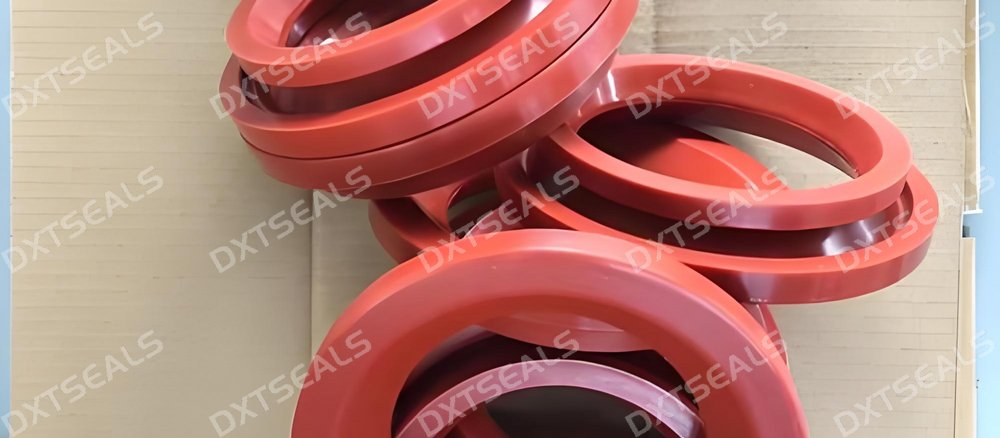
Air compressors rely heavily on high-performance sealing components to ensure stable pressure, lubrication control, and long service life. Among the most commonly used sealing materials, rubber elastomers (such as NBR, FKM, EPDM) and PTFE (Polytetrafluoroethylene) stand out due to their unique performance characteristics. Selecting the right material is critical for preventing air leakage, oil carryover, and premature component failure.
This article compares rubber and PTFE materials widely used in air compressor seals and provides practical selection advice based on application conditions. As a professional sealing manufacturer, DXTSEALS offers customized solutions for both rubber and PTFE-based sealing systems.
1. Rubber vs. PTFE: Core Performance Differences
Rubber elastomers and PTFE have fundamentally different molecular structures, leading to significant variations in temperature resistance, wear behavior, and chemical compatibility.
1. Temperature Resistance
-
Rubber (NBR, EPDM, HNBR):
Typically withstands –20°C to 120°C, depending on compound. -
FKM (Viton):
Excellent high-temperature range up to 200°C. -
PTFE:
Superior temperature resistance from –50°C to 260°C, suitable for extreme heat environments in high-speed compressors.
Conclusion:
For elevated temperatures or continuous high-speed rotation, PTFE is the better choice.
2. Wear Resistance
-
Rubber:
Good elasticity but limited wear resistance under high friction. -
PTFE:
Outstanding low friction coefficient and excellent wear resistance, especially when filled PTFE (carbon, glass fiber, bronze) is used.
Conclusion:
Dynamic sealing parts like scraper rings, piston rings, and rotary seals benefit significantly from PTFE.
3. Chemical Compatibility
-
NBR: Sensitive to synthetic oils and additives.
-
EPDM: Excellent for water-based systems but not oil-resistant.
-
FKM: Outstanding resistance to most lubricants and chemicals.
-
PTFE: Almost universal chemical resistance; unaffected by oils, coolants, solvents, and corrosive gases.
Conclusion:
PTFE provides universal compatibility, while rubber must be carefully selected based on specific fluids.
4. Elasticity and Compression Set
-
Rubber:
Highly elastic, ideal for O-rings and static seals. -
PTFE:
Rigid, low elasticity; often requires spring-energized designs or precise tolerances.
Conclusion:
Rubber is preferred for sealing gaps where flexibility is required.
2. Common Seal Types in Air Compressors and Recommended Materials
1. Shaft Seals (Oil Seals)
-
Recommended: FKM, HNBR, PTFE lip seals
-
Exposed to heat, oil, and continuous rotation.
2. Scraper Rings / Oil Control Rings
-
Recommended: PTFE or filled PTFE
-
High wear and friction demands.
3. O-Rings
-
Recommended:
-
NBR for general use
-
FKM for high temperature
-
EPDM for water or coolant systems
-
HNBR for high-pressure oil environments
-
4. PTFE Piston Rings / Wear Rings
-
Recommended: Carbon-filled or glass-filled PTFE
-
Provides dimensional stability under high load.
DXTSEALS provides all the above in custom sizes, profiles, and compounds suitable for industrial compressor conditions.
3. How to Select the Right Material for Your Air Compressor Seals
When choosing between rubber and PTFE, consider the following factors:
1. Operating Temperature
-
≤120°C: NBR or EPDM
-
120–180°C: HNBR or FKM
-
180–260°C: PTFE
2. Medium Compatibility
-
Oil + additives: FKM or PTFE
-
Water-based fluids: EPDM
-
Synthetic lubricants: PTFE
3. Speed & Friction
-
High rotation or sliding motion → PTFE
-
Static sealing → Rubber O-rings
4. Pressure Requirements
-
High pressure or pulsation → HNBR, FKM, or filled PTFE
5. Longevity Expectations
-
PTFE lasts significantly longer under mechanical wear
-
Rubber offers economical performance for moderate conditions
Conclusion
Rubber and PTFE materials each play essential roles in air compressor sealing systems. Rubber provides flexibility, cost-effectiveness, and reliable static sealing, while PTFE offers unmatched temperature resistance, chemical stability, and wear performance.
Choosing the right material ensures stable compressor operation, reduced downtime, and extended service life.
For precision-engineered rubber and PTFE sealing solutions, DXTSEALS delivers high-quality customized products designed specifically for demanding compressor environments.