
Introduction
In high-speed rotating equipment, sealing performance directly affects efficiency, reliability, and service life. Rotary spring-energized seals are widely used in applications where conventional oil seals and elastomer seals struggle to perform under high speed, high temperature, and demanding media conditions.
This article provides a detailed analysis of the sealing performance of rotary spring-energized seals under high-speed operating conditions.
Challenges of High-Speed Sealing Applications
High rotational speeds introduce several challenges for sealing systems:
-
Increased friction and heat generation
-
Accelerated wear of sealing surfaces
-
Dynamic shaft runout and vibration
-
Lubrication instability at high speeds
These factors require sealing solutions with low friction, excellent wear resistance, and stable contact force.
Structure of Rotary Spring-Energized Seals
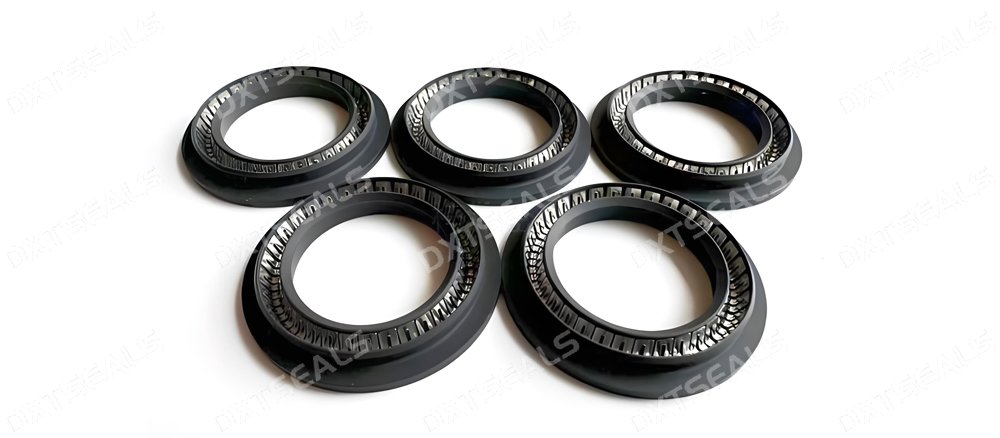
Rotary spring-energized seals typically consist of:
-
A PTFE or filled PTFE sealing jacket with optimized lip geometry
-
An internal energizing spring that maintains consistent radial force
This structure enables stable sealing performance across a wide speed range while compensating for shaft tolerances and thermal expansion.
Sealing Performance Analysis Under High-Speed Conditions
Low Friction and Heat Control
PTFE-based materials provide a low coefficient of friction, significantly reducing heat buildup at the sealing interface during high-speed rotation.
Stable Contact Pressure
The energizing spring ensures constant sealing force, preventing loss of contact caused by centrifugal force or thermal deformation at high speeds.
Wear Resistance and Service Life
Filled PTFE compounds enhance wear resistance, allowing the seal to maintain performance even under continuous high-speed operation.
Pressure-Assisted Sealing Effect
System pressure further energizes the sealing lip, improving sealing reliability without excessive friction.
Key Factors Affecting High-Speed Performance
Shaft Surface Finish and Hardness
Proper shaft surface finish minimizes friction and wear, directly influencing seal performance at high rotational speeds.
Lubrication Conditions
Adequate lubrication helps dissipate heat and reduce wear, especially in high-speed rotary applications.
Spring Type Selection
Different spring designs—such as canted coil or helical springs—affect load distribution and dynamic response under high-speed conditions.
Typical High-Speed Applications
-
High-speed pumps and compressors
-
Electric motors and spindles
-
Turbo machinery and blowers
-
Aerospace and precision rotating equipment
At DXTSEALS, we develop rotary spring-energized seals optimized for high-speed applications, focusing on low friction, thermal stability, and long service life.
Conclusion
Rotary spring-energized seals offer reliable sealing performance under high-speed conditions by combining low-friction PTFE materials with precisely engineered spring energization. Through proper design, material selection, and installation, these seals effectively control heat, minimize wear, and maintain stability in demanding rotary applications.
Understanding the performance characteristics of rotary spring-energized seals is essential for achieving optimal sealing results in high-speed systems.