
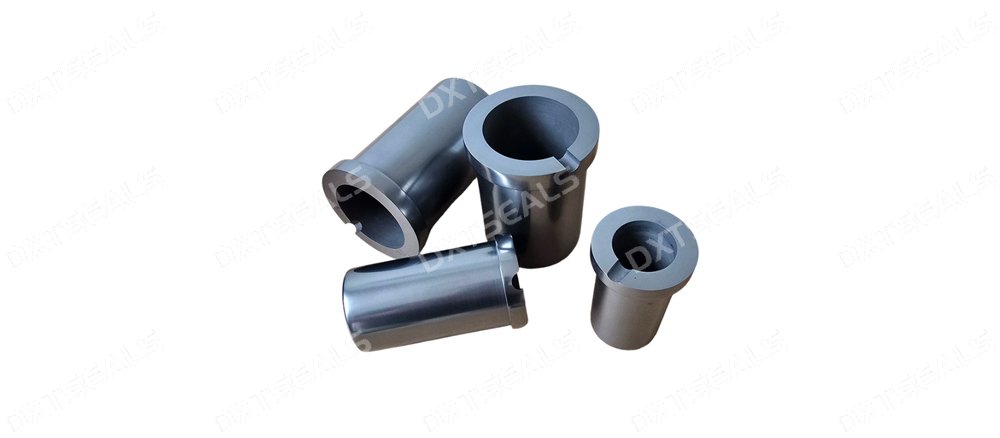
Graphite is widely used in industrial applications because of its excellent self-lubrication, chemical resistance, thermal stability, and wear resistance. However, the performance of graphite components depends not only on material properties but also on manufacturing precision.
Unlike metals, graphite is a brittle material that requires specialized machining techniques to achieve accurate dimensions and reliable performance. Precision CNC machining plays a critical role in producing high-quality graphite components with tight tolerances, excellent surface finishes, and consistent quality.
From mechanical seal faces and graphite rings to pump and compressor components, advanced CNC machining technology helps maximize the performance and service life of graphite parts.
The Importance of Precision Machining for Graphite Components
Graphite components are often used in demanding applications where even small dimensional errors can affect equipment performance.
Precision CNC machining ensures:
- Accurate component dimensions
- Consistent product quality
- Improved sealing performance
- Reduced wear and friction
- Longer service life
- Better equipment reliability
For applications such as mechanical seals, pumps, and compressors, machining accuracy directly affects leakage control and operational efficiency.
Challenges of Machining Graphite Materials
Although graphite has excellent engineering properties, it presents unique machining challenges.
Brittle Material Characteristics
Graphite has high compressive strength but relatively low tensile strength. Improper machining methods can cause:
- Cracking
- Edge chipping
- Surface damage
- Dimensional inaccuracies
Professional CNC machining processes are required to minimize these risks.
Fine Particle Generation
Graphite machining produces fine carbon particles that require proper equipment and dust control systems to maintain machining accuracy and protect machinery.
Tight Tolerance Requirements
Many graphite sealing components require extremely precise dimensions and surface finishes. Advanced machining techniques are necessary to achieve stable performance.
How CNC Machining Improves Graphite Component Performance
Improved Dimensional Accuracy
Precision CNC machining allows manufacturers to produce graphite components with tight dimensional tolerances.
Accurate dimensions are essential for:
- Proper assembly
- Correct sealing pressure
- Reduced leakage
- Stable equipment operation
For mechanical seals, precise machining ensures proper contact between sealing faces.
Better Surface Finish
The surface quality of graphite components directly affects friction and sealing performance.
Precision machining and finishing processes help achieve:
- Smooth sealing surfaces
- Reduced friction
- Lower wear rates
- Improved sealing reliability
High-quality surface finishes are especially important for rotating equipment operating at high speeds.
Enhanced Sealing Performance
Graphite is commonly used in mechanical seal applications where precise contact between components is required.
CNC machining improves:
- Seal face flatness
- Component concentricity
- Groove accuracy
- Assembly consistency
These improvements help reduce leakage and extend seal life.
Increased Wear Resistance
Accurate machining reduces uneven contact and excessive friction, which helps prevent premature wear.
Benefits include:
- Longer operating cycles
- Reduced maintenance frequency
- Improved equipment efficiency
Consistent Production Quality
CNC machining provides excellent repeatability for both small-batch and large-volume production.
Manufacturers can maintain consistent quality through:
- Automated machining processes
- Digital programming control
- Precision measurement
- Process monitoring
This is especially important for OEM production and replacement graphite components.
CNC Machining Processes for Graphite Components
Manufacturing high-quality graphite parts usually involves several precision processes.
CNC Turning
CNC turning is commonly used for producing:
- Graphite rings
- Bushings
- Cylindrical sealing components
- Rotating parts
It provides accurate diameter control and excellent surface quality.
CNC Milling
CNC milling is suitable for complex graphite components with:
- Special geometries
- Multiple surfaces
- Precision slots
- Custom designs
Precision Grinding
Grinding improves:
- Surface flatness
- Dimensional accuracy
- Sealing face quality
It is commonly used for mechanical seal faces and precision sealing components.
Lapping and Polishing
For high-performance sealing applications, lapping and polishing processes provide ultra-smooth surfaces that improve contact performance.
Applications of Precision Machined Graphite Components
Precision CNC machined graphite parts are widely used in:
Mechanical Seals
Graphite seal faces provide low friction and excellent wear resistance in pumps, mixers, and compressors.
Pumps
Graphite components help improve pump reliability in:
- Chemical pumps
- High-temperature pumps
- Process pumps
- Industrial circulation systems
Compressors
Precision graphite components support reliable sealing under high-speed and continuous operating conditions.
Common parts include:
- Carbon seal rings
- Guide rings
- Wear components
- Sealing elements
Semiconductor and High-Temperature Equipment
High-purity graphite components are used where dimensional stability and thermal resistance are critical.
Custom Graphite Component Manufacturing
Many industrial applications require graphite parts designed specifically for unique equipment conditions.
Custom CNC machining services include:
- Manufacturing from customer drawings
- Reverse engineering from samples
- OEM graphite components
- Prototype production
- Small batch manufacturing
- High-volume production
Experienced manufacturers can optimize machining processes according to material grade, component design, and application requirements.
Quality Control in Graphite CNC Machining
Reliable graphite components require strict quality inspection.
Typical quality control processes include:
- Dimensional measurement
- Surface roughness inspection
- Flatness testing
- Material verification
- Visual inspection
- Final performance evaluation
Advanced inspection methods ensure that each graphite component meets required specifications.
Choosing a Precision Graphite Machining Manufacturer
When selecting a graphite component supplier, important factors include:
- CNC machining capability
- Experience with graphite materials
- Precision manufacturing technology
- Quality control systems
- Custom design capability
- Industry application knowledge
A professional manufacturer can provide reliable graphite solutions for mechanical seals, pumps, compressors, and other industrial equipment.
Conclusion
Precision CNC machining significantly improves the performance of graphite components by enhancing dimensional accuracy, surface quality, sealing reliability, and product consistency.
For demanding industrial applications, high-quality graphite materials combined with advanced machining technology provide reliable solutions for mechanical seals, pumps, compressors, and other critical equipment.
By choosing an experienced manufacturer with precision CNC machining capabilities, companies can achieve longer component life, reduced maintenance costs, and improved operational efficiency.