
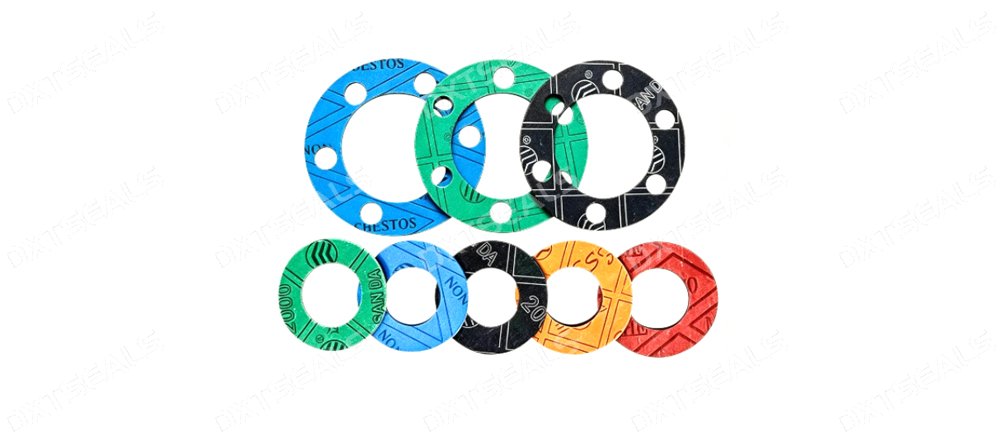
Choosing the right flange gasket is essential for maintaining a reliable and leak-free connection in industrial piping systems. Although flange gaskets may look simple, their performance depends on several factors, including gasket material, flange facing, operating temperature, pressure, fluid compatibility, dimensions, and applicable standards.
Among the most commonly used options are EPDM flange gaskets, non-asbestos flange gaskets, Full Face (FF) gaskets, and Raised Face (RF) gaskets. However, these terms describe different aspects of a gasket. EPDM and non-asbestos primarily describe the gasket material, while FF and RF describe the flange facing and gasket configuration.
Understanding these differences makes it easier to select the correct gasket for water systems, chemical processing equipment, industrial pipelines, pumps, valves, heat exchangers, and other applications.
Understanding the Difference Between EPDM, Non-Asbestos, FF, and RF
Before selecting a flange gasket, it is important to understand what each term means.
EPDM is a synthetic rubber material known for its resistance to water, weathering, ozone, and many aqueous chemicals. EPDM gaskets are widely used in water and utility applications.
Non-asbestos gaskets are generally made from compressed synthetic fibers combined with elastomeric binders. They were developed as asbestos-free alternatives for a wide range of industrial sealing applications.
FF, or Full Face, refers to a gasket designed to cover the entire flange face, including the bolt holes. Full Face gaskets are commonly associated with flat-face flanges.
RF, or Raised Face, refers to a gasket designed to seal around the raised sealing surface of a raised-face flange. RF gaskets generally have a smaller outside diameter than Full Face gaskets.
Therefore, these categories are not necessarily alternatives to one another.
For example, a gasket can be:
-
EPDM Full Face gasket
-
EPDM Raised Face gasket
-
Non-asbestos Full Face gasket
-
Non-asbestos Raised Face gasket
This distinction is one of the most important points when selecting a replacement flange gasket.
1. EPDM Flange Gaskets
EPDM stands for Ethylene Propylene Diene Monomer. It is a synthetic elastomer widely used for sealing water, steam-related applications within suitable limits, and various aqueous fluids.
One of the major advantages of EPDM is its excellent resistance to:
-
Water
-
Hot water within the appropriate temperature range
-
Ozone
-
Weathering
-
Aging
-
Many diluted acids and alkalis
-
Some polar chemicals
EPDM is particularly suitable for applications where resistance to water and environmental exposure is more important than resistance to petroleum-based oils.
Typical EPDM Flange Gasket Applications
EPDM flange gaskets are commonly found in:
-
Water treatment systems
-
Drinking water and utility piping
-
HVAC systems
-
Cooling water systems
-
Industrial water pipelines
-
Pump and valve connections
-
General fluid handling equipment
-
Outdoor piping systems
However, EPDM is generally not the first choice for applications involving petroleum oils, fuels, and many hydrocarbon-based fluids.
For these applications, another elastomer or gasket material may be more appropriate.
Advantages of EPDM
The main advantages of EPDM flange gaskets include:
-
Excellent water resistance
-
Good weather and ozone resistance
-
Good aging resistance
-
Good resistance to many aqueous chemicals
-
Flexible sealing behavior
-
Suitable for many low- to medium-pressure piping applications
The actual temperature and pressure capability depends on the EPDM formulation, gasket construction, flange condition, and application.
2. Non-Asbestos Flange Gaskets
Non-asbestos flange gaskets are commonly manufactured from compressed fiber gasket materials. Synthetic fibers are combined with elastomeric binders and compressed into gasket sheet material.
They provide an asbestos-free alternative for industrial sealing applications where a compressed fiber gasket is appropriate.
Non-asbestos gasket materials can provide a useful combination of:
-
Compressibility
-
Mechanical strength
-
Sealing performance
-
Temperature resistance
-
Pressure resistance
-
Chemical resistance
The exact performance depends strongly on the fiber type, binder system, density, thickness, and specific grade.
Typical Applications of Non-Asbestos Gaskets
Non-asbestos flange gaskets are widely used in:
-
Industrial piping
-
Pumps
-
Valves
-
Water systems
-
HVAC equipment
-
Heat exchangers
-
Chemical processing equipment
-
General machinery
-
Utility systems
-
Industrial fluid handling
They are particularly useful when a more rigid compressed gasket material is preferred instead of a rubber-only gasket.
Advantages of Non-Asbestos Gaskets
Compared with conventional rubber gaskets, non-asbestos compressed fiber gaskets can provide higher mechanical strength and better suitability for certain temperature and pressure conditions.
However, material selection must always be based on the actual fluid and operating conditions.
A non-asbestos gasket that performs well in one industrial medium may not be suitable for another.
3. Full Face (FF) Flange Gaskets
FF stands for Full Face.
A Full Face gasket extends across the complete flange face and normally includes holes corresponding to the flange bolt pattern.
This design is commonly used with flat-face flanges.
The large gasket area provides coverage across the entire flange face and can be useful for applications where the flange design requires full-face sealing.
Characteristics of FF Gaskets
Typical characteristics include:
-
Large outside diameter
-
Bolt holes integrated into the gasket
-
Coverage across the complete flange face
-
Common use with flat-face flanges
-
Available in rubber, non-asbestos, PTFE, graphite, and other materials
For example, an EPDM FF gasket combines the properties of EPDM with the Full Face configuration.
Likewise, a non-asbestos FF gasket combines compressed fiber material with the Full Face configuration.
When Should You Use an FF Gasket?
An FF gasket should generally be selected when the mating flange configuration requires a Full Face gasket.
Using the correct gasket geometry is important because the gasket must match the flange sealing surface and bolt pattern.
An incorrectly selected RF gasket may not provide the required coverage on a flat-face flange.
4. Raised Face (RF) Flange Gaskets
RF stands for Raised Face.
A raised-face flange has a raised sealing surface around the center of the flange. An RF gasket is designed to seal primarily within this raised-face area.
Compared with an FF gasket, an RF gasket normally has:
-
Smaller outside diameter
-
No bolt holes through the gasket
-
A sealing area concentrated around the raised face
-
A configuration designed for raised-face flanges
RF gaskets are widely used in industrial piping systems and process equipment.
Common RF Gasket Materials
RF gaskets can be manufactured from various materials, including:
-
Non-asbestos compressed fiber
-
PTFE
-
Graphite
-
Spiral wound gasket constructions
-
Rubber materials for suitable applications
-
Other specialty gasket materials
The correct material depends on the operating medium, temperature, pressure, flange type, and sealing requirements.
5. FF vs RF: What Is the Difference?
The primary difference between FF and RF is not the gasket material.
It is the sealing configuration and flange facing.
| Feature | FF Gasket | RF Gasket |
|---|---|---|
| Full Name | Full Face | Raised Face |
| Typical Flange | Flat Face | Raised Face |
| Gasket Coverage | Entire flange face | Raised sealing area |
| Bolt Holes | Usually included | Usually not included |
| Outside Diameter | Larger | Smaller |
| Typical Applications | Flat-face piping | Raised-face industrial piping |
| Available Materials | EPDM, non-asbestos, PTFE, etc. | Non-asbestos, PTFE, graphite, spiral wound, etc. |
The correct choice should therefore start with identifying the flange face configuration.
Do not select an FF or RF gasket solely based on material preference.
6. EPDM vs Non-Asbestos: Which Material Is Better?
There is no universal winner between EPDM and non-asbestos gasket materials.
The better material depends on the application.
EPDM Is Often Preferred When:
-
The system contains water
-
Excellent water resistance is required
-
Weather and ozone resistance are important
-
The gasket needs elastomeric flexibility
-
The application involves suitable aqueous chemicals
-
The flange connection benefits from a resilient rubber gasket
Non-Asbestos Is Often Preferred When:
-
A compressed fiber gasket is required
-
Higher mechanical strength is desirable
-
Industrial temperature and pressure conditions require a suitable compressed gasket grade
-
The application is compatible with the selected non-asbestos material
-
A traditional industrial sheet gasket construction is preferred
However, neither material should be selected only because it is commonly used.
The actual fluid, temperature, pressure, flange material, flange surface, bolt loading, and gasket dimensions should all be considered.
7. How to Select Between EPDM FF, EPDM RF, Non-Asbestos FF, and Non-Asbestos RF
A practical selection process can be divided into several steps.
Step 1: Identify the Flange Facing
First determine whether the flange is:
-
Flat Face (FF)
-
Raised Face (RF)
-
Another specialized flange configuration
This determines the basic gasket geometry.
For a flat-face flange, a Full Face gasket is commonly required.
For a raised-face flange, an RF gasket is normally selected.
Step 2: Identify the Fluid
The process medium is one of the most important factors in gasket selection.
Ask:
-
Is the medium water?
-
Is it oil?
-
Is it fuel?
-
Is it steam?
-
Is it an acid or alkali?
-
Is it a solvent?
-
Is it a chemical mixture?
-
Is it compressed air or gas?
EPDM performs particularly well in many water and aqueous applications, but its compatibility with oils and hydrocarbons is limited.
Non-asbestos materials have different chemical compatibility depending on their formulation.
Always check the chemical compatibility of the specific gasket grade rather than relying only on the generic material name.
Step 3: Check Operating Temperature
Temperature can significantly affect gasket performance.
The gasket must maintain its sealing properties at both normal operating temperature and potential temperature peaks.
For example:
-
EPDM is suitable for many moderate-temperature water applications.
-
Non-asbestos materials are available in grades designed for different industrial temperature ranges.
-
PTFE may be selected when exceptional chemical resistance is required.
-
Graphite may be considered for higher-temperature applications where its properties are appropriate.
The actual allowable temperature should be confirmed from the gasket manufacturer's technical data for the specific material grade.
Step 4: Check Pressure Requirements
Pressure affects the mechanical demands placed on the gasket.
The required gasket should be selected based on:
-
Operating pressure
-
Pressure class
-
Flange design
-
Bolt load
-
Gasket thickness
-
Gasket material
-
Fluid type
A gasket should not be selected based solely on nominal pipe size.
Two gaskets with the same nominal diameter may have significantly different requirements because of different pressure classes and flange standards.
8. Flange Standards and Gasket Dimensions Matter
Even the correct gasket material and face type will not work properly if the dimensions are wrong.
Important dimensions include:
-
Inside diameter
-
Outside diameter
-
Thickness
-
Bolt-hole diameter
-
Bolt-hole quantity
-
Bolt-hole spacing
-
Flange outside diameter
-
Sealing area
The applicable flange standard must also be identified.
Common standards include:
-
ASME / ANSI
-
EN
-
DIN
-
JIS
-
Other regional or equipment-specific standards
For example, an ASME flange and a DIN flange may have different dimensions even when their nominal pipe sizes appear similar.
This is why simply matching the nominal pipe size is not enough when ordering a replacement gasket.
9. Why Gasket Thickness Is Important
Gasket thickness affects sealing performance, compression, flange separation, and bolt loading.
A gasket that is too thick may require excessive compression or change the flange assembly condition.
A gasket that is too thin may not adequately compensate for surface imperfections or flange irregularities.
Common gasket thicknesses vary according to material, application, and standard.
Instead of choosing thickness based on a general rule, it should be selected according to:
-
Flange condition
-
Gasket material
-
Surface finish
-
Bolt loading
-
Pressure
-
Temperature
-
Manufacturer recommendations
For replacement applications, measuring the original gasket can provide useful information, but the flange standard and engineering requirements should also be verified.
10. EPDM FF and EPDM RF Gaskets
It is useful to look at these combinations separately.
EPDM FF Gasket
An EPDM FF gasket combines:
EPDM material + Full Face configuration
It is commonly suitable for water systems using flat-face flanges.
Typical applications include:
-
Water treatment
-
HVAC
-
Cooling water
-
Utility piping
-
Pumps and valves
-
General water distribution
EPDM RF Gasket
An EPDM RF gasket combines:
EPDM material + Raised Face configuration
It is designed for suitable raised-face flange applications where EPDM is chemically and thermally compatible with the service medium.
The main difference from an EPDM FF gasket is the geometry, not the basic rubber material.
11. Non-Asbestos FF and RF Gaskets
The same principle applies to non-asbestos materials.
Non-Asbestos FF Gasket
A non-asbestos FF gasket is a compressed fiber gasket designed for a Full Face flange configuration.
It may be used in:
-
Industrial water systems
-
Pumps
-
Valves
-
HVAC systems
-
Utility piping
-
General industrial equipment
Non-Asbestos RF Gasket
A non-asbestos RF gasket is designed for raised-face flange applications.
It can be used in industrial piping and equipment where the selected non-asbestos grade is compatible with the operating conditions.
The material grade is important because "non-asbestos" describes a family of gasket constructions rather than one universal material specification.
12. Common Mistakes When Choosing Flange Gaskets
Several mistakes occur frequently during gasket replacement.
Choosing the Material Without Checking the Fluid
A gasket may have excellent mechanical properties but still fail because the process medium attacks the material.
Chemical compatibility should always be checked.
Confusing FF and RF
FF and RF describe flange configuration.
They should not be treated as material names.
An EPDM gasket can be FF or RF, just as a non-asbestos gasket can be FF or RF.
Matching Only the Pipe Size
Nominal size alone does not guarantee dimensional compatibility.
The flange standard, pressure class, bolt pattern, gasket ID, OD, and thickness should be verified.
Ignoring Temperature
A gasket suitable for cold water may not be suitable for hot water, steam, or another high-temperature process.
Selecting the Cheapest Gasket
Low initial cost does not necessarily mean lower total cost.
A gasket with poor compatibility can cause leakage, maintenance downtime, equipment damage, and repeated replacement.
13. Custom Flange Gasket Manufacturing
Standard flange gaskets cover many common applications, but industrial equipment often requires non-standard dimensions.
Custom gasket manufacturing may be necessary when:
-
The flange is non-standard
-
The original gasket is obsolete
-
The equipment uses a special bolt pattern
-
The gasket has an unusual inside or outside diameter
-
A special thickness is required
-
The original manufacturer is no longer available
-
A replacement gasket must be manufactured from a drawing or sample
Custom flange gaskets can be produced from materials such as EPDM, non-asbestos sheet, PTFE, graphite, and other engineering gasket materials.
A manufacturer should be provided with as much information as possible, including the flange standard, dimensions, material requirements, operating medium, temperature, pressure, and application.
14. Practical Selection Guide
The following simplified guide can help narrow down the appropriate gasket.
| Application Requirement | Possible Selection |
|---|---|
| Water + flat-face flange | EPDM FF |
| Water + raised-face flange | EPDM RF |
| Industrial service + flat-face flange | Non-asbestos FF |
| Industrial service + raised-face flange | Non-asbestos RF |
| Excellent water/weather resistance | EPDM |
| Compressed fiber construction | Non-asbestos |
| Flat-face flange | FF configuration |
| Raised-face flange | RF configuration |
| High chemical resistance | Consider PTFE or other suitable material |
| High-temperature service | Consider graphite or other suitable high-temperature material |
This table is only a starting point. Final selection should be based on the actual operating conditions and the technical data of the selected gasket grade.
Conclusion
Choosing the right flange gasket requires more than simply selecting a gasket by size. The gasket material, flange facing, dimensions, pressure class, temperature, fluid compatibility, and applicable standard all influence sealing performance.
The most important distinction is that EPDM and non-asbestos describe gasket materials, while FF and RF describe gasket configurations associated with different flange faces.
For water and many aqueous applications, EPDM can provide excellent resistance to water, ozone, weathering, and aging. Non-asbestos compressed fiber gaskets can be a practical choice for many industrial applications where mechanical strength and compressed gasket construction are required.
At the same time, FF and RF selection must match the flange geometry. A Full Face gasket is generally intended for flat-face flange applications, while a Raised Face gasket is designed for raised-face flanges.
For replacement and custom applications, the best approach is to verify the complete specification rather than relying on nominal pipe size alone. Confirm the flange standard, pressure class, gasket dimensions, material, operating medium, temperature, pressure, and sealing configuration before manufacturing or ordering the gasket.
By evaluating these factors systematically, users can select a flange gasket that provides better sealing reliability, longer service life, and compatibility with the actual operating environment.