
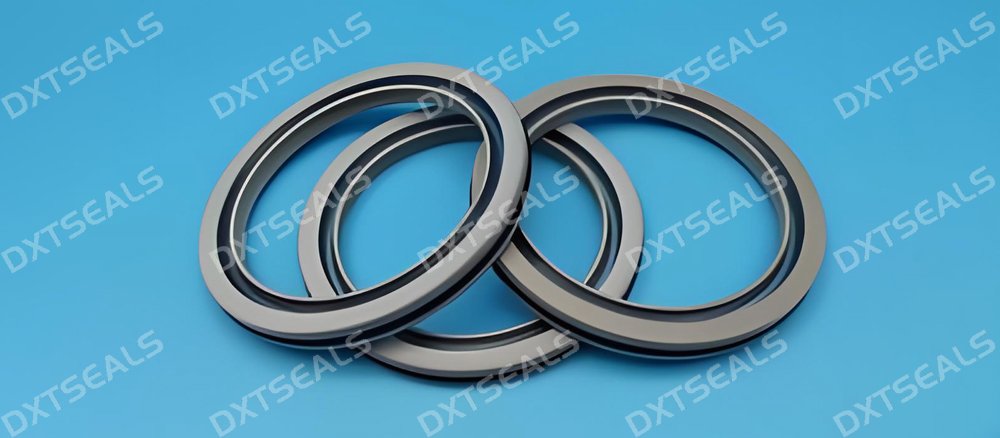
Air compressors operate under demanding conditions—high pressure, heat, and continuous lubrication cycles. The performance and durability of seals directly determine whether the compressor can maintain efficiency and avoid leakage.
Choosing the right material for sealing rings is therefore essential. Among the most widely used are NBR (Nitrile Rubber), FKM (Fluorocarbon Rubber), and PTFE (Polytetrafluoroethylene). Each has its unique strengths and limitations depending on the application.
In this article, DXTSEALS compares these three materials to help you select the most suitable option for your air compressor.
1️⃣ NBR (Nitrile Rubber): Cost-Effective and Oil-Resistant
NBR is one of the most common seal materials used in air compressors. It offers excellent oil resistance and good mechanical properties, making it ideal for general industrial applications.
Advantages:
-
Excellent resistance to oils, greases, and fuels
-
Good tensile strength and elasticity
-
Affordable and widely available
Limitations:
-
Poor resistance to ozone, UV, and weathering
-
Limited high-temperature capability (up to ~100°C continuous)
Typical Applications:
NBR seals are commonly used in air compressor shafts, pistons, and oil circuits where moderate temperatures and pressures are present.
2️⃣ FKM (Fluorocarbon Rubber): High-Temperature and Chemical Resistant
FKM, also known by trade names like Viton®, is a premium-grade sealing material designed for harsh environments. It delivers superior resistance to heat, chemicals, and oil-based fluids.
Advantages:
-
Outstanding high-temperature resistance (up to 200–250°C)
-
Excellent chemical and oil resistance
-
Low compression set and long service life
Limitations:
-
Higher material cost
-
Limited performance in very low-temperature conditions
Typical Applications:
FKM seals are preferred in high-performance air compressors, such as those used in automotive, aerospace, and petrochemical industries, where stability and reliability are critical.
3️⃣ PTFE (Polytetrafluoroethylene): The Ultimate in Chemical and Friction Resistance
PTFE, also known as Teflon®, stands out for its exceptional chemical inertness, low friction, and broad temperature tolerance. Unlike rubber materials, PTFE does not rely on elasticity but rather on its unique structure to provide sealing performance.
Advantages:
-
Excellent chemical and temperature resistance (–200°C to +260°C)
-
Low friction coefficient and wear resistance
-
Non-stick and non-reactive surface
Limitations:
-
Rigid material, less elastic than rubber
-
Requires precise machining and proper installation design
Typical Applications:
PTFE sealing rings are ideal for high-speed compressor shafts, aggressive chemical environments, and long maintenance intervals.
⚙️ Material Comparison Table
| Property | NBR | FKM | PTFE |
|---|---|---|---|
| Temperature Range (°C) | –40 to +100 | –20 to +250 | –200 to +260 |
| Oil Resistance | ★★★★☆ | ★★★★★ | ★★★★★ |
| Chemical Resistance | ★★☆☆☆ | ★★★★☆ | ★★★★★ |
| Elasticity | ★★★★★ | ★★★★☆ | ★☆☆☆☆ |
| Wear Resistance | ★★★☆☆ | ★★★★☆ | ★★★★★ |
| Cost Efficiency | ★★★★★ | ★★★☆☆ | ★★☆☆☆ |
🏭 DXTSEALS Expert Recommendation
-
For general-purpose air compressors, choose NBR — it balances performance and cost effectively.
-
For high-temperature or chemical exposure conditions, FKM offers superior durability.
-
For extreme conditions, such as high-speed shafts or aggressive gases, PTFE delivers unmatched resistance and longevity.
At DXTSEALS, we manufacture and customize air compressor sealing rings in all three materials, ensuring optimal sealing performance for your equipment and working environment.
✅ Conclusion
Selecting the correct seal material can greatly extend the lifespan and efficiency of your air compressor. While NBR is suitable for general use, FKM and PTFE provide enhanced performance for demanding conditions.
With DXTSEALS, you can rely on expert engineering, precision manufacturing, and material optimization to achieve reliable sealing solutions for every application.