
Introduction
Rubber gaskets are widely used in industrial equipment, piping systems, fluid-handling assemblies, and mechanical connections. Their flexibility allows them to conform to mating surfaces and create a seal when the appropriate compression is applied. However, some applications require additional structural support to help maintain gasket shape, improve handling, or reduce unwanted deformation during installation.
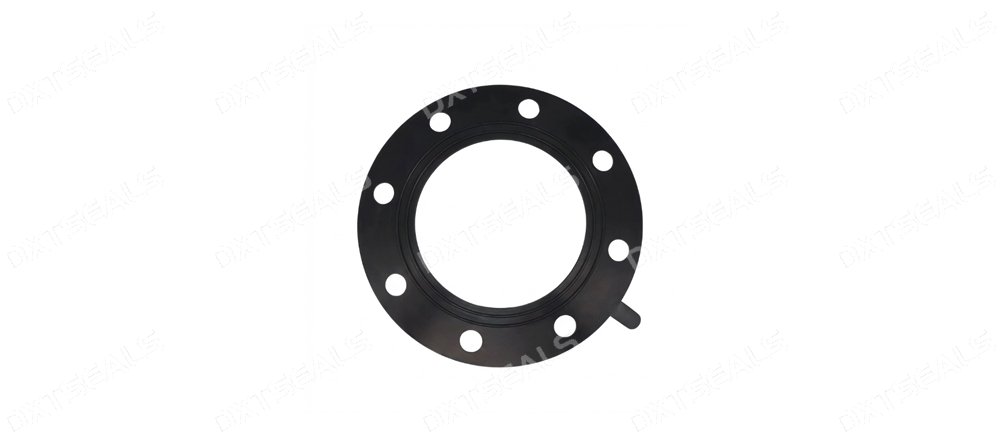
Metal-reinforced rubber gaskets combine an elastomeric sealing material with a metal insert or reinforcement. The rubber provides the sealing interface, while the metal component supports the gasket structure according to the design.
This combination can be useful for large gaskets, specialized flange connections, and applications where dimensional stability and installation reliability are important. The actual benefits depend on the gasket geometry, rubber compound, insert material, and operating conditions.
This article explains how metal inserts work, their main advantages, common rubber and metal materials, and the factors to consider when selecting a reinforced rubber gasket.
1. What Are Metal-Reinforced Rubber Gaskets?
Metal-reinforced rubber gaskets are sealing components that integrate a metal insert, carrier, or supporting element into a rubber structure. Unlike a conventional rubber-only gasket, the reinforced design provides additional mechanical support in selected areas.
The rubber portion forms the sealing contact surface and accommodates the required compression. The metal reinforcement helps support the gasket's geometry and may improve its resistance to distortion during handling and assembly.
Depending on the application, metal-reinforced rubber gaskets may feature:
-
A metal insert fully embedded within the rubber
-
A metal core surrounded by an elastomeric sealing layer
-
A metal carrier integrated into a specific section of the gasket
-
A custom reinforcement profile designed for a particular flange or equipment connection
These configurations are not interchangeable. The correct design depends on the required sealing surface, available installation space, bolt arrangement, and mechanical loading conditions.
Metal reinforcement does not automatically make a gasket suitable for higher pressure. The complete sealing assembly must be evaluated to confirm its pressure capability and long-term performance.
2. How Metal Inserts Improve Gasket Strength
The main purpose of a metal insert is to provide structural support that rubber alone may not deliver in a particular design.
Improved Dimensional Stability
Rubber is flexible and can deform under applied loads. For large, thin, or irregularly shaped gaskets, this flexibility can make it more difficult to maintain the intended geometry during storage, transportation, and installation.
A properly designed metal insert can help the gasket retain its shape and maintain dimensional stability during handling. This is especially useful when accurate positioning is important for aligning the gasket with bolt holes or flange surfaces.
Better Handling Strength
Large rubber gaskets can stretch, bend, or become distorted when lifted or positioned. An integrated metal reinforcement can make the assembly easier to handle and may reduce unwanted deformation before installation.
This advantage is particularly relevant to large-diameter gaskets and custom components with complex geometries.
Additional Structural Support
The metal insert can support selected portions of the gasket and help resist unwanted bending or distortion under defined mechanical conditions.
The extent of this benefit depends on the insert's material, thickness, shape, and location. Reinforcement should be designed around the expected loads rather than added without considering the complete gasket structure.
More Consistent Installation
A gasket that maintains its intended shape can be easier to position between mating surfaces. Better handling and alignment may reduce installation difficulties and help prevent problems caused by incorrect placement.
However, a metal insert cannot compensate for damaged flange faces, improper bolt tightening, poor alignment, or an unsuitable gasket design.
3. How Metal Inserts Support Sealing Stability
Structural strength and sealing performance are related, but they are not the same. A metal insert primarily provides support; the rubber sealing layer must still create and maintain the required contact with the mating surfaces.
Maintaining the Intended Sealing Geometry
A suitable insert can help maintain the gasket's designed shape during installation. This may support more consistent contact between the rubber sealing surface and the flange faces.
The insert must not interfere with the areas that need to compress to form a seal.
Supporting Controlled Compression
Rubber gaskets rely on compression to establish sealing contact. If the gasket distorts during installation, the resulting compression may become uneven.
A well-designed reinforcement can help preserve the intended geometry. Nevertheless, the correct compression depends on rubber hardness, gasket thickness, flange condition, bolt loading, and the insert configuration.
Reducing Handling-Related Distortion
Damage or deformation before installation can affect gasket positioning and sealing performance. Metal reinforcement can help reduce these risks in designs that are otherwise difficult to handle.
Important Design Limitation
A metal insert does not necessarily improve elastic recovery, eliminate rubber compression set, or prevent long-term material aging. Those characteristics depend largely on the rubber compound and operating environment.
For reliable sealing, reinforcement, elastomer selection, flange design, and installation procedures must work together.
4. Common Rubber Materials Used in Metal-Reinforced Gaskets
The rubber material should be selected according to the working medium, temperature, environmental exposure, and required mechanical properties.
| Rubber Material | Key Properties | Typical Applications | Important Limitations |
|---|---|---|---|
| EPDM | Good weather, ozone, and water resistance | Water systems, HVAC, wastewater, outdoor equipment | Generally unsuitable for petroleum oils and fuels |
| NBR | Good resistance to many petroleum oils and hydraulic fluids | Oil-handling equipment, machinery, hydraulic systems | Weather, ozone, and high-temperature performance depend on the compound |
| FKM | Good heat resistance and resistance to many oils and chemicals | Selected chemical, automotive, and industrial applications | Compatibility varies by grade; not suitable for every chemical |
| Silicone | Good flexibility across a broad temperature range for suitable grades | Selected equipment, appliance, and specialized sealing applications | Mechanical strength and wear resistance may be limiting |
| Natural rubber | High elasticity and good mechanical properties in suitable formulations | Selected industrial and general-purpose applications | Limited resistance to oils, ozone, and some chemicals |
These are general material characteristics. Actual performance depends on the formulation, manufacturing process, and service conditions.
EPDM is a common choice when the application requires water resistance and outdoor durability. NBR may be more suitable for compatible oil-based media, while FKM can be considered for selected high-temperature or chemically demanding applications.
The metal reinforcement and rubber compound should be selected together. For example, the metal may need additional corrosion resistance if it is exposed to moisture, chemicals, or the surrounding environment.
5. Common Metal Insert Materials and Designs
The metal insert provides structural support, so its material and geometry are important to overall gasket performance.
Carbon Steel Inserts
Carbon steel can be an economical choice for applications where the mechanical requirements are well defined and corrosion can be controlled. Depending on the environment, surface treatment or protective coatings may be necessary.
Stainless Steel Inserts
Stainless steel is often considered where improved corrosion resistance is required. The appropriate grade depends on exposure conditions, including moisture, chemicals, temperature, and possible contact with the working medium.
Stainless steel should not be assumed to resist every chemical environment; grade selection remains important.
Custom Metal Profiles
The insert can be produced in different shapes and thicknesses to match the gasket design. Options may include flat inserts, shaped carriers, or other profiles developed for a particular connection.
Key design considerations include:
-
Insert thickness and stiffness
-
Position within the rubber body
-
Edge shape and surface finish
-
Corrosion resistance
-
Bonding or mechanical retention method
-
Compatibility with the rubber molding process
-
Clearance from the sealing contact area
Sharp edges or unsuitable insert placement may damage the rubber, create stress concentrations, or interfere with compression. These risks should be addressed during design and manufacturing.
6. Metal-Reinforced Rubber Gaskets vs. Standard Rubber Gaskets
Metal reinforcement is beneficial when additional support is required, but it is not necessary for every application.
| Feature | Standard Rubber Gasket | Metal-Reinforced Rubber Gasket |
|---|---|---|
| Construction | Rubber or elastomer alone | Rubber integrated with metal reinforcement |
| Flexibility | Generally higher | Depends on insert design |
| Dimensional stability | Depends on rubber hardness and geometry | May improve with suitable reinforcement |
| Handling of large components | May require additional care | Can be easier with appropriate support |
| Structural rigidity | Primarily provided by rubber | Additional support from metal |
| Design complexity | Generally simpler | Requires insert and rubber integration |
| Manufacturing cost | Often lower | Usually higher, depending on construction |
| Customization | Standard and custom options | Often designed for specific requirements |
A standard rubber gasket may be the better choice for simple flange connections where flexibility and low cost are the main priorities. A metal-reinforced design is worth considering when the gasket's size, shape, or installation requirements create a need for additional support.
The final decision should reflect the actual service conditions rather than assuming that reinforced gaskets are always more reliable.
7. Industrial Applications of Metal-Reinforced Rubber Gaskets
Industrial Piping Systems
Flange connections in industrial piping may require gaskets with specific dimensions and mechanical characteristics. Metal reinforcement can support handling and positioning where the gasket geometry warrants it.
The rubber compound must be compatible with the transported fluid and operating conditions.
Water Supply and Wastewater Treatment
EPDM-based reinforced gaskets may be suitable for selected water and wastewater applications. The insert can provide additional support for certain large or specially shaped gaskets.
Wastewater composition should be evaluated because cleaning chemicals and contaminants may affect elastomer compatibility.
HVAC and Cooling Systems
HVAC equipment often contains water circulation systems, cooling lines, pumps, and other flanged connections. Reinforced rubber gaskets can be considered when a standard gasket does not provide the desired handling characteristics or structural support.
Pumps, Tanks, and Industrial Equipment
Equipment connections may involve vibration, repeated maintenance, limited installation space, or non-standard gasket geometries. A custom reinforcement design can help address some of these requirements, provided the rubber material and assembly are appropriate for the application.
Large-Diameter and Custom Connections
Large rubber gaskets can be difficult to move and position accurately. Reinforcement may help maintain their shape during handling and installation.
For these applications, the insert should be designed to support the gasket without reducing the required sealing contact area or preventing proper compression.
8. Manufacturing Process and Quality Control
Metal-reinforced rubber gaskets require coordinated control of the metal component and the elastomer.
Although the exact production process varies, common manufacturing considerations include:
-
Metal insert fabrication: The reinforcement is cut, punched, machined, or formed to the specified shape.
-
Surface preparation: The metal may require cleaning or treatment to support bonding, corrosion protection, or compatibility with the selected manufacturing process.
-
Rubber compound preparation: The appropriate elastomer formulation is selected and prepared.
-
Insert integration: The metal component is positioned and incorporated into the rubber body through the specified process.
-
Dimensional inspection: Critical dimensions, thickness, hole positions, and overall geometry are checked.
-
Visual and workmanship inspection: The gasket is examined for visible defects, incomplete coverage, damage, or irregularities.
-
Application-specific verification: Material, dimensional, or sealing tests are conducted where required by the product specification.
The integration method must suit the design. Depending on the construction, the insert may be bonded to the rubber, mechanically retained, or incorporated through a molding process.
For critical applications, acceptance criteria should be defined before production. These may include dimensional tolerances, material identification, appearance requirements, and suitable sealing verification.
9. How to Choose the Right Metal-Reinforced Rubber Gasket
A reliable selection process begins with the application requirements rather than the reinforcement alone.
Step 1: Identify the Working Medium
Determine the fluid or gas in contact with the gasket, including its concentration, additives, and cleaning agents. Confirm that the selected rubber compound is compatible.
Step 2: Define Operating Conditions
Record the normal and maximum operating temperatures, pressure, pressure fluctuations, and expected service cycles. Consider startup, shutdown, and maintenance conditions where relevant.
Step 3: Specify the Gasket Geometry
Provide the inside diameter, outside diameter, thickness, shape, bolt-hole pattern, and flange details. Drawings or samples are particularly useful for non-standard parts.
Step 4: Select the Metal Insert
Choose the insert material, thickness, profile, and position according to the required support and corrosion resistance. Ensure the reinforcement does not interfere with the sealing surface.
Step 5: Confirm Compression and Installation Requirements
Review flange surface condition, alignment, bolt loading, and tightening procedures. The gasket must compress sufficiently to seal without damaging the elastomer or distorting the assembly.
Step 6: Review Manufacturing and Inspection Requirements
Confirm tolerances, rubber material specifications, insert details, inspection criteria, and any required validation tests before production begins.
A qualified manufacturer can use these details to evaluate whether a metal-reinforced design is necessary or whether a standard rubber gasket would be sufficient.
10. Custom Metal-Reinforced Rubber Gasket Solutions
Standard gasket designs do not always satisfy the dimensional and mechanical requirements of specialized equipment. Custom manufacturing can provide more flexibility in selecting rubber compounds, insert materials, thicknesses, and geometries.
When requesting a custom gasket, provide the following information whenever available:
-
Rubber material, such as EPDM, NBR, FKM, or silicone
-
Metal insert material and thickness
-
Gasket dimensions and profile
-
Flange standard and connection details
-
Working medium, temperature, and pressure
-
Required corrosion resistance
-
Installation and compression requirements
-
Drawings, samples, and required tolerances
-
Quantity and inspection requirements
Custom metal-reinforced rubber gaskets can be developed for standard equipment replacements as well as non-standard industrial sealing applications. The design should be verified against the actual operating conditions to ensure that the reinforcement improves usability without compromising the sealing function.
Conclusion
Metal-reinforced rubber gaskets combine the sealing flexibility of elastomers with the structural support of metal inserts. When properly designed, the reinforcement can improve dimensional stability, simplify handling, and support more consistent gasket positioning during installation.
However, metal inserts do not automatically increase pressure ratings or eliminate common rubber-related limitations. Sealing reliability still depends on the rubber compound, insert geometry, flange design, compression, working medium, and installation quality.
By evaluating these factors together, engineers and purchasing teams can determine whether a standard rubber gasket or a metal-reinforced design is the better solution. For specialized applications, custom manufacturing offers the opportunity to match the gasket structure and materials to the equipment's specific requirements.