
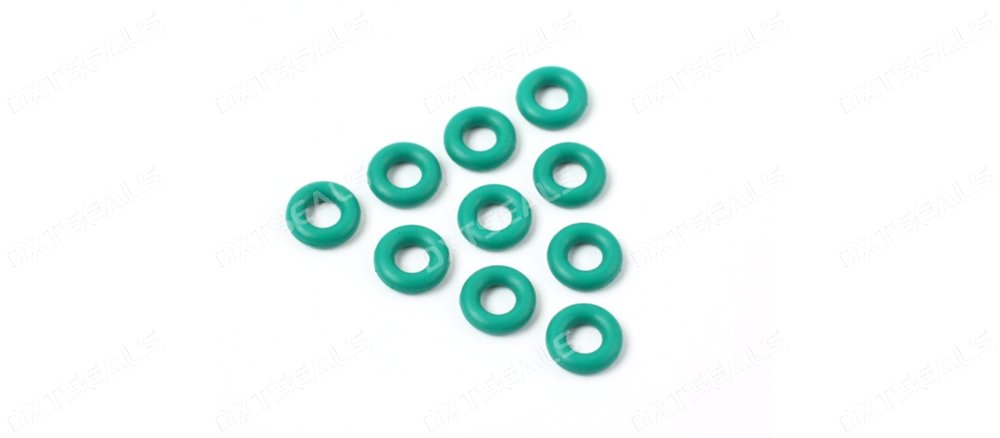
O-rings are one of the most widely used sealing components in industrial equipment. Their simple circular design, compact installation space, standardized dimensions, and wide material selection make them suitable for applications ranging from hydraulic cylinders and pneumatic systems to pumps, valves, chemical equipment, and general machinery.
However, the performance of an O-ring depends heavily on the material from which it is manufactured. A material that performs well in an oil-based hydraulic system may not be suitable for hot water, steam, aggressive chemicals, or outdoor exposure.
Among the most commonly used O-ring materials are NBR, FKM, EPDM, silicone, and PTFE. Each material has different advantages and limitations.
This article compares these five materials and explains how to select an O-ring according to the actual application.
Why O-Ring Material Selection Matters
An O-ring must maintain sufficient sealing contact throughout its service life. Temperature, pressure, chemicals, movement, and environmental exposure can all affect its performance.
Incorrect material selection may result in:
- Swelling
- Shrinkage
- Hardening
- Softening
- Loss of elasticity
- Compression set
- Cracking
- Wear
- Extrusion
- Leakage
- Premature seal failure
For this reason, selecting an O-ring should involve more than checking its size. The material, hardness, temperature, pressure, process medium, and sealing configuration should be considered together.
NBR O-Rings
NBR stands for nitrile butadiene rubber. It is one of the most widely used elastomers for industrial O-rings.
NBR provides a useful combination of oil resistance, mechanical strength, flexibility, abrasion resistance, and cost-effectiveness.
Advantages of NBR
- Good resistance to petroleum-based oils
- Good compatibility with many hydraulic fluids
- Good abrasion resistance
- Good mechanical strength
- Good elasticity
- Widely available
- Cost-effective for many general applications
Limitations of NBR
Compared with some high-performance elastomers, NBR has limitations in:
- High-temperature applications
- Ozone exposure
- Long-term outdoor weathering
- Certain aggressive chemicals
- Some specialized fuels and solvents
Typical NBR Applications
NBR O-rings are commonly used in:
- Hydraulic cylinders
- Hydraulic valves
- Pneumatic equipment
- Pumps
- Oil systems
- Automotive machinery
- Industrial equipment
- General mechanical assemblies
NBR is often a practical choice when the application involves compatible oils or hydraulic fluids and does not require the higher temperature or environmental resistance of specialized materials.
FKM O-Rings
FKM refers to a family of fluoroelastomers designed for demanding sealing applications.
FKM O-rings are commonly considered when high temperature, oil, fuel, chemical, and environmental resistance are important.
Advantages of FKM
- Excellent resistance to many oils
- Good resistance to many fuels
- Good high-temperature performance
- Good chemical resistance
- Excellent ozone resistance
- Excellent weathering resistance
- Good aging resistance
- Good compression-set resistance for suitable grades
Limitations of FKM
FKM generally costs more than NBR and is not universally compatible with all chemicals.
Certain chemical environments, including some ketones, amines, and other specific fluids, may require alternative elastomers or specialized FKM formulations.
FKM can also be less suitable for certain low-temperature applications depending on the grade.
Typical FKM Applications
FKM O-rings are commonly used in:
- Fuel systems
- Oil systems
- Automotive equipment
- High-temperature machinery
- Chemical processing equipment
- Pumps and valves
- Aerospace and demanding industrial equipment
EPDM O-Rings
EPDM stands for ethylene propylene diene monomer rubber.
EPDM is particularly well known for its resistance to water, ozone, weathering, and many environmental conditions.
Advantages of EPDM
- Excellent water resistance
- Excellent ozone resistance
- Excellent weather resistance
- Good aging resistance
- Good flexibility
- Suitable for many water-based applications
- Good resistance to selected chemicals
Limitations of EPDM
EPDM is generally not the preferred material for:
- Petroleum-based oils
- Mineral oils
- Fuels
- Many hydrocarbon-based fluids
Therefore, EPDM should not be selected simply because it has good temperature or weather resistance. The process medium must also be compatible.
Typical EPDM Applications
EPDM O-rings are commonly used in:
- Water systems
- HVAC equipment
- Cooling systems
- Water treatment
- Outdoor equipment
- Industrial water systems
- Plumbing equipment
- Selected steam and hot-water applications
Silicone O-Rings
Silicone rubber is known for its excellent flexibility and broad temperature performance.
Silicone O-rings are frequently used where flexibility, temperature resistance, weather resistance, and aging performance are important.
Advantages of Silicone
- Excellent flexibility
- Broad temperature capability
- Good low-temperature flexibility
- Excellent ozone resistance
- Good weather resistance
- Good aging resistance
- Available in specialized grades
Limitations of Silicone
Compared with some other elastomers, silicone generally has:
- Lower mechanical strength
- Lower abrasion resistance
- Limited suitability for demanding dynamic applications
- Limited compatibility with certain oils and fuels
Therefore, silicone is often more suitable for static or low-stress sealing applications than high-speed dynamic sealing.
Typical Silicone O-Ring Applications
Silicone O-rings are commonly found in:
- Electrical equipment
- Medical equipment
- Laboratory equipment
- Food-related equipment using suitable grades
- Temperature-sensitive applications
- Outdoor equipment
- General industrial applications
For food, medical, or pharmaceutical applications, the specific compound and relevant regulatory requirements should be confirmed.
PTFE O-Rings and Sealing Rings
PTFE, or polytetrafluoroethylene, is different from conventional elastomeric O-ring materials.
PTFE has extremely good chemical resistance and very low friction, but it does not have the same elastic recovery as rubber.
For this reason, PTFE is often used as a sealing ring or specialized O-ring rather than as a direct replacement for a conventional elastomeric O-ring.
Advantages of PTFE
- Excellent chemical resistance
- Very low friction
- Excellent corrosion resistance
- Very low moisture absorption
- Good high-temperature capability
- Excellent non-stick characteristics
- Suitable for many aggressive chemical environments
Limitations of PTFE
PTFE has much lower elasticity than rubber.
This means that PTFE sealing rings require careful consideration of:
- Groove design
- Installation method
- Compression
- Thermal expansion
- Pressure
- Clearance
- Seal geometry
For applications requiring high elastic recovery, an elastomeric O-ring may be more appropriate.
Typical PTFE Applications
PTFE sealing rings are commonly considered for:
- Chemical processing equipment
- Aggressive chemical media
- Valves
- Pumps
- High-purity equipment
- Specialized industrial machinery
- Applications requiring very low friction
O-Ring Material Comparison
The following table provides a general comparison of the five materials.
| Property | NBR | FKM | EPDM | Silicone | PTFE |
|---|---|---|---|---|---|
| Material type | Elastomer | Fluoroelastomer | Elastomer | Silicone elastomer | Fluoropolymer |
| Oil resistance | Good–Excellent | Excellent | Poor | Limited | Excellent |
| Water resistance | Good | Good | Excellent | Good | Excellent |
| Chemical resistance | Good | Very good–Excellent | Good for selected media | Good for selected media | Excellent |
| High-temperature performance | Good | Excellent | Good | Excellent | Excellent |
| Low-temperature flexibility | Good | Grade dependent | Good | Excellent | Limited elasticity |
| Ozone resistance | Moderate | Excellent | Excellent | Excellent | Excellent |
| Weather resistance | Moderate | Excellent | Excellent | Excellent | Excellent |
| Abrasion resistance | Good | Good | Good | Moderate | Good |
| Elasticity | Good | Good | Excellent | Excellent | Low |
| Dynamic sealing | Good | Good | Good | Limited for demanding applications | Application dependent |
| Typical application | Oil and hydraulic systems | High-temperature/oil/fuel | Water and outdoor systems | Temperature/flexibility | Chemical/high-performance sealing |
This is a general comparison. Actual performance depends on the specific compound, hardness, temperature, pressure, medium, and equipment design.
NBR vs FKM
NBR and FKM are frequently compared because both are used in oil, fuel, hydraulic, and industrial applications.
NBR
NBR is generally more cost-effective and provides good mechanical and oil-resistance properties for many general-purpose applications.
FKM
FKM is generally selected when the application requires higher temperature performance, improved resistance to many fuels and oils, or better ozone and weather resistance.
The choice between NBR and FKM should be based on the actual operating conditions rather than simply choosing the higher-cost material.
NBR vs EPDM
NBR and EPDM have significantly different fluid compatibility.
NBR is commonly used with:
- Petroleum-based oils
- Hydraulic fluids
- Lubricating oils
EPDM is commonly used with:
- Water
- Hot water
- Cooling water
- Outdoor environments
- Many water-based fluids
EPDM is generally not preferred for petroleum-based oils and fuels, while NBR is generally more appropriate for many oil-based applications.
FKM vs EPDM
FKM and EPDM are both capable of handling demanding environments, but they are commonly selected for different types of media.
FKM is widely used for oils, fuels, high-temperature service, and many demanding industrial fluids.
EPDM is particularly useful for water, ozone, weathering, and many water-based applications.
Neither material is universally superior. The process medium should be one of the first factors considered.
Silicone vs Other O-Ring Materials
Silicone stands out because of its flexibility and temperature performance.
Compared with NBR, silicone may offer better low-temperature flexibility but generally has lower abrasion and mechanical strength.
Compared with FKM, silicone may be selected for flexibility and specialized temperature applications rather than oil and fuel resistance.
Compared with EPDM, silicone can provide excellent temperature flexibility, while EPDM is often preferred for water and ozone-related applications where chemical compatibility is appropriate.
PTFE vs Elastomeric O-Rings
PTFE should not simply be treated as a higher-performance version of an elastomeric O-ring.
The fundamental difference is elasticity.
Elastomeric materials such as NBR, FKM, EPDM, and silicone can deform and recover elastically to maintain sealing contact.
PTFE has excellent chemical resistance and low friction but significantly lower elastic recovery.
Therefore:
- Choose an elastomer when elastic sealing is important.
- Consider PTFE when chemical resistance is the primary requirement.
- Consider specialized PTFE sealing designs when friction or chemical exposure is particularly demanding.
Choosing O-Ring Material by Application
Hydraulic Systems
NBR is widely used in hydraulic applications involving compatible mineral-oil-based hydraulic fluids.
FKM may be considered for higher-temperature hydraulic systems or fluids requiring improved temperature and chemical resistance.
Water and HVAC Systems
EPDM is commonly selected for water, cooling water, HVAC, and outdoor applications.
Its water, ozone, and weather resistance make it suitable for many static and dynamic water-system seals.
Fuel and Oil Systems
NBR and FKM can both be considered depending on the specific fuel, temperature, and operating conditions.
FKM is frequently selected for more demanding fuel and high-temperature applications.
Chemical Processing
PTFE may be considered when excellent chemical resistance and low friction are required.
FKM can also be suitable for many chemical applications, but compatibility must be confirmed for the specific chemical and operating conditions.
High-Temperature Applications
FKM, silicone, and PTFE may all be considered for elevated-temperature applications, depending on the medium and sealing design.
Graphite or other specialized sealing materials may be more appropriate when temperatures exceed the practical range of elastomeric O-rings.
Outdoor Equipment
EPDM, FKM, and silicone all offer good resistance to environmental exposure, although their fluid compatibility differs significantly.
If the outdoor equipment is also exposed to oils or fuels, FKM may be considered. For water and weather exposure, EPDM is often a practical option.
O-Ring Hardness Selection
Material selection should be combined with appropriate hardness selection.
O-ring hardness is commonly specified using the Shore A scale.
A softer O-ring may conform well to surface irregularities and provide effective sealing with relatively low contact force.
A harder O-ring may provide greater resistance to extrusion under suitable pressure and clearance conditions.
The correct hardness depends on:
- Operating pressure
- Groove design
- Clearance
- Temperature
- Static or dynamic movement
- Material compound
- Installation conditions
The same material may therefore be available in different hardness grades for different applications.
Static vs Dynamic O-Ring Applications
Static Applications
Static O-rings are used where the mating components do not move relative to each other.
Examples include:
- Flange connections
- Valve covers
- Hydraulic manifolds
- Pipe fittings
- Equipment housings
Static sealing is generally less demanding in terms of friction and wear.
Dynamic Applications
Dynamic O-rings are exposed to relative movement.
Examples include:
- Hydraulic cylinders
- Pneumatic cylinders
- Rotary mechanisms
- Actuators
- Moving valve components
Dynamic applications require additional consideration of friction, lubrication, surface finish, speed, wear, pressure, and extrusion clearance.
O-Ring Temperature and Pressure Selection
Material temperature capability should always be evaluated together with pressure and process medium.
High temperature can cause:
- Hardening
- Softening
- Compression set
- Loss of elasticity
- Chemical degradation
Low temperature can reduce flexibility and sealing contact.
High pressure can increase the risk of extrusion, especially when there is a large clearance gap.
Backup rings, harder compounds, or alternative seal profiles may be required for certain high-pressure applications.
Specific temperature and pressure limits should be obtained from the material manufacturer or seal supplier for the actual compound and application.
Custom O-Ring Manufacturing
Standard O-ring sizes cover many industrial applications, but non-standard equipment may require customized sealing components.
Custom O-rings can be manufactured according to:
- Engineering drawings
- Customer samples
- Equipment dimensions
- OEM specifications
- Non-standard cross-sections
- Special hardness requirements
- Specific material requirements
Custom manufacturing can also be used when a standard O-ring size does not provide the required sealing geometry.
A professional manufacturer can help match the material, hardness, dimensions, and sealing design to the equipment's operating conditions.
Common O-Ring Material Selection Mistakes
Selecting Material Only by Temperature
A material may withstand the required temperature but still be incompatible with the process medium.
Choosing EPDM for Oil Applications
EPDM is excellent for many water-based applications but is generally not suitable for petroleum-based oils and fuels.
Assuming FKM Is Compatible With Every Chemical
FKM has excellent resistance to many chemicals, but no elastomer is universally resistant.
Treating PTFE Like a Rubber O-Ring
PTFE has much lower elasticity than conventional elastomers and requires appropriate sealing geometry and installation.
Ignoring Dynamic Conditions
A material that works well for static sealing may have different performance in high-speed or high-frequency dynamic applications.
Ignoring Hardness and Groove Design
Material selection alone does not determine O-ring performance. Hardness, compression, clearance, surface finish, and groove dimensions are also important.
Standard and Custom O-Ring Solutions
O-rings are highly versatile because they are available in many standardized sizes, materials, hardness grades, and configurations.
Standard O-rings can meet common requirements for hydraulic, pneumatic, automotive, water, and industrial equipment.
Custom O-rings can address:
- Non-standard dimensions
- Special materials
- Special hardness
- OEM replacement requirements
- Unusual groove designs
- Specialized operating environments
A reliable O-ring solution should consider the complete sealing system rather than selecting a material in isolation.
Conclusion
NBR, FKM, EPDM, silicone, and PTFE each provide different advantages for industrial O-ring applications.
NBR is widely used for oil, hydraulic, and general industrial sealing. FKM is commonly selected for high-temperature, oil, fuel, and demanding industrial applications. EPDM is well suited to water, ozone, and outdoor environments. Silicone provides excellent flexibility and broad temperature performance, while PTFE offers exceptional chemical resistance and very low friction.
The right O-ring material depends on the process medium, temperature, pressure, movement, chemical compatibility, hardness, groove design, and required service life.
There is no universal O-ring material for every application. By matching the material and sealing design to the actual operating conditions, manufacturers and equipment users can achieve more reliable and durable industrial sealing performance.